{"title":"Development of poly (vinyl alcohol)/carboxymethyl chitosan hydrogels loaded with encapsulated tea tree oil for wound care application","authors":"Pairayaphak Ngamplang , Chasuda Choipang , Sonthaya Chaiarwut , Piyachat Chuysinuan , Pitt Supaphol","doi":"10.1016/j.jddst.2025.106867","DOIUrl":null,"url":null,"abstract":"<div><div>In daily life, accidents and diseases are major causes of wounds. Wound management and wound dressing are significant functions of wound healing. A hydrocolloid film composed of a natural polymer such as carboxymethyl chitosan (CMCS) is a good candidate for use in the treatment of low exudate wounds such as superficial and black/grey necrotic wounds. The hydrocolloid film can be easily removed from a wound and promotes tissue granulation. In recent years, concerns have arisen regarding the existence of harmful chemical substances in products that come into direct contact with human skin. Therefore, natural substances are an exceptional choice. Due to their antibacterial properties, tea tree oil (TTO) and its active components have found uses in various applications, e.g. cosmetics, wound care, and food packaging. However, TTO has major drawbacks due to its high volatility and poor solubility in water as well as other polar solvents. Cyclodextrin is an ideal choice for enhancing its water solubility while preserving its antibacterial characteristics by utilizing the formation of an inclusion complex (IC) with certain TTO components. Various techniques have been utilized to examine the obtained ICs, i.e. GC-MS, UV–vis, 1H NMR, DSC, TG/DTG, FTIR, Zeta-sizer, and SEM. Moreover, molecular docking was employed to examine the preferred orientation of terpinene-4-ol within the cyclodextrin cavity. The hydrocolloid film loaded with a cyclodextrin/TTO IC exhibited enhanced antibacterial activity through observations of their Time-kill assay against model bacteria, e.g., <em>Staphylococcus aureus</em> (<em>S. aureus</em>) and Methicilin-Resistant <em>Staphylococcus aureus</em> (MRSA) (gram-positive bacteria) and <em>Escherichia coli</em> (<em>E. coli</em>) and Acinetobacter baumannii (A. baumannii) (gram-negative bacteria). A hydrocolloid film with a concentration of 3.5 % ICs demonstrated the highest efficacy in inhibiting bacterial activity. Finally, a hydrocolloid film loaded with a cyclodextrin/TTO IC exhibited improved physical properties and antibacterial activity.</div></div>","PeriodicalId":15600,"journal":{"name":"Journal of Drug Delivery Science and Technology","volume":"107 ","pages":"Article 106867"},"PeriodicalIF":4.9000,"publicationDate":"2025-03-31","publicationTypes":"Journal Article","fieldsOfStudy":null,"isOpenAccess":false,"openAccessPdf":"","citationCount":"0","resultStr":null,"platform":"Semanticscholar","paperid":null,"PeriodicalName":"Journal of Drug Delivery Science and Technology","FirstCategoryId":"3","ListUrlMain":"https://www.sciencedirect.com/science/article/pii/S1773224725002709","RegionNum":3,"RegionCategory":"医学","ArticlePicture":[],"TitleCN":null,"AbstractTextCN":null,"PMCID":null,"EPubDate":"","PubModel":"","JCR":"Q1","JCRName":"PHARMACOLOGY & PHARMACY","Score":null,"Total":0}
引用次数: 0
Abstract
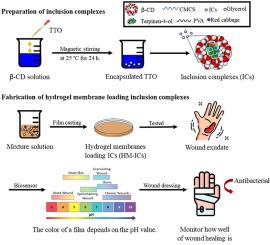
In daily life, accidents and diseases are major causes of wounds. Wound management and wound dressing are significant functions of wound healing. A hydrocolloid film composed of a natural polymer such as carboxymethyl chitosan (CMCS) is a good candidate for use in the treatment of low exudate wounds such as superficial and black/grey necrotic wounds. The hydrocolloid film can be easily removed from a wound and promotes tissue granulation. In recent years, concerns have arisen regarding the existence of harmful chemical substances in products that come into direct contact with human skin. Therefore, natural substances are an exceptional choice. Due to their antibacterial properties, tea tree oil (TTO) and its active components have found uses in various applications, e.g. cosmetics, wound care, and food packaging. However, TTO has major drawbacks due to its high volatility and poor solubility in water as well as other polar solvents. Cyclodextrin is an ideal choice for enhancing its water solubility while preserving its antibacterial characteristics by utilizing the formation of an inclusion complex (IC) with certain TTO components. Various techniques have been utilized to examine the obtained ICs, i.e. GC-MS, UV–vis, 1H NMR, DSC, TG/DTG, FTIR, Zeta-sizer, and SEM. Moreover, molecular docking was employed to examine the preferred orientation of terpinene-4-ol within the cyclodextrin cavity. The hydrocolloid film loaded with a cyclodextrin/TTO IC exhibited enhanced antibacterial activity through observations of their Time-kill assay against model bacteria, e.g., Staphylococcus aureus (S. aureus) and Methicilin-Resistant Staphylococcus aureus (MRSA) (gram-positive bacteria) and Escherichia coli (E. coli) and Acinetobacter baumannii (A. baumannii) (gram-negative bacteria). A hydrocolloid film with a concentration of 3.5 % ICs demonstrated the highest efficacy in inhibiting bacterial activity. Finally, a hydrocolloid film loaded with a cyclodextrin/TTO IC exhibited improved physical properties and antibacterial activity.
期刊介绍:
The Journal of Drug Delivery Science and Technology is an international journal devoted to drug delivery and pharmaceutical technology. The journal covers all innovative aspects of all pharmaceutical dosage forms and the most advanced research on controlled release, bioavailability and drug absorption, nanomedicines, gene delivery, tissue engineering, etc. Hot topics, related to manufacturing processes and quality control, are also welcomed.



 京公网安备 11010802042870号
京ICP备2023020795号-1
京公网安备 11010802042870号
京ICP备2023020795号-1

 分享
分享
 求助内容:
求助内容: 应助结果提醒方式:
 扫码关注我们
