Yiming Zhang , Yujie Wang , Ruilin Shi , Bingxuan Huang , Shaoyin Wei , Yuji Wang , Nao Xiao
{"title":"A smart photosensitive fluorescent probe for sensing Co2+ in extremely alkaline aqueous solution","authors":"Yiming Zhang , Yujie Wang , Ruilin Shi , Bingxuan Huang , Shaoyin Wei , Yuji Wang , Nao Xiao","doi":"10.1016/j.saa.2025.126159","DOIUrl":null,"url":null,"abstract":"<div><div>A novel pH-, viscosity-, and photo-sensitive polymorphic fluorescence probe <strong>NHP</strong> for sensing Co<sup>2+</sup> has been developed. The hydrazone-based <strong>NHP</strong> can be synthesized by only one step of reflux reaction and purified by washing with poor solvents. Three single crystals of <strong>NHP</strong>-1, <strong>NHP</strong>-2, and <strong>NHP</strong>-3 with different conformations were resolved. As a photo acid generator (PAG), the hydrogen atom on the imino group of the probe <strong>NHP</strong> can be shed with 365 nm ultraviolet (UV) light illumination or in alkaline conditions. Due to the above two conditions, the negatively charged ligand obtained after dehydrogenation of <strong>NHP</strong> can accelerate its chelation with Co<sup>2+</sup>. When irradiated with 365 nm UV light, the product (<strong>NHP<sub>2</sub>-Co<sup>2+</sup></strong> (I)) of <strong>NHP</strong> chelating with Co<sup>2+</sup> appears yellowish in aqueous solution. In a strong alkali aqueous solution, the chelate product (<strong>NHP<sub>2</sub>-Co<sup>2+</sup></strong> (II)) of <strong>NHP</strong> and Co<sup>2+</sup> showed bright blue-green fluorescence. The formed divalent Co(II) complex <strong>NHP<sub>2</sub>-Co<sup>2+</sup></strong> can be oxidized to trivalent Co(III) complex <strong>NHP<sub>3</sub>-Co<sup>3+</sup></strong>, as confirmed by the resolution of single crystals of <strong>NHP<sub>3</sub>-Co<sup>3+</sup></strong>.</div></div>","PeriodicalId":433,"journal":{"name":"Spectrochimica Acta Part A: Molecular and Biomolecular Spectroscopy","volume":"337 ","pages":"Article 126159"},"PeriodicalIF":4.6000,"publicationDate":"2025-03-31","publicationTypes":"Journal Article","fieldsOfStudy":null,"isOpenAccess":false,"openAccessPdf":"","citationCount":"0","resultStr":null,"platform":"Semanticscholar","paperid":null,"PeriodicalName":"Spectrochimica Acta Part A: Molecular and Biomolecular Spectroscopy","FirstCategoryId":"92","ListUrlMain":"https://www.sciencedirect.com/science/article/pii/S1386142525004652","RegionNum":2,"RegionCategory":"化学","ArticlePicture":[],"TitleCN":null,"AbstractTextCN":null,"PMCID":null,"EPubDate":"","PubModel":"","JCR":"Q1","JCRName":"SPECTROSCOPY","Score":null,"Total":0}
引用次数: 0
Abstract
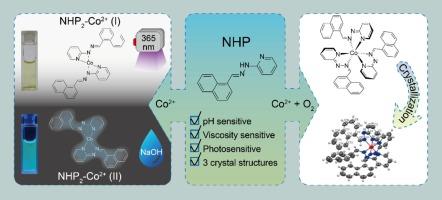
A novel pH-, viscosity-, and photo-sensitive polymorphic fluorescence probe NHP for sensing Co2+ has been developed. The hydrazone-based NHP can be synthesized by only one step of reflux reaction and purified by washing with poor solvents. Three single crystals of NHP-1, NHP-2, and NHP-3 with different conformations were resolved. As a photo acid generator (PAG), the hydrogen atom on the imino group of the probe NHP can be shed with 365 nm ultraviolet (UV) light illumination or in alkaline conditions. Due to the above two conditions, the negatively charged ligand obtained after dehydrogenation of NHP can accelerate its chelation with Co2+. When irradiated with 365 nm UV light, the product (NHP2-Co2+ (I)) of NHP chelating with Co2+ appears yellowish in aqueous solution. In a strong alkali aqueous solution, the chelate product (NHP2-Co2+ (II)) of NHP and Co2+ showed bright blue-green fluorescence. The formed divalent Co(II) complex NHP2-Co2+ can be oxidized to trivalent Co(III) complex NHP3-Co3+, as confirmed by the resolution of single crystals of NHP3-Co3+.
期刊介绍:
Spectrochimica Acta, Part A: Molecular and Biomolecular Spectroscopy (SAA) is an interdisciplinary journal which spans from basic to applied aspects of optical spectroscopy in chemistry, medicine, biology, and materials science.
The journal publishes original scientific papers that feature high-quality spectroscopic data and analysis. From the broad range of optical spectroscopies, the emphasis is on electronic, vibrational or rotational spectra of molecules, rather than on spectroscopy based on magnetic moments.
Criteria for publication in SAA are novelty, uniqueness, and outstanding quality. Routine applications of spectroscopic techniques and computational methods are not appropriate.
Topics of particular interest of Spectrochimica Acta Part A include, but are not limited to:
Spectroscopy and dynamics of bioanalytical, biomedical, environmental, and atmospheric sciences,
Novel experimental techniques or instrumentation for molecular spectroscopy,
Novel theoretical and computational methods,
Novel applications in photochemistry and photobiology,
Novel interpretational approaches as well as advances in data analysis based on electronic or vibrational spectroscopy.



 京公网安备 11010802042870号
京ICP备2023020795号-1
京公网安备 11010802042870号
京ICP备2023020795号-1

 分享
分享
 求助内容:
求助内容: 应助结果提醒方式:
 扫码关注我们
