{"title":"Novel intrinsic microporous binders in the cathode catalyst layer for high-performance alkaline water electrolysis","authors":"Xin Wang , Lei Liu , Nanwen Li","doi":"10.1016/j.jpowsour.2025.236916","DOIUrl":null,"url":null,"abstract":"<div><div>Anion exchange membrane water electrolysis (AEMWE) garners significant attention. However, systematic studies on the binder structure and content are scarce. Therefore, we report two novel quaternized polymers of intrinsic microporosity with pyrrolidinium and piperidinium cations (referred to as QPIM-Py and QPIM-Pi) as binder materials. Additionally, the effect of the microporosity structure on the AEMWE performance is compared to that of the control binder without microporosity (poly(p-terphenyl N,N-dimethylpiperidinium) referred to as PAP-TP-85, 85 is the molar ratio between N-methyl-4-piperidone and aryl monomers). The hydrogen permeabilities of QPIM-Py and QPIM-Pi membranes are found to be 60.5 and 32.4 barrer, which are significantly higher than that of the PAP-TP-85 (4.07 barrer). Moreover, the surface area of the QPIM-based catalyst layer (CL) is substantially higher than that of the control CL. Finally, with home-made PAP-TP-85 membrane and the aforementioned binders in the CL, it is demonstrated that the binder structure in the cathode CL has a considerable impact on the AEMWE performance. The AEMWE with QPIM-Py-10 % binder achieves the best performance, with a current density of 2000 mA/cm<sup>2</sup> at a voltage of 2.04 V. Furthermore, the CL with modified binder demonstrates a much higher performance than that with microporosity-free binder in AEMWE.</div></div>","PeriodicalId":377,"journal":{"name":"Journal of Power Sources","volume":"641 ","pages":"Article 236916"},"PeriodicalIF":7.9000,"publicationDate":"2025-06-15","publicationTypes":"Journal Article","fieldsOfStudy":null,"isOpenAccess":false,"openAccessPdf":"","citationCount":"0","resultStr":null,"platform":"Semanticscholar","paperid":null,"PeriodicalName":"Journal of Power Sources","FirstCategoryId":"5","ListUrlMain":"https://www.sciencedirect.com/science/article/pii/S0378775325007529","RegionNum":2,"RegionCategory":"工程技术","ArticlePicture":[],"TitleCN":null,"AbstractTextCN":null,"PMCID":null,"EPubDate":"2025/4/3 0:00:00","PubModel":"Epub","JCR":"Q1","JCRName":"CHEMISTRY, PHYSICAL","Score":null,"Total":0}
引用次数: 0
Abstract
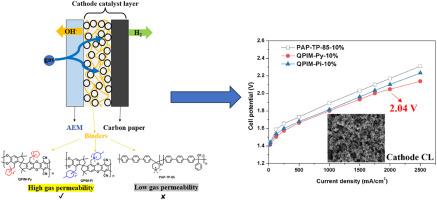
Anion exchange membrane water electrolysis (AEMWE) garners significant attention. However, systematic studies on the binder structure and content are scarce. Therefore, we report two novel quaternized polymers of intrinsic microporosity with pyrrolidinium and piperidinium cations (referred to as QPIM-Py and QPIM-Pi) as binder materials. Additionally, the effect of the microporosity structure on the AEMWE performance is compared to that of the control binder without microporosity (poly(p-terphenyl N,N-dimethylpiperidinium) referred to as PAP-TP-85, 85 is the molar ratio between N-methyl-4-piperidone and aryl monomers). The hydrogen permeabilities of QPIM-Py and QPIM-Pi membranes are found to be 60.5 and 32.4 barrer, which are significantly higher than that of the PAP-TP-85 (4.07 barrer). Moreover, the surface area of the QPIM-based catalyst layer (CL) is substantially higher than that of the control CL. Finally, with home-made PAP-TP-85 membrane and the aforementioned binders in the CL, it is demonstrated that the binder structure in the cathode CL has a considerable impact on the AEMWE performance. The AEMWE with QPIM-Py-10 % binder achieves the best performance, with a current density of 2000 mA/cm2 at a voltage of 2.04 V. Furthermore, the CL with modified binder demonstrates a much higher performance than that with microporosity-free binder in AEMWE.
期刊介绍:
The Journal of Power Sources is a publication catering to researchers and technologists interested in various aspects of the science, technology, and applications of electrochemical power sources. It covers original research and reviews on primary and secondary batteries, fuel cells, supercapacitors, and photo-electrochemical cells.
Topics considered include the research, development and applications of nanomaterials and novel componentry for these devices. Examples of applications of these electrochemical power sources include:
• Portable electronics
• Electric and Hybrid Electric Vehicles
• Uninterruptible Power Supply (UPS) systems
• Storage of renewable energy
• Satellites and deep space probes
• Boats and ships, drones and aircrafts
• Wearable energy storage systems



 京公网安备 11010802042870号
京ICP备2023020795号-1
京公网安备 11010802042870号
京ICP备2023020795号-1

 分享
分享
 求助内容:
求助内容: 应助结果提醒方式:
 扫码关注我们
