Insights into the effect of segment rearrangement induced by dynamic disulfide bond on UV aging resistance of UV-induced self-compensated epoxy crosslinked network
Mingli Wang , Ziyu Liu , Tiancheng Wang , Jiahao Ma , Jue Cheng , Xiaoqing Liu , Junying Zhang
{"title":"Insights into the effect of segment rearrangement induced by dynamic disulfide bond on UV aging resistance of UV-induced self-compensated epoxy crosslinked network","authors":"Mingli Wang , Ziyu Liu , Tiancheng Wang , Jiahao Ma , Jue Cheng , Xiaoqing Liu , Junying Zhang","doi":"10.1016/j.polymdegradstab.2025.111352","DOIUrl":null,"url":null,"abstract":"<div><div>The deterioration of epoxy resin properties caused by UV radiation is a major bottleneck in the epoxy resin applications development. And, its mechanism is UV-induced chemical bond breaking and the stress concentration resulting from the structural changes in the crosslinked network. However, the strategy to improve UV aging resistance have always been unsatisfactory, as the integrity of the chemical bond has been overemphasized and the failure caused by the stress concentration has been neglected. Herein, an epoxy crosslinked network containing two photosensitive groups, anthracene and disulfide, was prepared. Among them, anthracene can absorb UVA wavelength light and proceed [4 + 4] cycloaddition reaction, so as to compensate for the damage of chemical crosslinked structure; thanks to the chain segment rapid relaxation during annealing, the dynamic disulfide bonds can not only absorb and shield UV light, but also greatly avoid the stress concentration. After 600 h (actual UV exposure time 400 h) simulated UV aging (340 nm, 0.76 W·m<sup>-2</sup>), the tensile strength and fracture toughness decreased by only -2.6 % and -18.9 %, which showed excellent performance retention after UV aging, compared with the control sample. This study will provide important guidance for the structure and formulation design of UV-resistant aging resins.</div></div>","PeriodicalId":406,"journal":{"name":"Polymer Degradation and Stability","volume":"238 ","pages":"Article 111352"},"PeriodicalIF":7.4000,"publicationDate":"2025-08-01","publicationTypes":"Journal Article","fieldsOfStudy":null,"isOpenAccess":false,"openAccessPdf":"","citationCount":"0","resultStr":null,"platform":"Semanticscholar","paperid":null,"PeriodicalName":"Polymer Degradation and Stability","FirstCategoryId":"92","ListUrlMain":"https://www.sciencedirect.com/science/article/pii/S014139102500182X","RegionNum":2,"RegionCategory":"化学","ArticlePicture":[],"TitleCN":null,"AbstractTextCN":null,"PMCID":null,"EPubDate":"2025/3/29 0:00:00","PubModel":"Epub","JCR":"Q1","JCRName":"POLYMER SCIENCE","Score":null,"Total":0}
引用次数: 0
Abstract
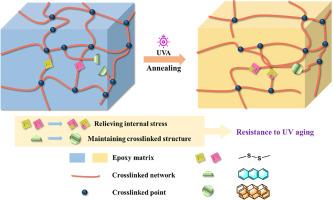
The deterioration of epoxy resin properties caused by UV radiation is a major bottleneck in the epoxy resin applications development. And, its mechanism is UV-induced chemical bond breaking and the stress concentration resulting from the structural changes in the crosslinked network. However, the strategy to improve UV aging resistance have always been unsatisfactory, as the integrity of the chemical bond has been overemphasized and the failure caused by the stress concentration has been neglected. Herein, an epoxy crosslinked network containing two photosensitive groups, anthracene and disulfide, was prepared. Among them, anthracene can absorb UVA wavelength light and proceed [4 + 4] cycloaddition reaction, so as to compensate for the damage of chemical crosslinked structure; thanks to the chain segment rapid relaxation during annealing, the dynamic disulfide bonds can not only absorb and shield UV light, but also greatly avoid the stress concentration. After 600 h (actual UV exposure time 400 h) simulated UV aging (340 nm, 0.76 W·m-2), the tensile strength and fracture toughness decreased by only -2.6 % and -18.9 %, which showed excellent performance retention after UV aging, compared with the control sample. This study will provide important guidance for the structure and formulation design of UV-resistant aging resins.
期刊介绍:
Polymer Degradation and Stability deals with the degradation reactions and their control which are a major preoccupation of practitioners of the many and diverse aspects of modern polymer technology.
Deteriorative reactions occur during processing, when polymers are subjected to heat, oxygen and mechanical stress, and during the useful life of the materials when oxygen and sunlight are the most important degradative agencies. In more specialised applications, degradation may be induced by high energy radiation, ozone, atmospheric pollutants, mechanical stress, biological action, hydrolysis and many other influences. The mechanisms of these reactions and stabilisation processes must be understood if the technology and application of polymers are to continue to advance. The reporting of investigations of this kind is therefore a major function of this journal.
However there are also new developments in polymer technology in which degradation processes find positive applications. For example, photodegradable plastics are now available, the recycling of polymeric products will become increasingly important, degradation and combustion studies are involved in the definition of the fire hazards which are associated with polymeric materials and the microelectronics industry is vitally dependent upon polymer degradation in the manufacture of its circuitry. Polymer properties may also be improved by processes like curing and grafting, the chemistry of which can be closely related to that which causes physical deterioration in other circumstances.



 京公网安备 11010802042870号
京ICP备2023020795号-1
京公网安备 11010802042870号
京ICP备2023020795号-1

 分享
分享
 求助内容:
求助内容: 应助结果提醒方式:
 扫码关注我们
