Hong Liu, Zhaochu Hu, Liyuan Qing, Jingliang Guo, Wen Zhang, Xiuhong Liao, Tao Luo, Ming Li and Zaicong Wang
{"title":"Accurate determination of Ti stable isotopes in Ti-rich minerals using nanosecond LA-MC-ICP-MS†","authors":"Hong Liu, Zhaochu Hu, Liyuan Qing, Jingliang Guo, Wen Zhang, Xiuhong Liao, Tao Luo, Ming Li and Zaicong Wang","doi":"10.1039/D4JA00404C","DOIUrl":null,"url":null,"abstract":"<p >Mass-dependent titanium (Ti) isotopic variations in Ti-rich minerals as geological tracers are commonly measured by laser ablation (LA) coupled with multi-collector inductively coupled plasma mass spectrometry (MC-ICP-MS). A high-precision method for <em>in situ</em> Ti stable isotopic analysis in Ti-rich minerals was developed using nanosecond (ns) LA-MC-ICP-MS. Analytical performances of ns-LA-MC-ICP-MS were contrasted with femtosecond (fs) LA-MC-ICP-MS for Ti isotopic analysis in Ti-rich minerals and Ti metal. Matrix effects, more pronounced in ns-LA-MC-ICP-MS, were observed using non-matrix-matched calibration. Wet plasma conditions mitigated these effects compared to dry plasma conditions, effectively eliminating them between rutile and Ti metal using fs-LA-MC-ICP-MS. However, matrix effects persisted between rutile and other Ti-rich minerals (ilmenite, titanite and perovskite), even under wet plasma conditions. Subsequent Ti isotopic analyses of five Ti-rich minerals, using matrix-matched calibration protocols with both techniques, yielded internal precision (δ<small><sup>49</sup></small>Ti, 2SE) of ≤0.08‰ at <small><sup>49</sup></small>Ti signal intensities >0.6 V with 10<small><sup>11</sup></small> Ω resistors. External reproducibility (δ<small><sup>49</sup></small>Ti, 2SD) ranged from ±0.11‰ to ±0.17‰ across the five minerals analyzed by ns-LA-MC-ICP-MS, consistent with the precision achieved by fs-LA-MC-ICP-MS. Results obtained <em>via</em> ns-LA-MC-ICP-MS agreed with those from both fs-LA-MC-ICP-MS and solution nebulization MC-ICP-MS, except for Ti metal, confirming the accuracy of the ns-LA-MC-ICP-MS method. Isotopically homogeneous ilmenite GER16 and titanite MAD12 are proposed as bracketing and/or quality control standards.</p>","PeriodicalId":81,"journal":{"name":"Journal of Analytical Atomic Spectrometry","volume":" 4","pages":" 1113-1121"},"PeriodicalIF":3.1000,"publicationDate":"2025-03-11","publicationTypes":"Journal Article","fieldsOfStudy":null,"isOpenAccess":false,"openAccessPdf":"","citationCount":"0","resultStr":null,"platform":"Semanticscholar","paperid":null,"PeriodicalName":"Journal of Analytical Atomic Spectrometry","FirstCategoryId":"92","ListUrlMain":"https://pubs.rsc.org/en/content/articlelanding/2025/ja/d4ja00404c","RegionNum":2,"RegionCategory":"化学","ArticlePicture":[],"TitleCN":null,"AbstractTextCN":null,"PMCID":null,"EPubDate":"","PubModel":"","JCR":"Q2","JCRName":"CHEMISTRY, ANALYTICAL","Score":null,"Total":0}
引用次数: 0
Abstract
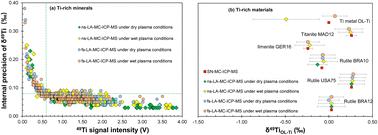
Mass-dependent titanium (Ti) isotopic variations in Ti-rich minerals as geological tracers are commonly measured by laser ablation (LA) coupled with multi-collector inductively coupled plasma mass spectrometry (MC-ICP-MS). A high-precision method for in situ Ti stable isotopic analysis in Ti-rich minerals was developed using nanosecond (ns) LA-MC-ICP-MS. Analytical performances of ns-LA-MC-ICP-MS were contrasted with femtosecond (fs) LA-MC-ICP-MS for Ti isotopic analysis in Ti-rich minerals and Ti metal. Matrix effects, more pronounced in ns-LA-MC-ICP-MS, were observed using non-matrix-matched calibration. Wet plasma conditions mitigated these effects compared to dry plasma conditions, effectively eliminating them between rutile and Ti metal using fs-LA-MC-ICP-MS. However, matrix effects persisted between rutile and other Ti-rich minerals (ilmenite, titanite and perovskite), even under wet plasma conditions. Subsequent Ti isotopic analyses of five Ti-rich minerals, using matrix-matched calibration protocols with both techniques, yielded internal precision (δ49Ti, 2SE) of ≤0.08‰ at 49Ti signal intensities >0.6 V with 1011 Ω resistors. External reproducibility (δ49Ti, 2SD) ranged from ±0.11‰ to ±0.17‰ across the five minerals analyzed by ns-LA-MC-ICP-MS, consistent with the precision achieved by fs-LA-MC-ICP-MS. Results obtained via ns-LA-MC-ICP-MS agreed with those from both fs-LA-MC-ICP-MS and solution nebulization MC-ICP-MS, except for Ti metal, confirming the accuracy of the ns-LA-MC-ICP-MS method. Isotopically homogeneous ilmenite GER16 and titanite MAD12 are proposed as bracketing and/or quality control standards.



 京公网安备 11010802042870号
京ICP备2023020795号-1
京公网安备 11010802042870号
京ICP备2023020795号-1

 分享
分享
 求助内容:
求助内容: 应助结果提醒方式:
 扫码关注我们
