{"title":"Novel pancreatic lipase inhibitory peptides derived from lotus seed protein: isolation, identification, and the interaction mechanism†","authors":"Haoran Chen, Zhenling Lang, Jingwen Chen, Tingting Gao, Baodong Zheng and Shaoxiao Zeng","doi":"10.1039/D5FO01008J","DOIUrl":null,"url":null,"abstract":"<p >In this study, pancreatic lipase (PL) inhibitory peptides were identified from a lotus seed protein (LSP) hydrolysate and the potential mechanism was investigated. The LSP hydrolysate was isolated and purified, and six PL inhibitory peptides were screened; in particular, Phe-Leu-Leu (FLL) and Glu-Phe-Phe (EFF) exhibited the strongest inhibitory activity. Molecular docking results indicated that FLL and EFF interacted with residues around the PL active site through hydrogen bonding and hydrophobic interactions. The Lineweaver–Burk curve revealed that FLL acted as a mixed-type inhibitor, while EFF exhibited non-competitive inhibition of PL. Additionally, fluorescence spectroscopy, circular dichroism (CD), and ultraviolet-visible (UV-Vis) spectrometry analyses confirmed that FLL and EFF altered the microenvironment and secondary structure of PL by increasing the β-sheet content and reducing the α-helix content, thereby decreasing the catalytic activity of PL. Molecular dynamics simulation further confirmed that PL–peptide complexes exhibited a more stable state and compact structure. In summary, FLL and EFF could be used in the development of food supplements for obesity prevention.</p>","PeriodicalId":77,"journal":{"name":"Food & Function","volume":" 8","pages":" 3180-3194"},"PeriodicalIF":5.4000,"publicationDate":"2025-03-19","publicationTypes":"Journal Article","fieldsOfStudy":null,"isOpenAccess":false,"openAccessPdf":"","citationCount":"0","resultStr":null,"platform":"Semanticscholar","paperid":null,"PeriodicalName":"Food & Function","FirstCategoryId":"97","ListUrlMain":"https://pubs.rsc.org/en/content/articlelanding/2025/fo/d5fo01008j","RegionNum":1,"RegionCategory":"农林科学","ArticlePicture":[],"TitleCN":null,"AbstractTextCN":null,"PMCID":null,"EPubDate":"","PubModel":"","JCR":"Q1","JCRName":"BIOCHEMISTRY & MOLECULAR BIOLOGY","Score":null,"Total":0}
引用次数: 0
Abstract
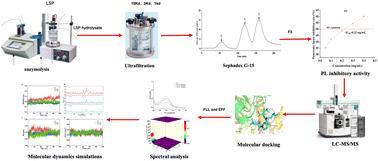
In this study, pancreatic lipase (PL) inhibitory peptides were identified from a lotus seed protein (LSP) hydrolysate and the potential mechanism was investigated. The LSP hydrolysate was isolated and purified, and six PL inhibitory peptides were screened; in particular, Phe-Leu-Leu (FLL) and Glu-Phe-Phe (EFF) exhibited the strongest inhibitory activity. Molecular docking results indicated that FLL and EFF interacted with residues around the PL active site through hydrogen bonding and hydrophobic interactions. The Lineweaver–Burk curve revealed that FLL acted as a mixed-type inhibitor, while EFF exhibited non-competitive inhibition of PL. Additionally, fluorescence spectroscopy, circular dichroism (CD), and ultraviolet-visible (UV-Vis) spectrometry analyses confirmed that FLL and EFF altered the microenvironment and secondary structure of PL by increasing the β-sheet content and reducing the α-helix content, thereby decreasing the catalytic activity of PL. Molecular dynamics simulation further confirmed that PL–peptide complexes exhibited a more stable state and compact structure. In summary, FLL and EFF could be used in the development of food supplements for obesity prevention.
期刊介绍:
Food & Function provides a unique venue for physicists, chemists, biochemists, nutritionists and other food scientists to publish work at the interface of the chemistry, physics and biology of food. The journal focuses on food and the functions of food in relation to health.



 京公网安备 11010802042870号
京ICP备2023020795号-1
京公网安备 11010802042870号
京ICP备2023020795号-1

 分享
分享
 求助内容:
求助内容: 应助结果提醒方式:
 扫码关注我们
