Ine Dirks, Matías Nicolás Bossa, Abel Díaz Berenguer, Tanmoy Mukherjee, Hichem Sahli, Nikos Deligiannis, Emma Verelst, Bart Ilsen, Simon Van Eyndhoven, Lucie Seyler, Arne Witdouck, Gilles Darcis, Julien Guiot, Athanasios Giannakis, Jef Vandemeulebroucke
{"title":"Development and multicentric external validation of a prognostic COVID-19 severity model based on thoracic CT.","authors":"Ine Dirks, Matías Nicolás Bossa, Abel Díaz Berenguer, Tanmoy Mukherjee, Hichem Sahli, Nikos Deligiannis, Emma Verelst, Bart Ilsen, Simon Van Eyndhoven, Lucie Seyler, Arne Witdouck, Gilles Darcis, Julien Guiot, Athanasios Giannakis, Jef Vandemeulebroucke","doi":"10.1186/s12911-025-02983-z","DOIUrl":null,"url":null,"abstract":"<p><strong>Background: </strong>Risk stratification of COVID-19 patients can support therapeutic decisions, planning and resource allocation in the hospital. In times of high incidence, a prognostic model based on data efficiently retrieved from one source can enable fast decision support.</p><p><strong>Methods: </strong>A model was developed to identify patients at risk of developing severe COVID-19 within one month based on their age, sex and imaging features extracted from the thoracic computed tomography (CT). The model was trained on publicly available data from the Study of Thoracic CT in COVID-19 (STOIC) challenge and validated on unseen data from the same study and an external, multicentric dataset. The model, trained on data acquired before any variant of concern dominated, was assessed separately on data collected at later stages of the pandemic when the delta and omicron variants were most prevalent.</p><p><strong>Results: </strong>A logistic regression based on handcrafted features was found to perform on par with a direct deep learning approach, and the former was selected for simplicity. Volumetric and intensity-based features of lesions and healthy lung parenchyma proved most predictive, in addition to patient age and sex. The model reached an area under the curve of 0.78 on the challenge test set and 0.74 on the external test set. The performance did not drop for the subset acquired at a later stage of the pandemic.</p><p><strong>Conclusions: </strong>A logistic regression utilizing features from thoracic CT and its metadata can provide rapid decision support by estimating short-term COVID-19 severity. Its stable performance underscores its potential for real-world clinical integration. By enabling rapid risk stratification using readily available imaging data, this approach can support early clinical decision-making, optimize resource allocation, and improve patient management, particularly during surges in COVID-19 cases. Furthermore, this study provides a foundation for future research on prognostic modelling in respiratory infections.</p>","PeriodicalId":9340,"journal":{"name":"BMC Medical Informatics and Decision Making","volume":"25 1","pages":"156"},"PeriodicalIF":3.8000,"publicationDate":"2025-04-01","publicationTypes":"Journal Article","fieldsOfStudy":null,"isOpenAccess":false,"openAccessPdf":"https://www.ncbi.nlm.nih.gov/pmc/articles/PMC11963321/pdf/","citationCount":"0","resultStr":null,"platform":"Semanticscholar","paperid":null,"PeriodicalName":"BMC Medical Informatics and Decision Making","FirstCategoryId":"3","ListUrlMain":"https://doi.org/10.1186/s12911-025-02983-z","RegionNum":3,"RegionCategory":"医学","ArticlePicture":[],"TitleCN":null,"AbstractTextCN":null,"PMCID":null,"EPubDate":"","PubModel":"","JCR":"Q2","JCRName":"MEDICAL INFORMATICS","Score":null,"Total":0}
引用次数: 0
Abstract
Background: Risk stratification of COVID-19 patients can support therapeutic decisions, planning and resource allocation in the hospital. In times of high incidence, a prognostic model based on data efficiently retrieved from one source can enable fast decision support.
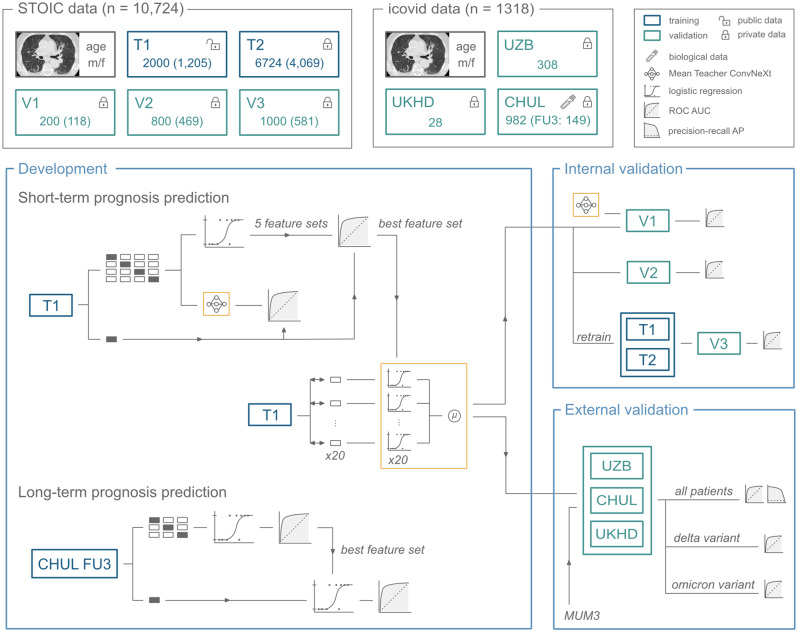
Methods: A model was developed to identify patients at risk of developing severe COVID-19 within one month based on their age, sex and imaging features extracted from the thoracic computed tomography (CT). The model was trained on publicly available data from the Study of Thoracic CT in COVID-19 (STOIC) challenge and validated on unseen data from the same study and an external, multicentric dataset. The model, trained on data acquired before any variant of concern dominated, was assessed separately on data collected at later stages of the pandemic when the delta and omicron variants were most prevalent.
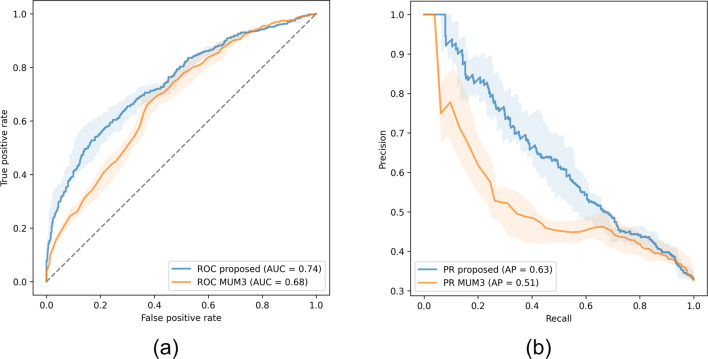
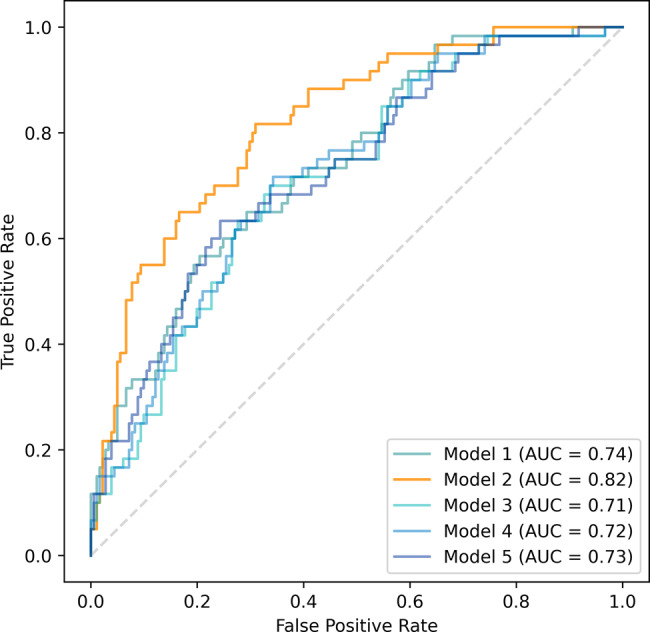
Results: A logistic regression based on handcrafted features was found to perform on par with a direct deep learning approach, and the former was selected for simplicity. Volumetric and intensity-based features of lesions and healthy lung parenchyma proved most predictive, in addition to patient age and sex. The model reached an area under the curve of 0.78 on the challenge test set and 0.74 on the external test set. The performance did not drop for the subset acquired at a later stage of the pandemic.
Conclusions: A logistic regression utilizing features from thoracic CT and its metadata can provide rapid decision support by estimating short-term COVID-19 severity. Its stable performance underscores its potential for real-world clinical integration. By enabling rapid risk stratification using readily available imaging data, this approach can support early clinical decision-making, optimize resource allocation, and improve patient management, particularly during surges in COVID-19 cases. Furthermore, this study provides a foundation for future research on prognostic modelling in respiratory infections.
期刊介绍:
BMC Medical Informatics and Decision Making is an open access journal publishing original peer-reviewed research articles in relation to the design, development, implementation, use, and evaluation of health information technologies and decision-making for human health.



 京公网安备 11010802042870号
京ICP备2023020795号-1
京公网安备 11010802042870号
京ICP备2023020795号-1

 分享
分享
 求助内容:
求助内容: 应助结果提醒方式:
 扫码关注我们
