Xiangming Hu MD , Can Wang MD , Dejing Feng MD , Zhe Li PhD , Yang Chen MD , Guannan Niu PhD , Zheng Zhou MD , Hongliang Zhang PhD , Yunqing Ye PhD , Moyang Wang PhD , Yongjian Wu PhD
{"title":"Association between lipoprotein(a) and long-term prognosis in patients receiving transcatheter aortic valve replacement","authors":"Xiangming Hu MD , Can Wang MD , Dejing Feng MD , Zhe Li PhD , Yang Chen MD , Guannan Niu PhD , Zheng Zhou MD , Hongliang Zhang PhD , Yunqing Ye PhD , Moyang Wang PhD , Yongjian Wu PhD","doi":"10.1016/j.jacl.2025.03.001","DOIUrl":null,"url":null,"abstract":"<div><h3>BACKGROUND</h3><div>Lipoprotein(a) (Lp[a]) has been identified as a significant risk factor for aortic stenosis (AS). However, its impact on outcomes post-transcatheter aortic valve replacement (TAVR) remains unknown.</div></div><div><h3>OBJECTIVE</h3><div>To investigate the association between Lp(a) levels and long-term outcomes as well as its impact on the bioprosthetic valve degeneration in patients post-TAVR.</div></div><div><h3>METHODS</h3><div>Patients with severe AS who underwent TAVR were consecutively recruited. Lp(a) was measured before TAVR procedure. The subjects were divided according to levels of Lp(a). The outcomes were all-cause mortality and possible structural valve degeneration (SVD) measured by Doppler echocardiography. Cox regression models and competing risk models were used to explore the association between Lp(a) levels and outcomes.</div></div><div><h3>RESULTS</h3><div>Of the 601 included patients (mean age: 75.5 ± 7.2, male: 58.7%), 137 patients (22.7%) experienced mortality after a median follow-up of 3.9 years. After multivariable adjustment, elevated Lp(a) (defined as ≥30 mg/dL) was identified as an independent predictor of all-cause mortality (hazard ratio [HR]: 1.81, 95% CI: 1.27-2.57, <em>P</em> = .001) and cardiovascular mortality (HR: 2.02, 95% CI: 1.12-3.66, <em>P</em> = .020). Elevated Lp(a) was also associated with increased risk of possible SVD (subdistribution HR: 3.40, 95% CI: 1.32-8.79, <em>P</em> = .012). Using a threshold value of 50 mg/dL for elevated Lp(a) still supported the main findings.</div></div><div><h3>CONCLUSION</h3><div>Elevated baseline Lp(a) levels are associated with poor clinical outcomes and possible SVD in patients with severe AS undergoing TAVR. Further research is warranted to confirm these findings.</div></div>","PeriodicalId":15392,"journal":{"name":"Journal of clinical lipidology","volume":"19 3","pages":"Pages 544-553"},"PeriodicalIF":4.6000,"publicationDate":"2025-05-01","publicationTypes":"Journal Article","fieldsOfStudy":null,"isOpenAccess":false,"openAccessPdf":"","citationCount":"0","resultStr":null,"platform":"Semanticscholar","paperid":null,"PeriodicalName":"Journal of clinical lipidology","FirstCategoryId":"3","ListUrlMain":"https://www.sciencedirect.com/science/article/pii/S1933287425000558","RegionNum":3,"RegionCategory":"医学","ArticlePicture":[],"TitleCN":null,"AbstractTextCN":null,"PMCID":null,"EPubDate":"2025/3/6 0:00:00","PubModel":"Epub","JCR":"Q2","JCRName":"PHARMACOLOGY & PHARMACY","Score":null,"Total":0}
引用次数: 0
Abstract
BACKGROUND
Lipoprotein(a) (Lp[a]) has been identified as a significant risk factor for aortic stenosis (AS). However, its impact on outcomes post-transcatheter aortic valve replacement (TAVR) remains unknown.
OBJECTIVE
To investigate the association between Lp(a) levels and long-term outcomes as well as its impact on the bioprosthetic valve degeneration in patients post-TAVR.
METHODS
Patients with severe AS who underwent TAVR were consecutively recruited. Lp(a) was measured before TAVR procedure. The subjects were divided according to levels of Lp(a). The outcomes were all-cause mortality and possible structural valve degeneration (SVD) measured by Doppler echocardiography. Cox regression models and competing risk models were used to explore the association between Lp(a) levels and outcomes.
RESULTS
Of the 601 included patients (mean age: 75.5 ± 7.2, male: 58.7%), 137 patients (22.7%) experienced mortality after a median follow-up of 3.9 years. After multivariable adjustment, elevated Lp(a) (defined as ≥30 mg/dL) was identified as an independent predictor of all-cause mortality (hazard ratio [HR]: 1.81, 95% CI: 1.27-2.57, P = .001) and cardiovascular mortality (HR: 2.02, 95% CI: 1.12-3.66, P = .020). Elevated Lp(a) was also associated with increased risk of possible SVD (subdistribution HR: 3.40, 95% CI: 1.32-8.79, P = .012). Using a threshold value of 50 mg/dL for elevated Lp(a) still supported the main findings.
CONCLUSION
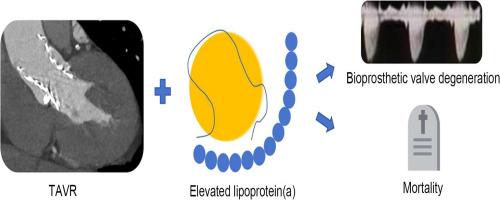
Elevated baseline Lp(a) levels are associated with poor clinical outcomes and possible SVD in patients with severe AS undergoing TAVR. Further research is warranted to confirm these findings.
期刊介绍:
Because the scope of clinical lipidology is broad, the topics addressed by the Journal are equally diverse. Typical articles explore lipidology as it is practiced in the treatment setting, recent developments in pharmacological research, reports of treatment and trials, case studies, the impact of lifestyle modification, and similar academic material of interest to the practitioner.
Sections of Journal of clinical lipidology will address pioneering studies and the clinicians who conduct them, case studies, ethical standards and conduct, professional guidance such as ATP and NCEP, editorial commentary, letters from readers, National Lipid Association (NLA) news and upcoming event information, as well as abstracts from the NLA annual scientific sessions and the scientific forums held by its chapters, when appropriate.



 京公网安备 11010802042870号
京ICP备2023020795号-1
京公网安备 11010802042870号
京ICP备2023020795号-1

 分享
分享

 求助内容:
求助内容: 应助结果提醒方式:
 扫码关注我们
