Anna Müller, Caroline Dos Santos Costa, Romina Buffarini, Juliana Dos Santos Vaz, Marlos Rodrigues Domingues, Pedro Curi Hallal, Janaina Vieira Dos Santos Motta
{"title":"Description and evaluation of an ultra-processed food consumption score for children.","authors":"Anna Müller, Caroline Dos Santos Costa, Romina Buffarini, Juliana Dos Santos Vaz, Marlos Rodrigues Domingues, Pedro Curi Hallal, Janaina Vieira Dos Santos Motta","doi":"10.11606/s1518-8787.2025059005816","DOIUrl":null,"url":null,"abstract":"<p><strong>Objective: </strong>To present a screener for consumption of ultra-processed foods for children in early childhood, evaluating the ability of the score generated by this screener to reflect the participation of ultra-processed foods in children's diets.</p><p><strong>Methods: </strong>This study was conducted with a convenience subsample of the 2015 Pelotas Birth Cohort (n = 365). The mothers of the participating children answered a food consumption questionnaire the day before the interview (screener) containing 16 subgroups of ultra-processed foods, followed by a traditional 24-hour food recall (24hR). Each participant's ultra-processed food consumption score corresponded to the number of food subgroups consumed and the percentage of energy derived from the participation of ultra-processed foods in the diet on the same day was calculated from the answers in the 24hR. The association between the score and the percentage of energy from ultra-processed foods was tested using linear regression models. The degree of agreement between the classification of participants according to approximate fifths of the percentage of calories from ultra-processed foods and according to the score intervals was assessed using the Pabak index.</p><p><strong>Results: </strong>The average percentage share of ultra-processed foods in the total caloric value of the diet, calculated using the 24hR, was directly and significantly associated with an increase in the ultra-processed food consumption score. There was substantial agreement between the ranges of the ultra-processed food consumption score obtained by the screener and the approximate fifths of the share of ultra-processed foods in the diet calculated by the 24hR (Pabak index = 0.65).</p><p><strong>Conclusions: </strong>The ultra-processed food consumption score, obtained from an ultra-processed food consumption screener, a practical and agile instrument, is capable of reflecting the participation of ultra-processed foods in children's diets, with regard to the 2015 Pelotas Birth Cohort.</p>","PeriodicalId":21230,"journal":{"name":"Revista de saude publica","volume":"59 ","pages":"e5"},"PeriodicalIF":2.1000,"publicationDate":"2025-03-31","publicationTypes":"Journal Article","fieldsOfStudy":null,"isOpenAccess":false,"openAccessPdf":"https://www.ncbi.nlm.nih.gov/pmc/articles/PMC11967337/pdf/","citationCount":"0","resultStr":null,"platform":"Semanticscholar","paperid":null,"PeriodicalName":"Revista de saude publica","FirstCategoryId":"3","ListUrlMain":"https://doi.org/10.11606/s1518-8787.2025059005816","RegionNum":4,"RegionCategory":"医学","ArticlePicture":[],"TitleCN":null,"AbstractTextCN":null,"PMCID":null,"EPubDate":"2025/1/1 0:00:00","PubModel":"eCollection","JCR":"Q3","JCRName":"PUBLIC, ENVIRONMENTAL & OCCUPATIONAL HEALTH","Score":null,"Total":0}
引用次数: 0
Abstract
Objective: To present a screener for consumption of ultra-processed foods for children in early childhood, evaluating the ability of the score generated by this screener to reflect the participation of ultra-processed foods in children's diets.
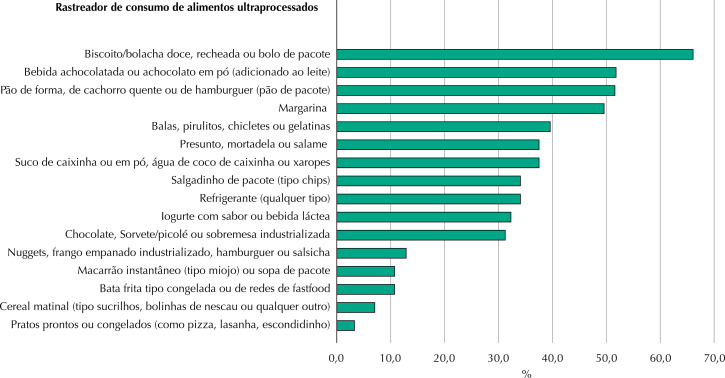
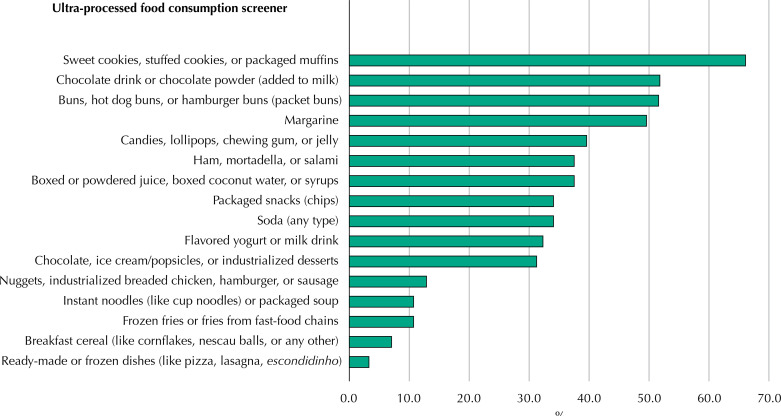
Methods: This study was conducted with a convenience subsample of the 2015 Pelotas Birth Cohort (n = 365). The mothers of the participating children answered a food consumption questionnaire the day before the interview (screener) containing 16 subgroups of ultra-processed foods, followed by a traditional 24-hour food recall (24hR). Each participant's ultra-processed food consumption score corresponded to the number of food subgroups consumed and the percentage of energy derived from the participation of ultra-processed foods in the diet on the same day was calculated from the answers in the 24hR. The association between the score and the percentage of energy from ultra-processed foods was tested using linear regression models. The degree of agreement between the classification of participants according to approximate fifths of the percentage of calories from ultra-processed foods and according to the score intervals was assessed using the Pabak index.
Results: The average percentage share of ultra-processed foods in the total caloric value of the diet, calculated using the 24hR, was directly and significantly associated with an increase in the ultra-processed food consumption score. There was substantial agreement between the ranges of the ultra-processed food consumption score obtained by the screener and the approximate fifths of the share of ultra-processed foods in the diet calculated by the 24hR (Pabak index = 0.65).
Conclusions: The ultra-processed food consumption score, obtained from an ultra-processed food consumption screener, a practical and agile instrument, is capable of reflecting the participation of ultra-processed foods in children's diets, with regard to the 2015 Pelotas Birth Cohort.



 京公网安备 11010802042870号
京ICP备2023020795号-1
京公网安备 11010802042870号
京ICP备2023020795号-1

 分享
分享
 求助内容:
求助内容: 应助结果提醒方式:
 扫码关注我们
