Natália Carminati, Gracielle Dos Santos David, Mariana Pinheiro Brendim
{"title":"Tongue pressure and self-assessment of swallowing after total laryngectomy.","authors":"Natália Carminati, Gracielle Dos Santos David, Mariana Pinheiro Brendim","doi":"10.1590/2317-1782/e20240185pt","DOIUrl":null,"url":null,"abstract":"<p><strong>Purpose: </strong>To evaluate tongue pressure, self-perception of swallowing, and whether tongue pressure is correlated with self-perception of swallowing in individuals undergoing total laryngectomy.</p><p><strong>Methods: </strong>Cross-sectional study with two groups - with and without total laryngectomy, matched by age and sex to individuals with total laryngectomy. Participants had their tongue tip and dorsum pressure measured and self-assessed their swallowing with the Swallow Outcomes After Laryngectomy questionnaire (SOAL).</p><p><strong>Results: </strong>The sample totaled 26 participants, 13 from each group. The mean maximum tongue dorsum pressure was 41.2±18.7 and 27.9±9.3 kilopascals, respectively, in the groups with and without total laryngectomy (p = 0.03). The median maximum tongue tip pressure was 33.7 (23.8-49.3) and 29.1 (22.5-35.7) kilopascals, respectively, in the groups with and without total laryngectomy (p = 0.29). The median SOAL was 6 (2.5-8.5) points in the group with total laryngectomy. The SOAL score was not statistically significantly correlated with tongue tip pressure (r = -0.17; p = 0.58) or dorsum pressure (r = -0.30; p = 0.31).</p><p><strong>Conclusion: </strong>Individuals with total laryngectomy had higher tongue dorsum pressure, although there was no difference in tongue tip pressure between individuals with and without total laryngectomy. Tongue pressure was not correlated with self-assessment of swallowing, although tongue tip pressure was correlated with dorsum pressure in individuals with total laryngectomy.</p>","PeriodicalId":46547,"journal":{"name":"CoDAS","volume":"37 3","pages":"e20240185"},"PeriodicalIF":0.8000,"publicationDate":"2025-03-31","publicationTypes":"Journal Article","fieldsOfStudy":null,"isOpenAccess":false,"openAccessPdf":"https://www.ncbi.nlm.nih.gov/pmc/articles/PMC11963879/pdf/","citationCount":"0","resultStr":null,"platform":"Semanticscholar","paperid":null,"PeriodicalName":"CoDAS","FirstCategoryId":"1085","ListUrlMain":"https://doi.org/10.1590/2317-1782/e20240185pt","RegionNum":0,"RegionCategory":null,"ArticlePicture":[],"TitleCN":null,"AbstractTextCN":null,"PMCID":null,"EPubDate":"2025/1/1 0:00:00","PubModel":"eCollection","JCR":"Q4","JCRName":"AUDIOLOGY & SPEECH-LANGUAGE PATHOLOGY","Score":null,"Total":0}
引用次数: 0
Abstract
Purpose: To evaluate tongue pressure, self-perception of swallowing, and whether tongue pressure is correlated with self-perception of swallowing in individuals undergoing total laryngectomy.
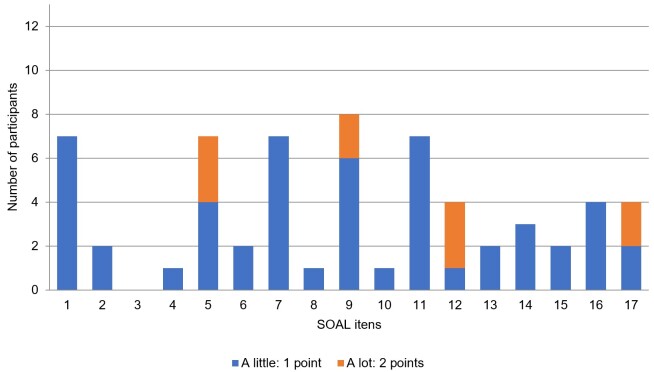
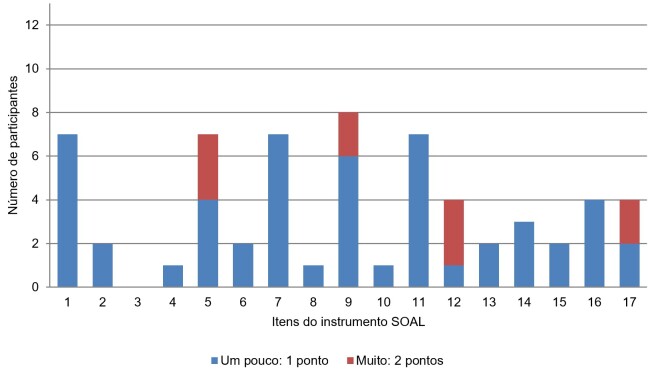
Methods: Cross-sectional study with two groups - with and without total laryngectomy, matched by age and sex to individuals with total laryngectomy. Participants had their tongue tip and dorsum pressure measured and self-assessed their swallowing with the Swallow Outcomes After Laryngectomy questionnaire (SOAL).
Results: The sample totaled 26 participants, 13 from each group. The mean maximum tongue dorsum pressure was 41.2±18.7 and 27.9±9.3 kilopascals, respectively, in the groups with and without total laryngectomy (p = 0.03). The median maximum tongue tip pressure was 33.7 (23.8-49.3) and 29.1 (22.5-35.7) kilopascals, respectively, in the groups with and without total laryngectomy (p = 0.29). The median SOAL was 6 (2.5-8.5) points in the group with total laryngectomy. The SOAL score was not statistically significantly correlated with tongue tip pressure (r = -0.17; p = 0.58) or dorsum pressure (r = -0.30; p = 0.31).
Conclusion: Individuals with total laryngectomy had higher tongue dorsum pressure, although there was no difference in tongue tip pressure between individuals with and without total laryngectomy. Tongue pressure was not correlated with self-assessment of swallowing, although tongue tip pressure was correlated with dorsum pressure in individuals with total laryngectomy.




 京公网安备 11010802042870号
京ICP备2023020795号-1
京公网安备 11010802042870号
京ICP备2023020795号-1

 分享
分享
 求助内容:
求助内容: 应助结果提醒方式:
 扫码关注我们
