{"title":"Bile acid is a responsible host factor for high-fat diet-induced gut microbiota alterations in rats: proof of the \"bile acid hypothesis\".","authors":"Masamichi Watanabe, Yuki Fujita, Masahito Hagio, Satoshi Ishizuka, Yoshitoshi Ogura, Tetsuya Hayashi, Satoru Fukiya, Atsushi Yokota","doi":"10.12938/bmfh.2024-042","DOIUrl":null,"url":null,"abstract":"<p><p>High-fat diet (HFD)-induced alterations in gut microbiota may be associated with host pathophysiology, prompting increased interest in elucidating their causal relationships. However, the mechanisms by which HFDs induce these alterations require further clarification. Our previous study using cholic acid (CA)-fed rats suggested that bile acid drives the HFD-induced microbiota alterations as a host factor, a concept termed the \"bile acid hypothesis\". We analyzed the alterations in the cecal microbiota and bile acid composition in HFD-fed rats and compared the results with those of rats on a CA-supplemented diet. In both cases, the concentrations of total bile acids, including highly bactericidal deoxycholic acid (DCA), increased, concomitant with the increases in the Firmicutes (Bacillota)/Bacteroidetes (Bacteroidota) ratio. Operational taxonomic units (OTUs), accounting for 63.39% of the cecal microbiota of control rats, showed a significant correlation with the total bile acid concentration in HFD-fed rats. A DCA sensitivity test conducted in Firmicutes isolates, corresponding to the predominant OTUs from the HFD-fed rats, exhibited significantly higher DCA resistance compared with Bacteroidetes. The top 12 most abundant OTUs of Firmicutes and Bacteroidetes showing positive or negative correlations with the total bile acid concentration were selected from the HFD-fed rats, and their dynamics were compared with those in the CA-fed rats. Of the 24 OTUs, 18, which constituted 48.28% of the cecal population in the control rats, were altered in the same direction (increase or decrease) in the HFD- and CA-supplemented diet groups. Therefore, approximately half of the cecal populations in the control rats were affected by bile acids, substantiating the bile acid hypothesis microbiologically and quantitatively.</p>","PeriodicalId":93908,"journal":{"name":"Bioscience of microbiota, food and health","volume":"44 2","pages":"110-121"},"PeriodicalIF":2.9000,"publicationDate":"2025-01-01","publicationTypes":"Journal Article","fieldsOfStudy":null,"isOpenAccess":false,"openAccessPdf":"https://www.ncbi.nlm.nih.gov/pmc/articles/PMC11957759/pdf/","citationCount":"0","resultStr":null,"platform":"Semanticscholar","paperid":null,"PeriodicalName":"Bioscience of microbiota, food and health","FirstCategoryId":"1085","ListUrlMain":"https://doi.org/10.12938/bmfh.2024-042","RegionNum":0,"RegionCategory":null,"ArticlePicture":[],"TitleCN":null,"AbstractTextCN":null,"PMCID":null,"EPubDate":"2024/10/31 0:00:00","PubModel":"Epub","JCR":"Q3","JCRName":"MICROBIOLOGY","Score":null,"Total":0}
引用次数: 0
Abstract
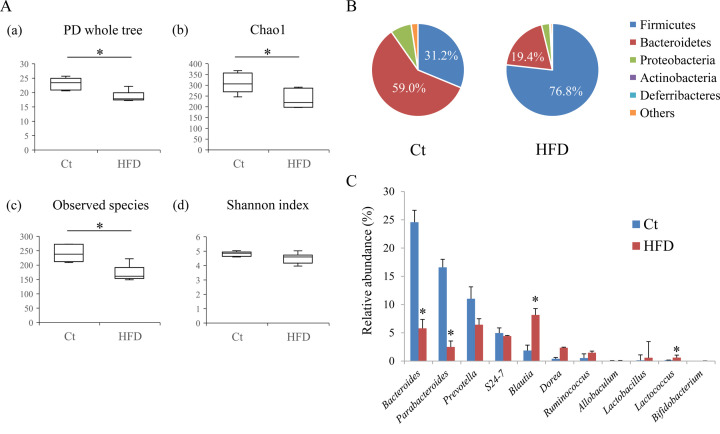
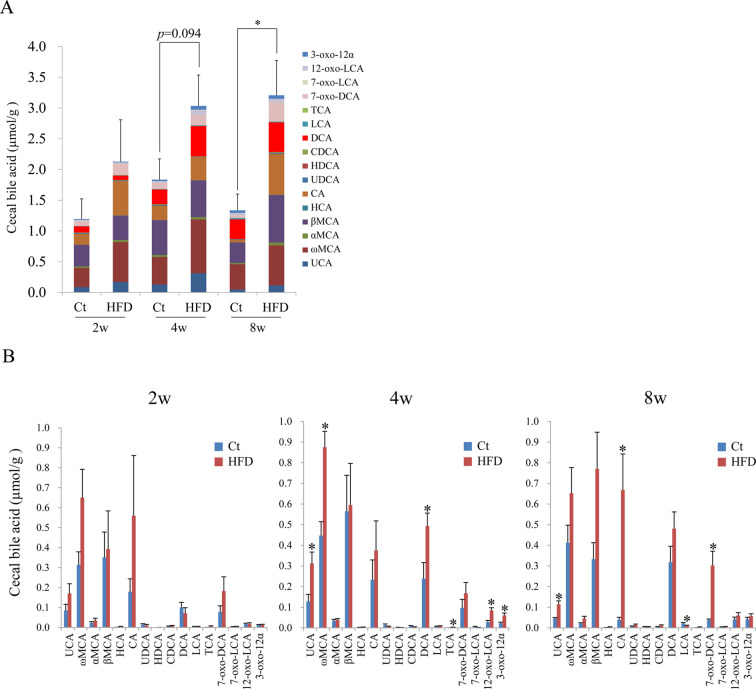
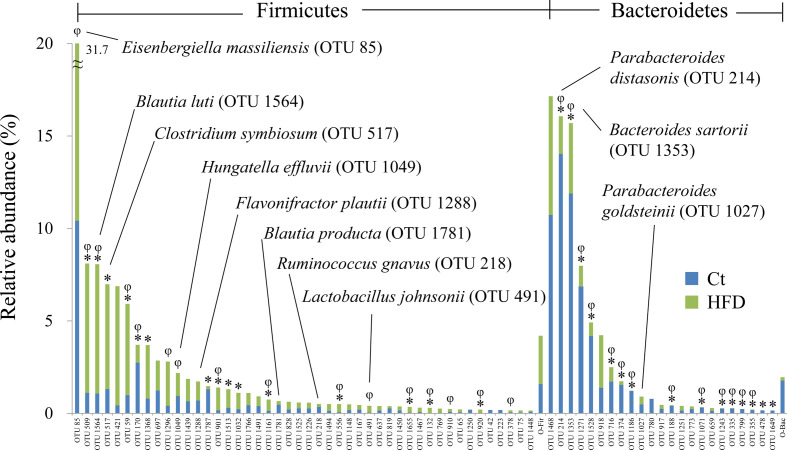
High-fat diet (HFD)-induced alterations in gut microbiota may be associated with host pathophysiology, prompting increased interest in elucidating their causal relationships. However, the mechanisms by which HFDs induce these alterations require further clarification. Our previous study using cholic acid (CA)-fed rats suggested that bile acid drives the HFD-induced microbiota alterations as a host factor, a concept termed the "bile acid hypothesis". We analyzed the alterations in the cecal microbiota and bile acid composition in HFD-fed rats and compared the results with those of rats on a CA-supplemented diet. In both cases, the concentrations of total bile acids, including highly bactericidal deoxycholic acid (DCA), increased, concomitant with the increases in the Firmicutes (Bacillota)/Bacteroidetes (Bacteroidota) ratio. Operational taxonomic units (OTUs), accounting for 63.39% of the cecal microbiota of control rats, showed a significant correlation with the total bile acid concentration in HFD-fed rats. A DCA sensitivity test conducted in Firmicutes isolates, corresponding to the predominant OTUs from the HFD-fed rats, exhibited significantly higher DCA resistance compared with Bacteroidetes. The top 12 most abundant OTUs of Firmicutes and Bacteroidetes showing positive or negative correlations with the total bile acid concentration were selected from the HFD-fed rats, and their dynamics were compared with those in the CA-fed rats. Of the 24 OTUs, 18, which constituted 48.28% of the cecal population in the control rats, were altered in the same direction (increase or decrease) in the HFD- and CA-supplemented diet groups. Therefore, approximately half of the cecal populations in the control rats were affected by bile acids, substantiating the bile acid hypothesis microbiologically and quantitatively.



 京公网安备 11010802042870号
京ICP备2023020795号-1
京公网安备 11010802042870号
京ICP备2023020795号-1

 分享
分享

 求助内容:
求助内容: 应助结果提醒方式:
 扫码关注我们
