Holmfridur S. Hannesdottir, Andrew J. McLeod, Matthew D. Schwartz, Cristian Vergu
{"title":"Applications of the Landau bootstrap","authors":"Holmfridur S. Hannesdottir, Andrew J. McLeod, Matthew D. Schwartz, Cristian Vergu","doi":"10.1103/physrevd.111.085003","DOIUrl":null,"url":null,"abstract":"We advocate a strategy of bootstrapping Feynman integrals from just knowledge of their singular behavior. This approach is complementary to other bootstrap programs, which exploit nonperturbative constraints such as unitarity, or amplitude-level constraints such as gauge invariance. We begin by studying where a Feynman integral can become singular, and the behavior it exhibits near these singularities. We then characterize the space of functions that we expect the integral to evaluate to, in order to formulate an appropriate ansatz. Finally, we derive constraints on where each singularity can appear in this ansatz, and use information about the expansion of the integral around singular points in order to determine the value of all remaining free coefficients. Throughout, we highlight how constraints that have previously only been derived for integrals with generic masses can be extended to integrals involving particles of equal or vanishing mass. We illustrate the effectiveness of this approach by bootstrapping a number of examples, including the four-point double box with a massive internal loop. <jats:supplementary-material> <jats:copyright-statement>Published by the American Physical Society</jats:copyright-statement> <jats:copyright-year>2025</jats:copyright-year> </jats:permissions> </jats:supplementary-material>","PeriodicalId":20167,"journal":{"name":"Physical Review D","volume":"133 1","pages":""},"PeriodicalIF":5.3000,"publicationDate":"2025-04-02","publicationTypes":"Journal Article","fieldsOfStudy":null,"isOpenAccess":false,"openAccessPdf":"","citationCount":"0","resultStr":null,"platform":"Semanticscholar","paperid":null,"PeriodicalName":"Physical Review D","FirstCategoryId":"101","ListUrlMain":"https://doi.org/10.1103/physrevd.111.085003","RegionNum":2,"RegionCategory":"物理与天体物理","ArticlePicture":[],"TitleCN":null,"AbstractTextCN":null,"PMCID":null,"EPubDate":"","PubModel":"","JCR":"Q1","JCRName":"Physics and Astronomy","Score":null,"Total":0}
引用次数: 0
Abstract
We advocate a strategy of bootstrapping Feynman integrals from just knowledge of their singular behavior. This approach is complementary to other bootstrap programs, which exploit nonperturbative constraints such as unitarity, or amplitude-level constraints such as gauge invariance. We begin by studying where a Feynman integral can become singular, and the behavior it exhibits near these singularities. We then characterize the space of functions that we expect the integral to evaluate to, in order to formulate an appropriate ansatz. Finally, we derive constraints on where each singularity can appear in this ansatz, and use information about the expansion of the integral around singular points in order to determine the value of all remaining free coefficients. Throughout, we highlight how constraints that have previously only been derived for integrals with generic masses can be extended to integrals involving particles of equal or vanishing mass. We illustrate the effectiveness of this approach by bootstrapping a number of examples, including the four-point double box with a massive internal loop. Published by the American Physical Society2025
期刊介绍:
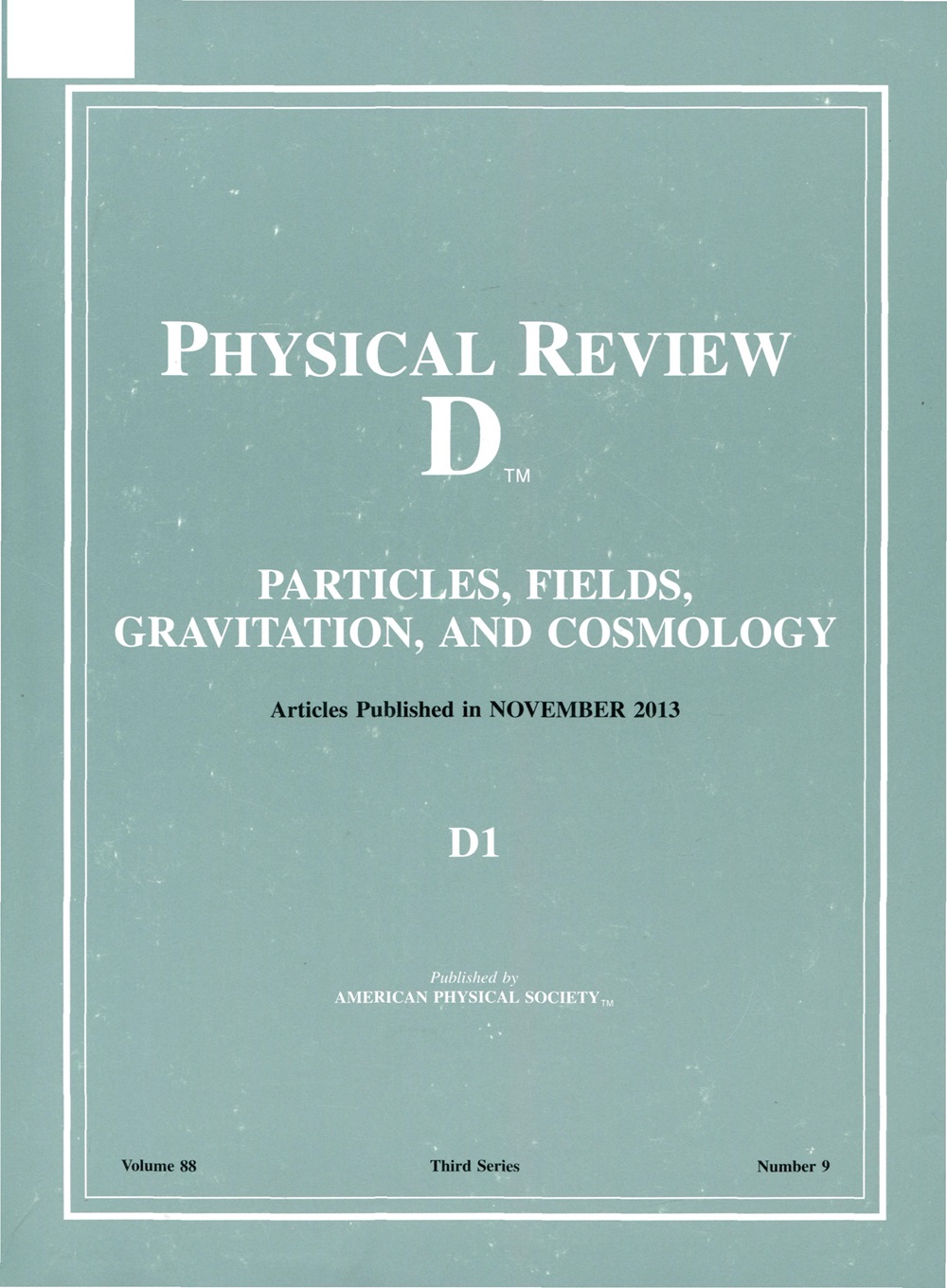
Physical Review D (PRD) is a leading journal in elementary particle physics, field theory, gravitation, and cosmology and is one of the top-cited journals in high-energy physics.
PRD covers experimental and theoretical results in all aspects of particle physics, field theory, gravitation and cosmology, including:
Particle physics experiments,
Electroweak interactions,
Strong interactions,
Lattice field theories, lattice QCD,
Beyond the standard model physics,
Phenomenological aspects of field theory, general methods,
Gravity, cosmology, cosmic rays,
Astrophysics and astroparticle physics,
General relativity,
Formal aspects of field theory, field theory in curved space,
String theory, quantum gravity, gauge/gravity duality.



 京公网安备 11010802042870号
京ICP备2023020795号-1
京公网安备 11010802042870号
京ICP备2023020795号-1

 分享
分享
 求助内容:
求助内容: 应助结果提醒方式:
 扫码关注我们
