Rong Shen , Peng Xia , Yanan Guo , Pengfei Ji , Xinyi Yuan , Lu Wang , Si Shuang , Liwei Zhou , Ruizhi Tong , Lijuan Zhang , Disheng Liu , Degui Wang
{"title":"Effects of polystyrene microparticles exposures on spermatogenic cell differentiation and reproductive endpoints in male mice","authors":"Rong Shen , Peng Xia , Yanan Guo , Pengfei Ji , Xinyi Yuan , Lu Wang , Si Shuang , Liwei Zhou , Ruizhi Tong , Lijuan Zhang , Disheng Liu , Degui Wang","doi":"10.1016/j.envpol.2025.126200","DOIUrl":null,"url":null,"abstract":"<div><div>The widespread distribution of microplastics in the environment has raised concerns about their potential implications for human health. Microplastics accumulate in animals and humans, but the risks associated with these pollutants are not fully understood. This study aimed to investigate the effects of polystyrene microplastics on the male reproductive system. The 0.1 μm polystyrene (PS) could accumulate in the testicular tissue and spermatogonia GC-1, while 1 μm PS was not easy to enter and accumulate in the testicular tissue and cells. Mice continuously exposed for 3-months to 0.1 μm PS demonstrated lower fertility and inhibited spermatogonium differentiation compared to control mice. The 0.1 μm PS were dispersed throughout the seminiferous tubule of the testis. Metabolic reprogramming was found to be involved in these processes. Histone methylation and autophagy-related pathways showed significant differences following PS treatment in testis tissue and GC-1 cells. Our findings suggest that chronic exposure to 0.1 μm PS inhibited spermatogenic cell differentiation and impaired fertility in male mice. We propose that abnormal epigenetic modifications in 0.1 μm PS exposed mice contributed to the dysregulation of glycolytic enzymes, and that the impaired autophagic pathway exacerbated the accumulation of glycolytic enzymes further. Glycolysis plays a critical role in the regulation of spermatogenic cell differentiation, and its regulation partially alleviated the impairments associated with PS exposure. In conclusion, our findings suggest that chronic exposure to nanoplastics PS inhibited spermatogenic cell differentiation and impaired fertility in male mice via disrupted epigenetic modification and metabolic dysregulation.</div></div>","PeriodicalId":311,"journal":{"name":"Environmental Pollution","volume":"373 ","pages":"Article 126200"},"PeriodicalIF":7.3000,"publicationDate":"2025-05-15","publicationTypes":"Journal Article","fieldsOfStudy":null,"isOpenAccess":false,"openAccessPdf":"","citationCount":"0","resultStr":null,"platform":"Semanticscholar","paperid":null,"PeriodicalName":"Environmental Pollution","FirstCategoryId":"93","ListUrlMain":"https://www.sciencedirect.com/science/article/pii/S0269749125005731","RegionNum":2,"RegionCategory":"环境科学与生态学","ArticlePicture":[],"TitleCN":null,"AbstractTextCN":null,"PMCID":null,"EPubDate":"2025/4/3 0:00:00","PubModel":"Epub","JCR":"Q1","JCRName":"ENVIRONMENTAL SCIENCES","Score":null,"Total":0}
引用次数: 0
Abstract
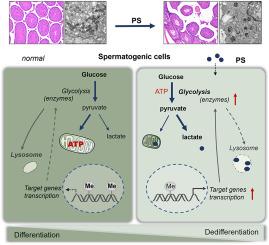
The widespread distribution of microplastics in the environment has raised concerns about their potential implications for human health. Microplastics accumulate in animals and humans, but the risks associated with these pollutants are not fully understood. This study aimed to investigate the effects of polystyrene microplastics on the male reproductive system. The 0.1 μm polystyrene (PS) could accumulate in the testicular tissue and spermatogonia GC-1, while 1 μm PS was not easy to enter and accumulate in the testicular tissue and cells. Mice continuously exposed for 3-months to 0.1 μm PS demonstrated lower fertility and inhibited spermatogonium differentiation compared to control mice. The 0.1 μm PS were dispersed throughout the seminiferous tubule of the testis. Metabolic reprogramming was found to be involved in these processes. Histone methylation and autophagy-related pathways showed significant differences following PS treatment in testis tissue and GC-1 cells. Our findings suggest that chronic exposure to 0.1 μm PS inhibited spermatogenic cell differentiation and impaired fertility in male mice. We propose that abnormal epigenetic modifications in 0.1 μm PS exposed mice contributed to the dysregulation of glycolytic enzymes, and that the impaired autophagic pathway exacerbated the accumulation of glycolytic enzymes further. Glycolysis plays a critical role in the regulation of spermatogenic cell differentiation, and its regulation partially alleviated the impairments associated with PS exposure. In conclusion, our findings suggest that chronic exposure to nanoplastics PS inhibited spermatogenic cell differentiation and impaired fertility in male mice via disrupted epigenetic modification and metabolic dysregulation.
期刊介绍:
Environmental Pollution is an international peer-reviewed journal that publishes high-quality research papers and review articles covering all aspects of environmental pollution and its impacts on ecosystems and human health.
Subject areas include, but are not limited to:
• Sources and occurrences of pollutants that are clearly defined and measured in environmental compartments, food and food-related items, and human bodies;
• Interlinks between contaminant exposure and biological, ecological, and human health effects, including those of climate change;
• Contaminants of emerging concerns (including but not limited to antibiotic resistant microorganisms or genes, microplastics/nanoplastics, electronic wastes, light, and noise) and/or their biological, ecological, or human health effects;
• Laboratory and field studies on the remediation/mitigation of environmental pollution via new techniques and with clear links to biological, ecological, or human health effects;
• Modeling of pollution processes, patterns, or trends that is of clear environmental and/or human health interest;
• New techniques that measure and examine environmental occurrences, transport, behavior, and effects of pollutants within the environment or the laboratory, provided that they can be clearly used to address problems within regional or global environmental compartments.




 京公网安备 11010802042870号
京ICP备2023020795号-1
京公网安备 11010802042870号
京ICP备2023020795号-1

 分享
分享
 求助内容:
求助内容: 应助结果提醒方式:
 扫码关注我们
