Qiangli Lv , Haoran Guo , Duo Xu , Yuling Zhai , Hua Wang , Tao Zhu , Xing Zhu , Kongzhai Li , Zhihong Yang , Zhishan Li
{"title":"Interfacial engineering of NiMn-LDH@Rh(OH)3 Heterojunctions for Promoted electrocatalytic urea oxidation","authors":"Qiangli Lv , Haoran Guo , Duo Xu , Yuling Zhai , Hua Wang , Tao Zhu , Xing Zhu , Kongzhai Li , Zhihong Yang , Zhishan Li","doi":"10.1016/j.apsusc.2025.163158","DOIUrl":null,"url":null,"abstract":"<div><div>The urea oxidation reaction (UOR) is considered as an alternative to the oxygen evolution reaction for high-efficiency hydrogen production, because it can simultaneously achieve wastewater treatment and hydrogen production. However, the slow kinetics of the UOR hinder its widespread adoption due to relatively complex molecule, it is urgent to rational design and preparation of high-performance UOR catalysts. Herein, we report a simple synthesis of the NiMn-LDH@Rh(OH)<sub>3</sub> heterostructure and a systematic investigation of urea-assisted electrolytic hydrogen production, significantly enhances the efficiency of urea electrolysis. The amorphous Rh(OH)<sub>3</sub> structure provides a higher density of active sites and greater catalytic surface exposure, while the synergistic interaction between Rh(OH)<sub>3</sub> and NiMn-LDH improves both electrical conductivity and catalytic performance. The catalyst of NiMn-LDH@Rh(OH)<sub>3</sub>–3 requires only 1.29 V overpotential to achieve a current density of 10 mA cm<sup>−2</sup> in a 1.0 M KOH and 0.33 M urea solution, surpassing other catalysts. Furthermore, it demonstrates remarkable stability with minimal potential increase during 48-hour chronopotentiometric tests at 100 mA cm<sup>−2</sup>. This work making the developed strategy promising for the rational design of highly active electrocatalysts for green hydrogen production and the treatment of urea-rich wastewater.</div></div>","PeriodicalId":247,"journal":{"name":"Applied Surface Science","volume":"700 ","pages":"Article 163158"},"PeriodicalIF":6.9000,"publicationDate":"2025-04-03","publicationTypes":"Journal Article","fieldsOfStudy":null,"isOpenAccess":false,"openAccessPdf":"","citationCount":"0","resultStr":null,"platform":"Semanticscholar","paperid":null,"PeriodicalName":"Applied Surface Science","FirstCategoryId":"88","ListUrlMain":"https://www.sciencedirect.com/science/article/pii/S0169433225008724","RegionNum":2,"RegionCategory":"材料科学","ArticlePicture":[],"TitleCN":null,"AbstractTextCN":null,"PMCID":null,"EPubDate":"","PubModel":"","JCR":"Q2","JCRName":"CHEMISTRY, PHYSICAL","Score":null,"Total":0}
引用次数: 0
Abstract
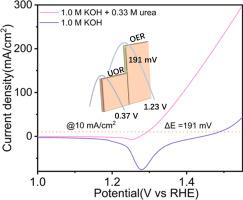
The urea oxidation reaction (UOR) is considered as an alternative to the oxygen evolution reaction for high-efficiency hydrogen production, because it can simultaneously achieve wastewater treatment and hydrogen production. However, the slow kinetics of the UOR hinder its widespread adoption due to relatively complex molecule, it is urgent to rational design and preparation of high-performance UOR catalysts. Herein, we report a simple synthesis of the NiMn-LDH@Rh(OH)3 heterostructure and a systematic investigation of urea-assisted electrolytic hydrogen production, significantly enhances the efficiency of urea electrolysis. The amorphous Rh(OH)3 structure provides a higher density of active sites and greater catalytic surface exposure, while the synergistic interaction between Rh(OH)3 and NiMn-LDH improves both electrical conductivity and catalytic performance. The catalyst of NiMn-LDH@Rh(OH)3–3 requires only 1.29 V overpotential to achieve a current density of 10 mA cm−2 in a 1.0 M KOH and 0.33 M urea solution, surpassing other catalysts. Furthermore, it demonstrates remarkable stability with minimal potential increase during 48-hour chronopotentiometric tests at 100 mA cm−2. This work making the developed strategy promising for the rational design of highly active electrocatalysts for green hydrogen production and the treatment of urea-rich wastewater.
尿素氧化反应(UOR)可以同时实现废水处理和制氢,被认为是替代析氧反应的高效制氢方法。但由于UOR的分子结构相对复杂,其缓慢的动力学特性阻碍了其广泛应用,因此合理设计和制备高性能UOR催化剂已成为当务之急。本文报道了一种简单合成NiMn-LDH@Rh(OH)3异质结构的方法,并对尿素辅助电解制氢进行了系统的研究,显著提高了尿素电解的效率。无定形的Rh(OH)3结构提供了更高的活性位点密度和更大的催化表面暴露,而Rh(OH)3和NiMn-LDH之间的协同相互作用提高了电导率和催化性能。在1.0 M KOH和0.33 M尿素溶液中,NiMn-LDH@Rh(OH) 3-3催化剂只需要1.29 V过电位就能达到10 mA cm−2的电流密度,优于其他催化剂。此外,它表现出显著的稳定性,在100 mA cm−2的48小时计时电位测试中,电位的增加最小。本研究为合理设计高效电催化剂用于绿色制氢和富尿素废水的处理提供了理论依据。
期刊介绍:
Applied Surface Science covers topics contributing to a better understanding of surfaces, interfaces, nanostructures and their applications. The journal is concerned with scientific research on the atomic and molecular level of material properties determined with specific surface analytical techniques and/or computational methods, as well as the processing of such structures.




 京公网安备 11010802042870号
京ICP备2023020795号-1
京公网安备 11010802042870号
京ICP备2023020795号-1

 分享
分享
 求助内容:
求助内容: 应助结果提醒方式:
 扫码关注我们
