{"title":"Multiplexed Sensing Textiles Enabled by Reconfigurable Weaving Meso-Structures for Intricate Kinematic Posture Recognition and Thermal Therapy Healthcare","authors":"Yangyang Peng, Fengxin Sun, Ruru Pan","doi":"10.1021/acssensors.5c00133","DOIUrl":null,"url":null,"abstract":"Wearable sensing textiles with multimodal mechanical stimulation detection capabilities have broad applications, such as sports guidance and rehabilitation training. However, current mainstream multimodal sensing textiles typically rely on combining discrete sensors with single functions intensively through sewing or adhesion to detect various mechanical stimuli. Herein, an all-in-one multiplexed sensing textile (MPST) capable of simultaneously detecting pressure and tensile strain is achieved by engineering an innovative hierarchical architecture of textiles. The functionality of MPST is directly derived from the reconfigurable sensing pathways of the woven meso-structures, enabling it to exhibit excellent pressure sensitivity (0.1 kPa<sup>–1</sup>), wide strain detection range (0–100%), superior durability, and desirable wearability. With the assistance of the Long Short-Term Memory (LSTM) algorithm, the MPST wearable system achieves a recognition accuracy of 97.5% in human kinematic postures of the elbow, knee, and foot. In addition, MPST demonstrates outstanding joule heating performance, which reaches 57.1 °C at a 2.5 V applied voltage. With its excellent multimodal sensing performance and joule heating ability, MPST holds great potential for applications in sports training guidance, assistive rehabilitation training, and soft robotics.","PeriodicalId":24,"journal":{"name":"ACS Sensors","volume":"107 1","pages":""},"PeriodicalIF":9.1000,"publicationDate":"2025-04-03","publicationTypes":"Journal Article","fieldsOfStudy":null,"isOpenAccess":false,"openAccessPdf":"","citationCount":"0","resultStr":null,"platform":"Semanticscholar","paperid":null,"PeriodicalName":"ACS Sensors","FirstCategoryId":"92","ListUrlMain":"https://doi.org/10.1021/acssensors.5c00133","RegionNum":1,"RegionCategory":"化学","ArticlePicture":[],"TitleCN":null,"AbstractTextCN":null,"PMCID":null,"EPubDate":"","PubModel":"","JCR":"Q1","JCRName":"CHEMISTRY, ANALYTICAL","Score":null,"Total":0}
引用次数: 0
Abstract
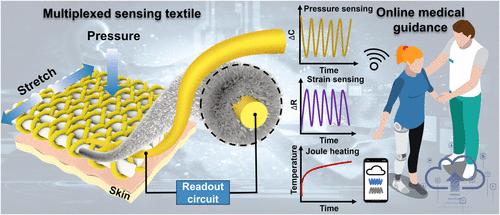
Wearable sensing textiles with multimodal mechanical stimulation detection capabilities have broad applications, such as sports guidance and rehabilitation training. However, current mainstream multimodal sensing textiles typically rely on combining discrete sensors with single functions intensively through sewing or adhesion to detect various mechanical stimuli. Herein, an all-in-one multiplexed sensing textile (MPST) capable of simultaneously detecting pressure and tensile strain is achieved by engineering an innovative hierarchical architecture of textiles. The functionality of MPST is directly derived from the reconfigurable sensing pathways of the woven meso-structures, enabling it to exhibit excellent pressure sensitivity (0.1 kPa–1), wide strain detection range (0–100%), superior durability, and desirable wearability. With the assistance of the Long Short-Term Memory (LSTM) algorithm, the MPST wearable system achieves a recognition accuracy of 97.5% in human kinematic postures of the elbow, knee, and foot. In addition, MPST demonstrates outstanding joule heating performance, which reaches 57.1 °C at a 2.5 V applied voltage. With its excellent multimodal sensing performance and joule heating ability, MPST holds great potential for applications in sports training guidance, assistive rehabilitation training, and soft robotics.
期刊介绍:
ACS Sensors is a peer-reviewed research journal that focuses on the dissemination of new and original knowledge in the field of sensor science, particularly those that selectively sense chemical or biological species or processes. The journal covers a broad range of topics, including but not limited to biosensors, chemical sensors, gas sensors, intracellular sensors, single molecule sensors, cell chips, and microfluidic devices. It aims to publish articles that address conceptual advances in sensing technology applicable to various types of analytes or application papers that report on the use of existing sensing concepts in new ways or for new analytes.



 京公网安备 11010802042870号
京ICP备2023020795号-1
京公网安备 11010802042870号
京ICP备2023020795号-1

 分享
分享
 求助内容:
求助内容: 应助结果提醒方式:
 扫码关注我们
