Junye Zhang , Linlin Wang , Yuping Liao , Chen Huang , Hangtian Zhu , Juan Wang , Linying Yuan , Tianchen Shen , Shigang Lu , Luyang Chen
{"title":"Trade-off between reversibility and fast Zn2+ kinetics: Toward ultra-stable low-temperature aqueous zinc-ion batteries","authors":"Junye Zhang , Linlin Wang , Yuping Liao , Chen Huang , Hangtian Zhu , Juan Wang , Linying Yuan , Tianchen Shen , Shigang Lu , Luyang Chen","doi":"10.1016/j.ensm.2025.104229","DOIUrl":null,"url":null,"abstract":"<div><div>Despite their environmental friendliness, security and high volumetric energy density of zinc anodes, aqueous Zinc-ion batteries (AZIBs) still face poor reversibility of Zn anodes, especially under high current density, originating from various parasitic reactions induced by high activity of water. The hydrated deep eutectic electrolyte (HDEE) effectively suppresses parasitic reactions, but the electrochemical performance still needs to be optimized. Here, our research emphasized the importance of balancing enhanced reversibility and fast Zn<sup>2+</sup> transfer kinetics. A new green and low-cost HDEE (Zn(ClO<sub>4</sub>)<sub>2</sub>·6H<sub>2</sub>O/Glycerol) is developed, and then an optimized solvation structure [Zn(H<sub>2</sub>O)<sub>2.0</sub>(Gl)<sub>1.3</sub>(ClO<sub>4</sub>)<sub>2.7</sub>]²⁺ can be formed by adding glycerol (Gl), which not only maintains a high Zn<sup>2+</sup> diffusion coefficient (1.2 × 10<sup>−7</sup> cm<sup>2</sup> s<sup>−1</sup>), but also disrupts the bulk water network via strong H-bonding with ClO₄<sup>−</sup> and water, significantly lowering the freezing point (−65 °C) and inhibiting the parasitic reactions/cathode dissolution. Furthermore, the evolution of the HDEEs solvation chemistry and its impact on the electrode/electrolyte interfacial stabilities can be understood through precise adjustments of the molar ratios of Zn(ClO<sub>4</sub>)<sub>2</sub>·6H<sub>2</sub>O and Gl, molecular dynamics and COMSOL simulation. The Zn//Zn with the HDEE (Zn|HDEE|Zn cells) can cycle for ∼5000 h without short-circuiting at 1 mA cm<sup>−2</sup>, which is roughly 12.5 times more stable than ordinary aqueous electrolyte, indicating effective suppression of parasitic reactions. The Zn//NH<sub>4</sub>V<sub>4</sub>O<sub>10</sub> with HDEE (Zn|HDEE|NH<sub>4</sub>V<sub>4</sub>O<sub>10</sub> cells) can stably cycle 3500 cycles with 120 mAh <em>g</em><sup>−1</sup> at 10 A <em>g</em><sup>−1</sup> at room temperature and 1000 cycles with 95 mAh <em>g</em><sup>−1</sup> at 5 A <em>g</em><sup>−1</sup> at a low temperature of -20 °C. This study provides a path toward the development of HDEE electrolyte and a thorough comprehension of the influence of Zn<sup>2+</sup> solvation structure on reversibility.</div></div>","PeriodicalId":306,"journal":{"name":"Energy Storage Materials","volume":"77 ","pages":"Article 104229"},"PeriodicalIF":20.2000,"publicationDate":"2025-04-01","publicationTypes":"Journal Article","fieldsOfStudy":null,"isOpenAccess":false,"openAccessPdf":"","citationCount":"0","resultStr":null,"platform":"Semanticscholar","paperid":null,"PeriodicalName":"Energy Storage Materials","FirstCategoryId":"88","ListUrlMain":"https://www.sciencedirect.com/science/article/pii/S2405829725002296","RegionNum":1,"RegionCategory":"材料科学","ArticlePicture":[],"TitleCN":null,"AbstractTextCN":null,"PMCID":null,"EPubDate":"2025/4/3 0:00:00","PubModel":"Epub","JCR":"Q1","JCRName":"CHEMISTRY, PHYSICAL","Score":null,"Total":0}
引用次数: 0
Abstract
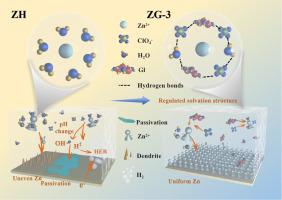
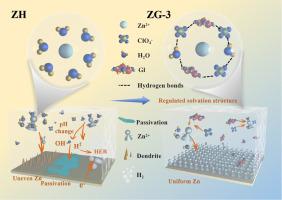
Despite their environmental friendliness, security and high volumetric energy density of zinc anodes, aqueous Zinc-ion batteries (AZIBs) still face poor reversibility of Zn anodes, especially under high current density, originating from various parasitic reactions induced by high activity of water. The hydrated deep eutectic electrolyte (HDEE) effectively suppresses parasitic reactions, but the electrochemical performance still needs to be optimized. Here, our research emphasized the importance of balancing enhanced reversibility and fast Zn2+ transfer kinetics. A new green and low-cost HDEE (Zn(ClO4)2·6H2O/Glycerol) is developed, and then an optimized solvation structure [Zn(H2O)2.0(Gl)1.3(ClO4)2.7]²⁺ can be formed by adding glycerol (Gl), which not only maintains a high Zn2+ diffusion coefficient (1.2 × 10⁻⁷ cm2 s−1), but also disrupts the bulk water network via strong H-bonding with ClO₄− and water, significantly lowering the freezing point (−65 °C) and inhibiting the parasitic reactions/cathode dissolution. Furthermore, the evolution of the HDEEs solvation chemistry and its impact on the electrode/electrolyte interfacial stabilities can be understood through precise adjustments of the molar ratios of Zn(ClO4)2·6H2O and Gl, molecular dynamics and COMSOL simulation. The Zn//Zn with the HDEE (Zn|HDEE|Zn cells) can cycle for ∼5000 h without short-circuiting at 1 mA cm−2, which is roughly 12.5 times more stable than ordinary aqueous electrolyte, indicating effective suppression of parasitic reactions. The Zn//NH4V4O10 with HDEE (Zn|HDEE|NH4V4O10 cells) can stably cycle 3500 cycles with 120 mAh g−1 at 10 A g−1 at room temperature and 1000 cycles with 95 mAh g−1 at 5 A g−1 at a low temperature of -20 °C. This study provides a path toward the development of HDEE electrolyte and a thorough comprehension of the influence of Zn2+ solvation structure on reversibility.
尽管锌阳极具有环保、安全、体积能量密度高的特点,但由于水的高活性诱导了各种寄生反应,导致锌阳极的可逆性较差,特别是在高电流密度下。水合深共晶电解质(HDEE)能有效抑制寄生反应,但其电化学性能仍有待优化。在这里,我们的研究强调了平衡增强的可逆性和快速Zn2+转移动力学的重要性。开发了一种新型的绿色低成本HDEE (Zn(ClO4)2·6H2O/Glycerol),通过添加甘油(Gl)形成优化的溶剂化结构[Zn(H2O)2.0(Gl)1.3(ClO4)2.7] 2+,不仅保持了较高的Zn2+扩散系数(1.2×10⁻⁷ cm2 s−1),而且通过与ClO₄−和水的强h键破坏了体积水网络,显著降低了凝固点(-65℃),抑制了寄生反应/阴极溶解。此外,通过精确调整Zn(ClO4)2·6H2O和Gl的摩尔比、分子动力学和COMSOL模拟,可以了解hdi溶剂化化学的演变及其对电极/电解质界面稳定性的影响。具有HDEE的Zn//Zn (Zn|HDEE|锌电池)可以在1 mA cm−2下循环约5000 h而不短路,其稳定性约为普通水电解质的12.5倍,表明有效抑制了寄生反应。具有HDEE的Zn//NH4V4O10 (Zn|HDEE|NH4V4O10电池)在室温下可稳定循环3500次,在10 A g−1下可稳定循环3500次,在-20℃低温下可稳定循环1000次,在5 A g−1下可稳定循环1000次。本研究为HDEE电解质的发展提供了一条途径,并深入了解了Zn2+溶剂化结构对可逆性的影响。
期刊介绍:
Energy Storage Materials is a global interdisciplinary journal dedicated to sharing scientific and technological advancements in materials and devices for advanced energy storage and related energy conversion, such as in metal-O2 batteries. The journal features comprehensive research articles, including full papers and short communications, as well as authoritative feature articles and reviews by leading experts in the field.
Energy Storage Materials covers a wide range of topics, including the synthesis, fabrication, structure, properties, performance, and technological applications of energy storage materials. Additionally, the journal explores strategies, policies, and developments in the field of energy storage materials and devices for sustainable energy.
Published papers are selected based on their scientific and technological significance, their ability to provide valuable new knowledge, and their relevance to the international research community.



 京公网安备 11010802042870号
京ICP备2023020795号-1
京公网安备 11010802042870号
京ICP备2023020795号-1

 分享
分享
 求助内容:
求助内容: 应助结果提醒方式:
 扫码关注我们
