Constructing a built-in electric field across an NiMo/NiMoP heterointerface for efficient and durable seawater electrolysis in anion exchange membrane electrolyzers†
Yue Xu, Shuaidong Li, Jiawen Cao, Zhongqi Ren, Yingjian He, Zeyun Cai, Chen Hou, Jingzi Zhang, Zuhuang Chen, Rongpei Shi, Samuel Jeong, Xi Lin and Kailong Hu
{"title":"Constructing a built-in electric field across an NiMo/NiMoP heterointerface for efficient and durable seawater electrolysis in anion exchange membrane electrolyzers†","authors":"Yue Xu, Shuaidong Li, Jiawen Cao, Zhongqi Ren, Yingjian He, Zeyun Cai, Chen Hou, Jingzi Zhang, Zuhuang Chen, Rongpei Shi, Samuel Jeong, Xi Lin and Kailong Hu","doi":"10.1039/D4EE05829A","DOIUrl":null,"url":null,"abstract":"<p >Seawater electrolysis is a promising route for hydrogen production using inexhaustible seawater resource. However, chloride ion (Cl<small><sup>−</sup></small>)-induced corrosion and limited catalytic activity pose challenges to the development of non-noble metal catalysts for seawater electrolysis in anion exchange membrane (AEM) electrolyzers. Herein, we fabricated an NiMo/NiMoP heterointerface to construct a strong built-in electric field (BEF) and further elucidated the impact of BEF on both electrocatalytic enhancement and corrosion resistance during seawater electrolysis. Theoretical simulations revealed that BEF benefitted the H adsorption, and simultaneously, the presence of an NiMoP layer effectively impeded Cl<small><sup>−</sup></small> adsorption owing to steric effects. The NiMo/NiMoP heterointerface with a continuous BEF (NiMo/NiMoP-C) exhibited superior activity and durability compared with its counterpart with isolated BEF (NiMo/NiMoP-I). The excellent performance of NiMo/NiMoP-C in AEM seawater electrolysis was confirmed as it exhibited a current density of 1.0 A cm<small><sup>−2</sup></small> at a cell voltage of 1.8 V and a durability for over 350 h. This study provides a novel strategy for BEF construction to achieve a highly active and corrosion-proof non-noble metal catalyst for hydrogen production through AEM seawater electrolysis.</p>","PeriodicalId":72,"journal":{"name":"Energy & Environmental Science","volume":" 10","pages":" 4811-4820"},"PeriodicalIF":30.8000,"publicationDate":"2025-04-03","publicationTypes":"Journal Article","fieldsOfStudy":null,"isOpenAccess":false,"openAccessPdf":"","citationCount":"0","resultStr":null,"platform":"Semanticscholar","paperid":null,"PeriodicalName":"Energy & Environmental Science","FirstCategoryId":"88","ListUrlMain":"https://pubs.rsc.org/en/content/articlelanding/2025/ee/d4ee05829a","RegionNum":1,"RegionCategory":"材料科学","ArticlePicture":[],"TitleCN":null,"AbstractTextCN":null,"PMCID":null,"EPubDate":"","PubModel":"","JCR":"Q1","JCRName":"CHEMISTRY, MULTIDISCIPLINARY","Score":null,"Total":0}
引用次数: 0
Abstract
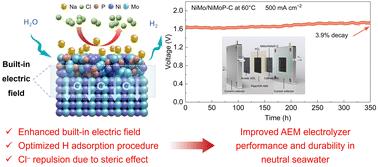
Seawater electrolysis is a promising route for hydrogen production using inexhaustible seawater resource. However, chloride ion (Cl−)-induced corrosion and limited catalytic activity pose challenges to the development of non-noble metal catalysts for seawater electrolysis in anion exchange membrane (AEM) electrolyzers. Herein, we fabricated an NiMo/NiMoP heterointerface to construct a strong built-in electric field (BEF) and further elucidated the impact of BEF on both electrocatalytic enhancement and corrosion resistance during seawater electrolysis. Theoretical simulations revealed that BEF benefitted the H adsorption, and simultaneously, the presence of an NiMoP layer effectively impeded Cl− adsorption owing to steric effects. The NiMo/NiMoP heterointerface with a continuous BEF (NiMo/NiMoP-C) exhibited superior activity and durability compared with its counterpart with isolated BEF (NiMo/NiMoP-I). The excellent performance of NiMo/NiMoP-C in AEM seawater electrolysis was confirmed as it exhibited a current density of 1.0 A cm−2 at a cell voltage of 1.8 V and a durability for over 350 h. This study provides a novel strategy for BEF construction to achieve a highly active and corrosion-proof non-noble metal catalyst for hydrogen production through AEM seawater electrolysis.
期刊介绍:
Energy & Environmental Science, a peer-reviewed scientific journal, publishes original research and review articles covering interdisciplinary topics in the (bio)chemical and (bio)physical sciences, as well as chemical engineering disciplines. Published monthly by the Royal Society of Chemistry (RSC), a not-for-profit publisher, Energy & Environmental Science is recognized as a leading journal. It boasts an impressive impact factor of 8.500 as of 2009, ranking 8th among 140 journals in the category "Chemistry, Multidisciplinary," second among 71 journals in "Energy & Fuels," second among 128 journals in "Engineering, Chemical," and first among 181 scientific journals in "Environmental Sciences."
Energy & Environmental Science publishes various types of articles, including Research Papers (original scientific work), Review Articles, Perspectives, and Minireviews (feature review-type articles of broad interest), Communications (original scientific work of an urgent nature), Opinions (personal, often speculative viewpoints or hypotheses on current topics), and Analysis Articles (in-depth examination of energy-related issues).



 京公网安备 11010802042870号
京ICP备2023020795号-1
京公网安备 11010802042870号
京ICP备2023020795号-1

 分享
分享
 求助内容:
求助内容: 应助结果提醒方式:
 扫码关注我们
