{"title":"The reaction between CO2 and chloroform in anion-functionalized ionic liquids with the formation of trichloroacetates†","authors":"Mingzhe Chen, Congyi Wu and Dezhong Yang","doi":"10.1039/D5CC00786K","DOIUrl":null,"url":null,"abstract":"<p >Here, 1,2,4-triazolide-based ionic liquids (ILs), <em>N</em>-ethyl-<em>N</em>,<em>N</em>-dimethyl-<em>N</em>-(2-methoxyethyl)ammonium 1,2,4-triazolide ([MOEN<small><sub>211</sub></small>][Triz]) and tetraethylammonium 1,2,4-triazolide ([N<small><sub>2222</sub></small>][Triz]), are used to capture CO<small><sub>2</sub></small>. The interaction results suggest that CO<small><sub>2</sub></small> reacts with the anion [Triz]<small><sup>−</sup></small> to form carbamate species. Surprisingly, when deuterated chloroform (CDCl<small><sub>3</sub></small>) or chloroform (CHCl<small><sub>3</sub></small>) is added into the absorption system at room temperature, it is found that CO<small><sub>2</sub></small> can react with not only the [Triz]<small><sup>−</sup></small> anion but also CDCl<small><sub>3</sub></small> (or CHCl<small><sub>3</sub></small>) to form carbamate and trichloroacetate species, respectively. In other words, CO<small><sub>2</sub></small> can easily react with cheap CHCl<small><sub>3</sub></small> in the presence of [Triz]-based ILs to form valuable chemical trichloroacetate under ambient conditions. Moreover, the formation of trichloroacetate can also be detected in the systems containing imidazolide ([Im]<small><sup>−</sup></small>) and pyrazolide ([Pyr]<small><sup>−</sup></small>) ILs. The findings of this work may provide another useful route for carbon capture and utilization.</p>","PeriodicalId":67,"journal":{"name":"Chemical Communications","volume":" 38","pages":" 6913-6916"},"PeriodicalIF":4.2000,"publicationDate":"2025-04-03","publicationTypes":"Journal Article","fieldsOfStudy":null,"isOpenAccess":false,"openAccessPdf":"","citationCount":"0","resultStr":null,"platform":"Semanticscholar","paperid":null,"PeriodicalName":"Chemical Communications","FirstCategoryId":"92","ListUrlMain":"https://pubs.rsc.org/en/content/articlelanding/2025/cc/d5cc00786k","RegionNum":2,"RegionCategory":"化学","ArticlePicture":[],"TitleCN":null,"AbstractTextCN":null,"PMCID":null,"EPubDate":"","PubModel":"","JCR":"Q2","JCRName":"CHEMISTRY, MULTIDISCIPLINARY","Score":null,"Total":0}
引用次数: 0
Abstract
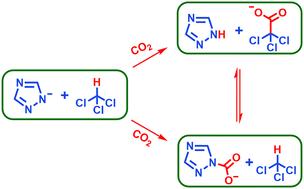
Here, 1,2,4-triazolide-based ionic liquids (ILs), N-ethyl-N,N-dimethyl-N-(2-methoxyethyl)ammonium 1,2,4-triazolide ([MOEN211][Triz]) and tetraethylammonium 1,2,4-triazolide ([N2222][Triz]), are used to capture CO2. The interaction results suggest that CO2 reacts with the anion [Triz]− to form carbamate species. Surprisingly, when deuterated chloroform (CDCl3) or chloroform (CHCl3) is added into the absorption system at room temperature, it is found that CO2 can react with not only the [Triz]− anion but also CDCl3 (or CHCl3) to form carbamate and trichloroacetate species, respectively. In other words, CO2 can easily react with cheap CHCl3 in the presence of [Triz]-based ILs to form valuable chemical trichloroacetate under ambient conditions. Moreover, the formation of trichloroacetate can also be detected in the systems containing imidazolide ([Im]−) and pyrazolide ([Pyr]−) ILs. The findings of this work may provide another useful route for carbon capture and utilization.
在这里,以1,2,4-三唑烷为基础的离子液体(ILs), n -乙基- n, n -二甲基- n -(2-甲氧基乙基)1,2,4-三唑烷铵([MOEN211][Triz])和1,2,4-三唑烷四乙基铵([N2222][Triz])被用来捕获二氧化碳。相互作用结果表明CO2与阴离子Triz -反应生成氨基甲酸酯。令人惊讶的是,当在室温下将氘化氯仿(CDCl3)或氯仿(CHCl3)加入吸收体系时,发现CO2不仅可以与[Triz] -阴离子反应,还可以与CDCl3(或CHCl3)反应,分别生成氨基甲酸酯和三氯乙酸酯。换句话说,在环境条件下,在[Triz]基il存在的情况下,CO2可以很容易地与廉价的化学物质CHCl3反应,形成有价值的化学物质三氯乙酸。此外,在含有咪唑烷([Im] -)和吡唑烷([Pyr] -) il的体系中也可以检测到三氯乙酸的形成。这项工作的发现可能为碳捕获和利用提供另一种有用的方法。
期刊介绍:
ChemComm (Chemical Communications) is renowned as the fastest publisher of articles providing information on new avenues of research, drawn from all the world''s major areas of chemical research.



 京公网安备 11010802042870号
京ICP备2023020795号-1
京公网安备 11010802042870号
京ICP备2023020795号-1

 分享
分享
 求助内容:
求助内容: 应助结果提醒方式:
 扫码关注我们
