Peng Gao , Kai Wang , Yinghang Sheng , Tong Cui , Fuli Li , Zhiquan Wang , Yingying Fu , Fei Dai , Siying Chen , Bo Li , Hongjian Guo
{"title":"Microstructure and properties of laser-cladded CoCrMoNb(TiC)x high entropy alloy coatings with various TiC contents","authors":"Peng Gao , Kai Wang , Yinghang Sheng , Tong Cui , Fuli Li , Zhiquan Wang , Yingying Fu , Fei Dai , Siying Chen , Bo Li , Hongjian Guo","doi":"10.1016/j.surfcoat.2025.132116","DOIUrl":null,"url":null,"abstract":"<div><div>In this work, CoCrMoNb(<em>TiC</em>)<sub>x</sub> high entropy alloy coatings with various TiC contents were fabricated by using the laser cladding technology. The effect of TiC content on the microstructure and mechanical properties of the coatings was investigated. The tribological properties of the CoCrMoNb(TiC)<sub>7.5%</sub> coatings were investigated in the temperature range from room temperature (RT) to 800 °C. The results showed that the CoCrMoNb(<em>TiC</em>)<sub>x</sub> coatings were mainly composed of BCC, FCC phases, and a small amount of Laves phases. The addition of TiC introduced new compounds such as Cr<sub>3</sub>C<sub>2</sub> and NbC into the coatings. As the TiC content increased, the skeletal-like structure progressively bonded and fused in the coating, resulted in a denser structure. The CoCrMoNb(TiC) 7.5 % coating exhibited the largest microhardness of 938HV<sub>0.3</sub> and best wear resistance (1.6 × 10<sup>−5</sup> mm<sup>3</sup>/Nm) at RT, which was mainly attributed to the synergistic effect of solid solution strengthening, fine grain strengthening, and dispersion strengthening by hard phases such as TiC, Cr<sub>3</sub>C<sub>2</sub> and NbC. The CoCrMoNb(TiC)<sub>7.5%</sub> coating demonstrated the best tribological property at 800 °C, primarily due to the formation of a dense enamel layer composed of Cr<sub>2</sub>O<sub>3</sub>, Co<sub>3</sub>O<sub>4</sub>, Nb<sub>2</sub>O<sub>5</sub>, and other oxides on the worn surface, which effectively reduced the friction and enhanced the anti-wear resistant of the coating.</div></div>","PeriodicalId":22009,"journal":{"name":"Surface & Coatings Technology","volume":"505 ","pages":"Article 132116"},"PeriodicalIF":6.1000,"publicationDate":"2025-06-01","publicationTypes":"Journal Article","fieldsOfStudy":null,"isOpenAccess":false,"openAccessPdf":"","citationCount":"0","resultStr":null,"platform":"Semanticscholar","paperid":null,"PeriodicalName":"Surface & Coatings Technology","FirstCategoryId":"88","ListUrlMain":"https://www.sciencedirect.com/science/article/pii/S0257897225003901","RegionNum":2,"RegionCategory":"材料科学","ArticlePicture":[],"TitleCN":null,"AbstractTextCN":null,"PMCID":null,"EPubDate":"2025/4/1 0:00:00","PubModel":"Epub","JCR":"Q1","JCRName":"MATERIALS SCIENCE, COATINGS & FILMS","Score":null,"Total":0}
引用次数: 0
Abstract
In this work, CoCrMoNb(TiC)x high entropy alloy coatings with various TiC contents were fabricated by using the laser cladding technology. The effect of TiC content on the microstructure and mechanical properties of the coatings was investigated. The tribological properties of the CoCrMoNb(TiC)7.5% coatings were investigated in the temperature range from room temperature (RT) to 800 °C. The results showed that the CoCrMoNb(TiC)x coatings were mainly composed of BCC, FCC phases, and a small amount of Laves phases. The addition of TiC introduced new compounds such as Cr3C2 and NbC into the coatings. As the TiC content increased, the skeletal-like structure progressively bonded and fused in the coating, resulted in a denser structure. The CoCrMoNb(TiC) 7.5 % coating exhibited the largest microhardness of 938HV0.3 and best wear resistance (1.6 × 10⁻⁵ mm3/Nm) at RT, which was mainly attributed to the synergistic effect of solid solution strengthening, fine grain strengthening, and dispersion strengthening by hard phases such as TiC, Cr3C2 and NbC. The CoCrMoNb(TiC)7.5% coating demonstrated the best tribological property at 800 °C, primarily due to the formation of a dense enamel layer composed of Cr2O3, Co3O4, Nb2O5, and other oxides on the worn surface, which effectively reduced the friction and enhanced the anti-wear resistant of the coating.
期刊介绍:
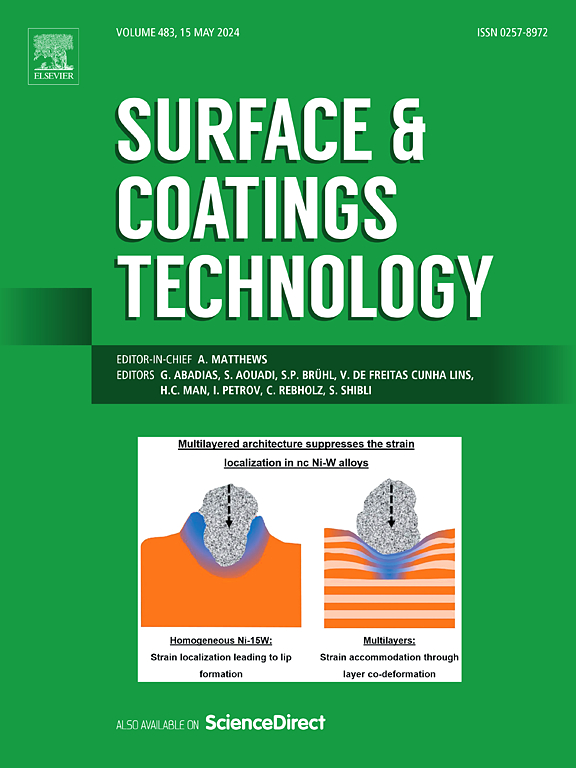
Surface and Coatings Technology is an international archival journal publishing scientific papers on significant developments in surface and interface engineering to modify and improve the surface properties of materials for protection in demanding contact conditions or aggressive environments, or for enhanced functional performance. Contributions range from original scientific articles concerned with fundamental and applied aspects of research or direct applications of metallic, inorganic, organic and composite coatings, to invited reviews of current technology in specific areas. Papers submitted to this journal are expected to be in line with the following aspects in processes, and properties/performance:
A. Processes: Physical and chemical vapour deposition techniques, thermal and plasma spraying, surface modification by directed energy techniques such as ion, electron and laser beams, thermo-chemical treatment, wet chemical and electrochemical processes such as plating, sol-gel coating, anodization, plasma electrolytic oxidation, etc., but excluding painting.
B. Properties/performance: friction performance, wear resistance (e.g., abrasion, erosion, fretting, etc), corrosion and oxidation resistance, thermal protection, diffusion resistance, hydrophilicity/hydrophobicity, and properties relevant to smart materials behaviour and enhanced multifunctional performance for environmental, energy and medical applications, but excluding device aspects.



 京公网安备 11010802042870号
京ICP备2023020795号-1
京公网安备 11010802042870号
京ICP备2023020795号-1

 分享
分享
 求助内容:
求助内容: 应助结果提醒方式:
 扫码关注我们
