Soomin Jeon , Hyun Woo Kang , Kyungwhan Min , Wooseok Lee , Hyeonjun Maeng , Chi Hoon Park , Tae-Hyun Kim
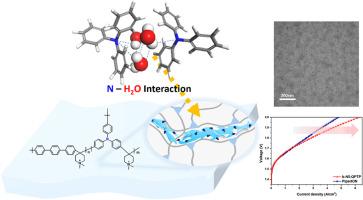
{"title":"Hyperbranched-type anion exchange membranes with electrostatic interactions for high performance anion exchange membrane water electrolysis","authors":"Soomin Jeon , Hyun Woo Kang , Kyungwhan Min , Wooseok Lee , Hyeonjun Maeng , Chi Hoon Park , Tae-Hyun Kim","doi":"10.1016/j.memsci.2025.124050","DOIUrl":null,"url":null,"abstract":"<div><div>Poly (aryl piperidinium) (PAP) has been widely employed in anion exchange membrane water electrolysis (AEMWE) because of its high ion exchange capacity and superior chemical stability. PAP-based anion exchange membranes (AEMs) equipped with hyperbranched structures have recently garnered significant attention as they contain multiple reactive sites, thus exhibiting high molecular weights and enhanced mechanical properties. Herein, hyperbranched poly (<em>p</em>-terphenyl <em>N</em>-methyl piperidinium) (QPTP) polymers using triphenylamine (b-Nm-QPTP) and triphenylmethane (b-Cm-QPTP) as hyperbranching units were fabricated and compared, notably with respect to the hyperbranching units. A linear QPTP polymer with no hyperbranched structures was also synthesized and used to fabricate a QPTP-based AEM for comparison. Both b-Nm-QPTP and b-Cm-QPTP achieved a higher viscosity (>1.4 dL/g) than the linear QPTP, and the b-Nm-QPTP- and b-Cm-QPTP-based AEMs exhibited enhanced mechanical properties (>30 MPa in terms of stress) compared to the QPTP-based AEM. Further, b-N5-QPTP, comprising 5 % triphenylamine, demonstrated the most pronounced microphase separation; this was attributed to nitrogen–water electrostatic interactions, as confirmed by molecular dynamics simulations. Thus, this membrane exhibited not only well-defined ion channels and improved ionic conductivity (157.68 mS/cm at 80 °C) but also remarkable chemical stability, with an ionic conductivity retention of over 96 % in 3 M KOH at 60 °C. Additionally, the AEMWE single-cell performance of b-N5-QPTP, 6.313 A/cm<sup>2</sup> at 2.0 V, was significantly higher than that of the commercial PiperION membrane (4.806 A/cm<sup>2</sup> at 2.0 V) and remained high (4.438 A/cm<sup>2</sup> at 2.0 V) even when non-noble metal catalysts were used, demonstrating its high feasibility for AEMWE applications.</div></div>","PeriodicalId":368,"journal":{"name":"Journal of Membrane Science","volume":"726 ","pages":"Article 124050"},"PeriodicalIF":9.0000,"publicationDate":"2025-05-01","publicationTypes":"Journal Article","fieldsOfStudy":null,"isOpenAccess":false,"openAccessPdf":"","citationCount":"0","resultStr":null,"platform":"Semanticscholar","paperid":null,"PeriodicalName":"Journal of Membrane Science","FirstCategoryId":"5","ListUrlMain":"https://www.sciencedirect.com/science/article/pii/S0376738825003631","RegionNum":1,"RegionCategory":"工程技术","ArticlePicture":[],"TitleCN":null,"AbstractTextCN":null,"PMCID":null,"EPubDate":"2025/3/31 0:00:00","PubModel":"Epub","JCR":"Q1","JCRName":"ENGINEERING, CHEMICAL","Score":null,"Total":0}
引用次数: 0
Abstract
Poly (aryl piperidinium) (PAP) has been widely employed in anion exchange membrane water electrolysis (AEMWE) because of its high ion exchange capacity and superior chemical stability. PAP-based anion exchange membranes (AEMs) equipped with hyperbranched structures have recently garnered significant attention as they contain multiple reactive sites, thus exhibiting high molecular weights and enhanced mechanical properties. Herein, hyperbranched poly (p-terphenyl N-methyl piperidinium) (QPTP) polymers using triphenylamine (b-Nm-QPTP) and triphenylmethane (b-Cm-QPTP) as hyperbranching units were fabricated and compared, notably with respect to the hyperbranching units. A linear QPTP polymer with no hyperbranched structures was also synthesized and used to fabricate a QPTP-based AEM for comparison. Both b-Nm-QPTP and b-Cm-QPTP achieved a higher viscosity (>1.4 dL/g) than the linear QPTP, and the b-Nm-QPTP- and b-Cm-QPTP-based AEMs exhibited enhanced mechanical properties (>30 MPa in terms of stress) compared to the QPTP-based AEM. Further, b-N5-QPTP, comprising 5 % triphenylamine, demonstrated the most pronounced microphase separation; this was attributed to nitrogen–water electrostatic interactions, as confirmed by molecular dynamics simulations. Thus, this membrane exhibited not only well-defined ion channels and improved ionic conductivity (157.68 mS/cm at 80 °C) but also remarkable chemical stability, with an ionic conductivity retention of over 96 % in 3 M KOH at 60 °C. Additionally, the AEMWE single-cell performance of b-N5-QPTP, 6.313 A/cm2 at 2.0 V, was significantly higher than that of the commercial PiperION membrane (4.806 A/cm2 at 2.0 V) and remained high (4.438 A/cm2 at 2.0 V) even when non-noble metal catalysts were used, demonstrating its high feasibility for AEMWE applications.
期刊介绍:
The Journal of Membrane Science is a publication that focuses on membrane systems and is aimed at academic and industrial chemists, chemical engineers, materials scientists, and membranologists. It publishes original research and reviews on various aspects of membrane transport, membrane formation/structure, fouling, module/process design, and processes/applications. The journal primarily focuses on the structure, function, and performance of non-biological membranes but also includes papers that relate to biological membranes. The Journal of Membrane Science publishes Full Text Papers, State-of-the-Art Reviews, Letters to the Editor, and Perspectives.



 京公网安备 11010802042870号
京ICP备2023020795号-1
京公网安备 11010802042870号
京ICP备2023020795号-1

 分享
分享
 求助内容:
求助内容: 应助结果提醒方式:
 扫码关注我们
