Emese Zsarnoczay , Saikiran Rapaka , U.Joseph Schoepf , Chiara Gnasso , Milan Vecsey-Nagy , Thomas M. Todoran , Muhammad Taha Hagar , Dmitrij Kravchenko , Giuseppe Tremamunno , Joseph Parkwood Griffith , Nicola Fink , Sydney Derrick , Meredith Bowman , Henry Sam , Mikayla Tiller , Kathleen Godoy , Florin Condrea , Puneet Sharma , Jim O’Doherty , Pal Maurovich-Horvat , Akos Varga-Szemes
{"title":"Accuracy of a deep neural network for automated pulmonary embolism detection on dedicated CT pulmonary angiograms","authors":"Emese Zsarnoczay , Saikiran Rapaka , U.Joseph Schoepf , Chiara Gnasso , Milan Vecsey-Nagy , Thomas M. Todoran , Muhammad Taha Hagar , Dmitrij Kravchenko , Giuseppe Tremamunno , Joseph Parkwood Griffith , Nicola Fink , Sydney Derrick , Meredith Bowman , Henry Sam , Mikayla Tiller , Kathleen Godoy , Florin Condrea , Puneet Sharma , Jim O’Doherty , Pal Maurovich-Horvat , Akos Varga-Szemes","doi":"10.1016/j.ejrad.2025.112077","DOIUrl":null,"url":null,"abstract":"<div><h3>Purpose</h3><div>To assess the performance of a Deep Neural Network (DNN)-based prototype algorithm for automated PE detection on CTPA scans.</div></div><div><h3>Methods</h3><div>Patients who had previously undergone CTPA with three different systems (SOMATOM Force, go.Top, and Definition AS; Siemens Healthineers, Forchheim, Germany) because of suspected PE from September 2022 to January 2023 were retrospectively enrolled in this study (n = 1,000, 58.8 % women). For detailed evaluation, all PE were divided into three location-based subgroups: central arteries, lobar branches, and peripheral regions. Clinical reports served as ground truth. Sensitivity, specificity, positive predictive value (PPV), negative predictive value (NPV), and accuracy were determined to evaluate the performance of DNN-based PE detection.</div></div><div><h3>Results</h3><div>Cases were excluded due to incomplete data (n = 32), inconclusive report (n = 17), insufficient contrast detected in the pulmonary trunk (n = 40), or failure of the preprocessing algorithms (n = 8). Therefore, the final cohort included 903 cases with a PE prevalence of 12 % (n = 110). The model achieved a sensitivity, specificity, PPV, and NPV of 84.6, 95.1, 70.5, and 97.8 %, respectively, and delivered an overall accuracy of 93.8 %. Among the false positive cases (n = 39), common sources of error included lung masses, pneumonia, and contrast flow artifacts. Common sources of false negatives (n = 17) included chronic and subsegmental PEs.</div></div><div><h3>Conclusion</h3><div>The proposed DNN-based algorithm provides excellent performance for the detection of PE, suggesting its potential utility to support radiologists in clinical reading and exam prioritization.</div></div>","PeriodicalId":12063,"journal":{"name":"European Journal of Radiology","volume":"187 ","pages":"Article 112077"},"PeriodicalIF":3.3000,"publicationDate":"2025-03-29","publicationTypes":"Journal Article","fieldsOfStudy":null,"isOpenAccess":false,"openAccessPdf":"","citationCount":"0","resultStr":null,"platform":"Semanticscholar","paperid":null,"PeriodicalName":"European Journal of Radiology","FirstCategoryId":"3","ListUrlMain":"https://www.sciencedirect.com/science/article/pii/S0720048X25001639","RegionNum":3,"RegionCategory":"医学","ArticlePicture":[],"TitleCN":null,"AbstractTextCN":null,"PMCID":null,"EPubDate":"","PubModel":"","JCR":"Q1","JCRName":"RADIOLOGY, NUCLEAR MEDICINE & MEDICAL IMAGING","Score":null,"Total":0}
引用次数: 0
Abstract
Purpose
To assess the performance of a Deep Neural Network (DNN)-based prototype algorithm for automated PE detection on CTPA scans.
Methods
Patients who had previously undergone CTPA with three different systems (SOMATOM Force, go.Top, and Definition AS; Siemens Healthineers, Forchheim, Germany) because of suspected PE from September 2022 to January 2023 were retrospectively enrolled in this study (n = 1,000, 58.8 % women). For detailed evaluation, all PE were divided into three location-based subgroups: central arteries, lobar branches, and peripheral regions. Clinical reports served as ground truth. Sensitivity, specificity, positive predictive value (PPV), negative predictive value (NPV), and accuracy were determined to evaluate the performance of DNN-based PE detection.
Results
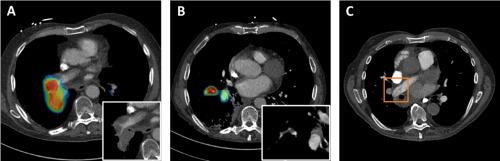
Cases were excluded due to incomplete data (n = 32), inconclusive report (n = 17), insufficient contrast detected in the pulmonary trunk (n = 40), or failure of the preprocessing algorithms (n = 8). Therefore, the final cohort included 903 cases with a PE prevalence of 12 % (n = 110). The model achieved a sensitivity, specificity, PPV, and NPV of 84.6, 95.1, 70.5, and 97.8 %, respectively, and delivered an overall accuracy of 93.8 %. Among the false positive cases (n = 39), common sources of error included lung masses, pneumonia, and contrast flow artifacts. Common sources of false negatives (n = 17) included chronic and subsegmental PEs.
Conclusion
The proposed DNN-based algorithm provides excellent performance for the detection of PE, suggesting its potential utility to support radiologists in clinical reading and exam prioritization.
期刊介绍:
European Journal of Radiology is an international journal which aims to communicate to its readers, state-of-the-art information on imaging developments in the form of high quality original research articles and timely reviews on current developments in the field.
Its audience includes clinicians at all levels of training including radiology trainees, newly qualified imaging specialists and the experienced radiologist. Its aim is to inform efficient, appropriate and evidence-based imaging practice to the benefit of patients worldwide.



 京公网安备 11010802042870号
京ICP备2023020795号-1
京公网安备 11010802042870号
京ICP备2023020795号-1

 分享
分享
 求助内容:
求助内容: 应助结果提醒方式:
 扫码关注我们
