{"title":"Time-resolved NH2 radical detection using 1.5 μm DFB laser","authors":"Daria M. Plastinina , Evgenii N. Chesnokov","doi":"10.1016/j.cplett.2025.142068","DOIUrl":null,"url":null,"abstract":"<div><div>Using a tunable DFB diode laser, 17 absorption lines of the NH<sub>2</sub> radical in the range of 6451–6474 cm<sup>−1</sup> were detected. The amidogen radical was produced by the photolysis of NH<sub>3</sub>. The frequencies and intensities of absorption lines were obtained. Using the strongest line at 6465.13 cm<sup>−1</sup>, the recombination kinetics was measured. Obtained value 2.6 × 10<sup>−12</sup> cm<sup>3</sup>/s is in the reasonable agreement with the literature data. The results will expand the capabilities of the DFB laser usage technique for studying elementary reactions that are important in the chemistry of nitrogen-containing fuel combustion.</div></div>","PeriodicalId":273,"journal":{"name":"Chemical Physics Letters","volume":"868 ","pages":"Article 142068"},"PeriodicalIF":3.1000,"publicationDate":"2025-06-01","publicationTypes":"Journal Article","fieldsOfStudy":null,"isOpenAccess":false,"openAccessPdf":"","citationCount":"0","resultStr":null,"platform":"Semanticscholar","paperid":null,"PeriodicalName":"Chemical Physics Letters","FirstCategoryId":"92","ListUrlMain":"https://www.sciencedirect.com/science/article/pii/S0009261425002088","RegionNum":3,"RegionCategory":"化学","ArticlePicture":[],"TitleCN":null,"AbstractTextCN":null,"PMCID":null,"EPubDate":"2025/3/29 0:00:00","PubModel":"Epub","JCR":"Q3","JCRName":"CHEMISTRY, PHYSICAL","Score":null,"Total":0}
引用次数: 0
Abstract
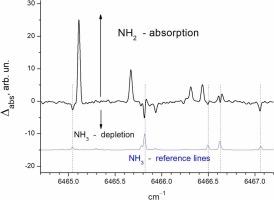
Using a tunable DFB diode laser, 17 absorption lines of the NH2 radical in the range of 6451–6474 cm−1 were detected. The amidogen radical was produced by the photolysis of NH3. The frequencies and intensities of absorption lines were obtained. Using the strongest line at 6465.13 cm−1, the recombination kinetics was measured. Obtained value 2.6 × 10⁻¹² cm3/s is in the reasonable agreement with the literature data. The results will expand the capabilities of the DFB laser usage technique for studying elementary reactions that are important in the chemistry of nitrogen-containing fuel combustion.
期刊介绍:
Chemical Physics Letters has an open access mirror journal, Chemical Physics Letters: X, sharing the same aims and scope, editorial team, submission system and rigorous peer review.
Chemical Physics Letters publishes brief reports on molecules, interfaces, condensed phases, nanomaterials and nanostructures, polymers, biomolecular systems, and energy conversion and storage.
Criteria for publication are quality, urgency and impact. Further, experimental results reported in the journal have direct relevance for theory, and theoretical developments or non-routine computations relate directly to experiment. Manuscripts must satisfy these criteria and should not be minor extensions of previous work.



 京公网安备 11010802042870号
京ICP备2023020795号-1
京公网安备 11010802042870号
京ICP备2023020795号-1

 分享
分享
 求助内容:
求助内容: 应助结果提醒方式:
 扫码关注我们
