Comprehensive investigation of activator influence on pyrolysis kinetics, thermodynamics, and product characteristics in one-step activated carbon preparation from spirulina
{"title":"Comprehensive investigation of activator influence on pyrolysis kinetics, thermodynamics, and product characteristics in one-step activated carbon preparation from spirulina","authors":"Ruihan Dong, Ziyue Tang, Yang Yang, Yingquan Chen, Xianhua Wang, Wei Cheng, Haiping Yang, Hanping Chen","doi":"10.1016/j.biortech.2025.132472","DOIUrl":null,"url":null,"abstract":"<div><div>The thermodynamics and kinetics effects of activators on the simultaneous activation pyrolysis of microalgae remain unclear. This study addresses this gap by investigating the effects of activators (KOH, KHCO<sub>3</sub>, CH<sub>3</sub>COOK, K<sub>2</sub>CO<sub>3</sub>) on Spirulina platensis (SP) pyrolysis using thermogravimetric-Fourier transform infrared spectrometer (TG-FTIR) and isoconversion methods. The results showed that all activators reduced the initial decomposition temperature of SP, leading to the earlier release of volatile pyrolysis products. Kinetics analysis further revealed that the addition of activators lowered the apparent activation energy (<em>E<sub>α</sub></em>) in the initial pyrolysis stage of SP. However, as the devolatilization process transitioned to the charring stage, the <em>E<sub>α</sub></em> gradually increased, surpassing that of SP pyrolyzed alone. Thermodynamic analysis indicated that the carbonization process of microalgae in the presence of activators required higher energy absorption. These findings reveal the mechanisms of activators in microalgae pyrolysis and provide insights into biochar production.</div></div>","PeriodicalId":258,"journal":{"name":"Bioresource Technology","volume":"428 ","pages":"Article 132472"},"PeriodicalIF":9.0000,"publicationDate":"2025-03-31","publicationTypes":"Journal Article","fieldsOfStudy":null,"isOpenAccess":false,"openAccessPdf":"","citationCount":"0","resultStr":null,"platform":"Semanticscholar","paperid":null,"PeriodicalName":"Bioresource Technology","FirstCategoryId":"5","ListUrlMain":"https://www.sciencedirect.com/science/article/pii/S0960852425004389","RegionNum":1,"RegionCategory":"环境科学与生态学","ArticlePicture":[],"TitleCN":null,"AbstractTextCN":null,"PMCID":null,"EPubDate":"","PubModel":"","JCR":"Q1","JCRName":"AGRICULTURAL ENGINEERING","Score":null,"Total":0}
引用次数: 0
Abstract
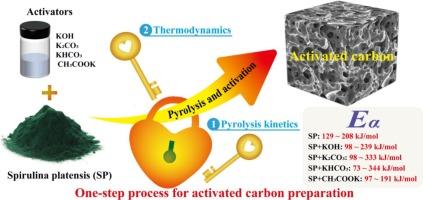
The thermodynamics and kinetics effects of activators on the simultaneous activation pyrolysis of microalgae remain unclear. This study addresses this gap by investigating the effects of activators (KOH, KHCO3, CH3COOK, K2CO3) on Spirulina platensis (SP) pyrolysis using thermogravimetric-Fourier transform infrared spectrometer (TG-FTIR) and isoconversion methods. The results showed that all activators reduced the initial decomposition temperature of SP, leading to the earlier release of volatile pyrolysis products. Kinetics analysis further revealed that the addition of activators lowered the apparent activation energy (Eα) in the initial pyrolysis stage of SP. However, as the devolatilization process transitioned to the charring stage, the Eα gradually increased, surpassing that of SP pyrolyzed alone. Thermodynamic analysis indicated that the carbonization process of microalgae in the presence of activators required higher energy absorption. These findings reveal the mechanisms of activators in microalgae pyrolysis and provide insights into biochar production.
期刊介绍:
Bioresource Technology publishes original articles, review articles, case studies, and short communications covering the fundamentals, applications, and management of bioresource technology. The journal seeks to advance and disseminate knowledge across various areas related to biomass, biological waste treatment, bioenergy, biotransformations, bioresource systems analysis, and associated conversion or production technologies.
Topics include:
• Biofuels: liquid and gaseous biofuels production, modeling and economics
• Bioprocesses and bioproducts: biocatalysis and fermentations
• Biomass and feedstocks utilization: bioconversion of agro-industrial residues
• Environmental protection: biological waste treatment
• Thermochemical conversion of biomass: combustion, pyrolysis, gasification, catalysis.



 京公网安备 11010802042870号
京ICP备2023020795号-1
京公网安备 11010802042870号
京ICP备2023020795号-1

 分享
分享
 求助内容:
求助内容: 应助结果提醒方式:
 扫码关注我们
