Haixian Guo , Hongliang Fu , Yue Lian , Jing Zhao , Huaihao Zhang
{"title":"B, N-codoped carbon skeletons with multistage pore structure for supercapacitor and capacitive deionization","authors":"Haixian Guo , Hongliang Fu , Yue Lian , Jing Zhao , Huaihao Zhang","doi":"10.1016/j.desal.2025.118862","DOIUrl":null,"url":null,"abstract":"<div><div>Due to the advantages of simple structure regulation, low cost and easy availability, asphalt-based carbon material has become a promising electrode material in supercapacitive research field. In this work, a boron-nitrogen co-doped multistage porous carbon material (BNMPC) was successfully prepared by various ways to regulate the nano-structure of asphalt-derived carbon material. From the synergistic activation of ammonium borate and potassium bicarbonate, the advanced pore structures were constructed, effectively ensuring full utilization of high specific surface area. At the same time, B and N atoms were successfully doped into the carbon lattice, which significantly improved the material's wettability and pseudocapacitance contribution. Ammonium borate (as doping and activation dual functional agent) secure the doping uniformity and stability of material properties. In addition, the B-N valence bond from B and N doping can improve the material's conductivity and ion transport kinetics, providing a strong guarantee for good supercapacitive properties. In supercapacitors (SC), BNMPC//BNMPC devices demonstrate superior performance, affording energy densities and power densities up to 8.3 Wh kg<sup>−1</sup> and 2.5 kW kg<sup>−1</sup>, respectively. As for capacitor deionization (CDI) device, its salt adsorption capacity can reach 14.8 mg g<sup>−1</sup>. In summary, the carbon materials prepared in this study show desirable capacitive properties.</div></div>","PeriodicalId":299,"journal":{"name":"Desalination","volume":"609 ","pages":"Article 118862"},"PeriodicalIF":9.8000,"publicationDate":"2025-04-02","publicationTypes":"Journal Article","fieldsOfStudy":null,"isOpenAccess":false,"openAccessPdf":"","citationCount":"0","resultStr":null,"platform":"Semanticscholar","paperid":null,"PeriodicalName":"Desalination","FirstCategoryId":"5","ListUrlMain":"https://www.sciencedirect.com/science/article/pii/S0011916425003376","RegionNum":1,"RegionCategory":"工程技术","ArticlePicture":[],"TitleCN":null,"AbstractTextCN":null,"PMCID":null,"EPubDate":"","PubModel":"","JCR":"Q1","JCRName":"ENGINEERING, CHEMICAL","Score":null,"Total":0}
引用次数: 0
Abstract
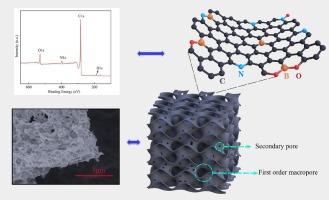
Due to the advantages of simple structure regulation, low cost and easy availability, asphalt-based carbon material has become a promising electrode material in supercapacitive research field. In this work, a boron-nitrogen co-doped multistage porous carbon material (BNMPC) was successfully prepared by various ways to regulate the nano-structure of asphalt-derived carbon material. From the synergistic activation of ammonium borate and potassium bicarbonate, the advanced pore structures were constructed, effectively ensuring full utilization of high specific surface area. At the same time, B and N atoms were successfully doped into the carbon lattice, which significantly improved the material's wettability and pseudocapacitance contribution. Ammonium borate (as doping and activation dual functional agent) secure the doping uniformity and stability of material properties. In addition, the B-N valence bond from B and N doping can improve the material's conductivity and ion transport kinetics, providing a strong guarantee for good supercapacitive properties. In supercapacitors (SC), BNMPC//BNMPC devices demonstrate superior performance, affording energy densities and power densities up to 8.3 Wh kg−1 and 2.5 kW kg−1, respectively. As for capacitor deionization (CDI) device, its salt adsorption capacity can reach 14.8 mg g−1. In summary, the carbon materials prepared in this study show desirable capacitive properties.
期刊介绍:
Desalination is a scholarly journal that focuses on the field of desalination materials, processes, and associated technologies. It encompasses a wide range of disciplines and aims to publish exceptional papers in this area.
The journal invites submissions that explicitly revolve around water desalting and its applications to various sources such as seawater, groundwater, and wastewater. It particularly encourages research on diverse desalination methods including thermal, membrane, sorption, and hybrid processes.
By providing a platform for innovative studies, Desalination aims to advance the understanding and development of desalination technologies, promoting sustainable solutions for water scarcity challenges.




 京公网安备 11010802042870号
京ICP备2023020795号-1
京公网安备 11010802042870号
京ICP备2023020795号-1

 分享
分享
 求助内容:
求助内容: 应助结果提醒方式:
 扫码关注我们
