Effect of sandblasting treatment on mechanical and electrochemical corrosion properties of SLM-formed Ti6Al4V radial gradient porous bionic bone scaffold
Tao Wen , Bibo Yao , Zhenhua Li , Meihong Liu , Yongchang Qi , Zixi Zhang , Jiping Zhu , Dingbang Wang , Zhanliang Liu
{"title":"Effect of sandblasting treatment on mechanical and electrochemical corrosion properties of SLM-formed Ti6Al4V radial gradient porous bionic bone scaffold","authors":"Tao Wen , Bibo Yao , Zhenhua Li , Meihong Liu , Yongchang Qi , Zixi Zhang , Jiping Zhu , Dingbang Wang , Zhanliang Liu","doi":"10.1016/j.matchemphys.2025.130825","DOIUrl":null,"url":null,"abstract":"<div><div>Radial gradient porous structures, which resemble human bone characteristics, are promising for use in implants. Selective laser melting (SLM) of porous biomaterials shows potential, but challenges such as unmelted powder on the surface affect material quality and dimensional accuracy. Considering the complex solution environment in the human body, corrosion resistance is crucial for implanted materials. In this study, a radial gradient porous scaffold is designed using a Gyroid unit cell structure and fabricated by SLM, followed by sandblasting. The forming accuracy, microstructure, mechanical properties, and electrochemical corrosion behavior in simulated body fluid (SBF) are investigated before and after sandblasting. Sandblasting effectively removes adhering powder, improving pore size accuracy and reducing porosity error from 1.41 %-1.69 % to 0.15 %–0.38 %. Grain size decreases, grain density increases, and unmelted voids are eliminated. However, the passivation film is damaged, reducing corrosion resistance, with a tenfold increase in corrosion current density compared to the original samples. After sandblasting, the elastic modulus increases from 7.84–8.83 GPa to 8.08–9.02 GPa, and the yield strength improves from 292.02–328.31 MPa to 300.17–336.73 MPa, enhancing the scaffold's load-bearing capacity. The SB0.8 structure exhibits the highest yield strength. The scaffold transitions from brittle fracture to a mixed fracture mode, with improved toughness and ductility after sandblasting.</div></div>","PeriodicalId":18227,"journal":{"name":"Materials Chemistry and Physics","volume":"340 ","pages":"Article 130825"},"PeriodicalIF":4.7000,"publicationDate":"2025-03-31","publicationTypes":"Journal Article","fieldsOfStudy":null,"isOpenAccess":false,"openAccessPdf":"","citationCount":"0","resultStr":null,"platform":"Semanticscholar","paperid":null,"PeriodicalName":"Materials Chemistry and Physics","FirstCategoryId":"88","ListUrlMain":"https://www.sciencedirect.com/science/article/pii/S0254058425004717","RegionNum":3,"RegionCategory":"材料科学","ArticlePicture":[],"TitleCN":null,"AbstractTextCN":null,"PMCID":null,"EPubDate":"","PubModel":"","JCR":"Q2","JCRName":"MATERIALS SCIENCE, MULTIDISCIPLINARY","Score":null,"Total":0}
引用次数: 0
Abstract
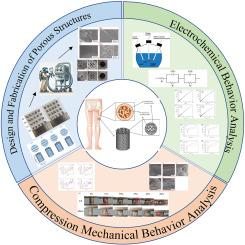
Radial gradient porous structures, which resemble human bone characteristics, are promising for use in implants. Selective laser melting (SLM) of porous biomaterials shows potential, but challenges such as unmelted powder on the surface affect material quality and dimensional accuracy. Considering the complex solution environment in the human body, corrosion resistance is crucial for implanted materials. In this study, a radial gradient porous scaffold is designed using a Gyroid unit cell structure and fabricated by SLM, followed by sandblasting. The forming accuracy, microstructure, mechanical properties, and electrochemical corrosion behavior in simulated body fluid (SBF) are investigated before and after sandblasting. Sandblasting effectively removes adhering powder, improving pore size accuracy and reducing porosity error from 1.41 %-1.69 % to 0.15 %–0.38 %. Grain size decreases, grain density increases, and unmelted voids are eliminated. However, the passivation film is damaged, reducing corrosion resistance, with a tenfold increase in corrosion current density compared to the original samples. After sandblasting, the elastic modulus increases from 7.84–8.83 GPa to 8.08–9.02 GPa, and the yield strength improves from 292.02–328.31 MPa to 300.17–336.73 MPa, enhancing the scaffold's load-bearing capacity. The SB0.8 structure exhibits the highest yield strength. The scaffold transitions from brittle fracture to a mixed fracture mode, with improved toughness and ductility after sandblasting.
期刊介绍:
Materials Chemistry and Physics is devoted to short communications, full-length research papers and feature articles on interrelationships among structure, properties, processing and performance of materials. The Editors welcome manuscripts on thin films, surface and interface science, materials degradation and reliability, metallurgy, semiconductors and optoelectronic materials, fine ceramics, magnetics, superconductors, specialty polymers, nano-materials and composite materials.



 京公网安备 11010802042870号
京ICP备2023020795号-1
京公网安备 11010802042870号
京ICP备2023020795号-1

 分享
分享
 求助内容:
求助内容: 应助结果提醒方式:
 扫码关注我们
