{"title":"Was the Lhasa Block at Low Latitudes in the Middle Permian? Insights From New Paleomagnetic and Geochronological Data","authors":"Longyun Xing, Xin Cheng, Mathew Domeier, Bitian Wei, Zhongshan Shen, Nan Jiang, Jiahui Zhang, Qinglong Chen, Shuqi Lan, Dongmeng Zhang, Yanan Zhou, Chenglong Deng, Hanning Wu","doi":"10.1029/2024GL114347","DOIUrl":null,"url":null,"abstract":"<p>The absence of reliable paleomagnetic constraints from the Lhasa Block has led to alternative interpretations of its late Paleozoic position and timing of rifting from Gondwana, reflecting uncertainties in early Neo-Tethyan paleogeography. This study presents paleomagnetic and geochronological data from the middle Permian Luobadui Formation, providing a new paleogeographic constraint on the Lhasa Block. Despite possible remagnetization, the dual-polarity magnetization, hosted in different minerals and lithologies, likely represents a middle Permian remanence. This constraint implies the Lhasa Block was located at 16.7 ± 5.3°S at 267.8 ± 5 Ma, following its rifting from Gondwana. New U-Pb detrital zircon ages from sandstones further suggest the Lhasa Block was located along the northwestern margin of Australia prior to rifting. Integrating other geological evidence, we propose that the Bangong Co-Nujiang and Yarlung-Zangbo oceans, now preserved as sutures flanking the Lhasa Block, both opened before the middle Permian, potentially representing branches of the same nascent oceanic corridor (Neo-Tethys).</p>","PeriodicalId":12523,"journal":{"name":"Geophysical Research Letters","volume":"52 7","pages":""},"PeriodicalIF":4.6000,"publicationDate":"2025-04-04","publicationTypes":"Journal Article","fieldsOfStudy":null,"isOpenAccess":false,"openAccessPdf":"https://onlinelibrary.wiley.com/doi/epdf/10.1029/2024GL114347","citationCount":"0","resultStr":null,"platform":"Semanticscholar","paperid":null,"PeriodicalName":"Geophysical Research Letters","FirstCategoryId":"89","ListUrlMain":"https://agupubs.onlinelibrary.wiley.com/doi/10.1029/2024GL114347","RegionNum":1,"RegionCategory":"地球科学","ArticlePicture":[],"TitleCN":null,"AbstractTextCN":null,"PMCID":null,"EPubDate":"","PubModel":"","JCR":"Q1","JCRName":"GEOSCIENCES, MULTIDISCIPLINARY","Score":null,"Total":0}
引用次数: 0
Abstract
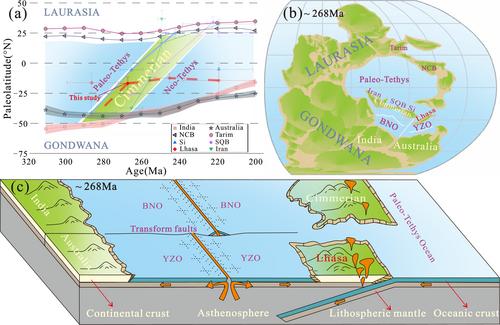
The absence of reliable paleomagnetic constraints from the Lhasa Block has led to alternative interpretations of its late Paleozoic position and timing of rifting from Gondwana, reflecting uncertainties in early Neo-Tethyan paleogeography. This study presents paleomagnetic and geochronological data from the middle Permian Luobadui Formation, providing a new paleogeographic constraint on the Lhasa Block. Despite possible remagnetization, the dual-polarity magnetization, hosted in different minerals and lithologies, likely represents a middle Permian remanence. This constraint implies the Lhasa Block was located at 16.7 ± 5.3°S at 267.8 ± 5 Ma, following its rifting from Gondwana. New U-Pb detrital zircon ages from sandstones further suggest the Lhasa Block was located along the northwestern margin of Australia prior to rifting. Integrating other geological evidence, we propose that the Bangong Co-Nujiang and Yarlung-Zangbo oceans, now preserved as sutures flanking the Lhasa Block, both opened before the middle Permian, potentially representing branches of the same nascent oceanic corridor (Neo-Tethys).
期刊介绍:
Geophysical Research Letters (GRL) publishes high-impact, innovative, and timely research on major scientific advances in all the major geoscience disciplines. Papers are communications-length articles and should have broad and immediate implications in their discipline or across the geosciences. GRLmaintains the fastest turn-around of all high-impact publications in the geosciences and works closely with authors to ensure broad visibility of top papers.





 京公网安备 11010802042870号
京ICP备2023020795号-1
京公网安备 11010802042870号
京ICP备2023020795号-1

 分享
分享
 求助内容:
求助内容: 应助结果提醒方式:
 扫码关注我们
