Harnessing Near-Infrared Light for Enhanced Solar Hydrogen Production from Escherichia coli Interfaced with Biocompatible Low-Bandgap Conjugated Polymer Nanosheets
Jie Zhou, Jun Cheng, Wan Zhang, Lei Wang, Hangxun Xu
{"title":"Harnessing Near-Infrared Light for Enhanced Solar Hydrogen Production from Escherichia coli Interfaced with Biocompatible Low-Bandgap Conjugated Polymer Nanosheets","authors":"Jie Zhou, Jun Cheng, Wan Zhang, Lei Wang, Hangxun Xu","doi":"10.1002/adma.202407805","DOIUrl":null,"url":null,"abstract":"<p>The efficient conversion of solar energy into clean hydrogen fuel presents a promising pathway for sustainable energy production. However, utilizing the full solar spectrum, particularly the near-infrared (NIR) region, remains underexplored in photosynthetic biohybrid systems. In this study, biocompatible, low-bandgap conjugated polymer nanosheets (PyTT-tBAL-HAB) are developed to integrate with non-photosynthetic, non-genetically engineered <i>Escherichia coli</i> (<i>E. coli</i>) for enhanced solar-driven biological hydrogen production. The PyTT-tBAL-HAB nanosheets exhibit unique NIR light absorption properties. Integrating these nanosheets with <i>E. coli</i> facilitates efficient electron transfer, resulting in a 1.96-fold increase in hydrogen production rate under NIR light. Consequently, this photosynthetic biohybrid system achieves a quantum efficiency of 18.36% at 940 nm. This study demonstrates the potential of using low-bandgap conjugated polymer nanosheets as advanced photosensitizers in semi-artificial photosynthetic systems, offering a robust platform for the effective utilization of the solar spectrum.</p>","PeriodicalId":114,"journal":{"name":"Advanced Materials","volume":"37 20","pages":""},"PeriodicalIF":26.8000,"publicationDate":"2025-04-03","publicationTypes":"Journal Article","fieldsOfStudy":null,"isOpenAccess":false,"openAccessPdf":"","citationCount":"0","resultStr":null,"platform":"Semanticscholar","paperid":null,"PeriodicalName":"Advanced Materials","FirstCategoryId":"88","ListUrlMain":"https://advanced.onlinelibrary.wiley.com/doi/10.1002/adma.202407805","RegionNum":1,"RegionCategory":"材料科学","ArticlePicture":[],"TitleCN":null,"AbstractTextCN":null,"PMCID":null,"EPubDate":"","PubModel":"","JCR":"Q1","JCRName":"CHEMISTRY, MULTIDISCIPLINARY","Score":null,"Total":0}
引用次数: 0
Abstract
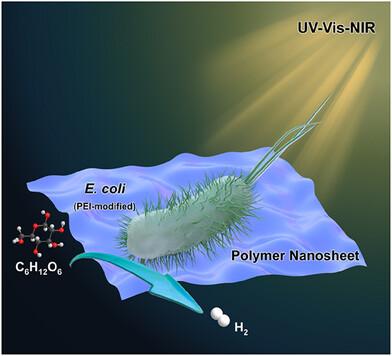
The efficient conversion of solar energy into clean hydrogen fuel presents a promising pathway for sustainable energy production. However, utilizing the full solar spectrum, particularly the near-infrared (NIR) region, remains underexplored in photosynthetic biohybrid systems. In this study, biocompatible, low-bandgap conjugated polymer nanosheets (PyTT-tBAL-HAB) are developed to integrate with non-photosynthetic, non-genetically engineered Escherichia coli (E. coli) for enhanced solar-driven biological hydrogen production. The PyTT-tBAL-HAB nanosheets exhibit unique NIR light absorption properties. Integrating these nanosheets with E. coli facilitates efficient electron transfer, resulting in a 1.96-fold increase in hydrogen production rate under NIR light. Consequently, this photosynthetic biohybrid system achieves a quantum efficiency of 18.36% at 940 nm. This study demonstrates the potential of using low-bandgap conjugated polymer nanosheets as advanced photosensitizers in semi-artificial photosynthetic systems, offering a robust platform for the effective utilization of the solar spectrum.
期刊介绍:
Advanced Materials, one of the world's most prestigious journals and the foundation of the Advanced portfolio, is the home of choice for best-in-class materials science for more than 30 years. Following this fast-growing and interdisciplinary field, we are considering and publishing the most important discoveries on any and all materials from materials scientists, chemists, physicists, engineers as well as health and life scientists and bringing you the latest results and trends in modern materials-related research every week.





 京公网安备 11010802042870号
京ICP备2023020795号-1
京公网安备 11010802042870号
京ICP备2023020795号-1

 分享
分享
 求助内容:
求助内容: 应助结果提醒方式:
 扫码关注我们
