Meher Seddik, Mohamed Mansour Bouzourraa, Halil İbrahim Ceylan, Jaouher Hamaidi, Hatem Ghouili, Hamdi Chtourou, Noomen Guelmami, Ismail Dergaa, Raul Ioan Muntean, Nizar Souissi
{"title":"The effect of time of day and menstrual cycle on physical performance and psychological responses in elite female Tunisian volleyball players.","authors":"Meher Seddik, Mohamed Mansour Bouzourraa, Halil İbrahim Ceylan, Jaouher Hamaidi, Hatem Ghouili, Hamdi Chtourou, Noomen Guelmami, Ismail Dergaa, Raul Ioan Muntean, Nizar Souissi","doi":"10.1186/s13102-025-01117-2","DOIUrl":null,"url":null,"abstract":"<p><strong>Background: </strong>The influence of circadian rhythms and menstrual cycle phases on athletic performance and psychological responses is critical for optimizing training and competition strategies for female athletes. This study aimed to investigate the effects of time of day and menstrual cycle phases on the physical performance and psychological responses of elite female Tunisian volleyball players.</p><p><strong>Methods: </strong>Thirteen elite female volleyball players were assessed during three different phases of their menstrual cycle (menstrual, follicular, and luteal) and at two different times of day (morning and evening). Physical performance was evaluated using the Modified Agility Test (MAT), Reactive Agility Test (RAT), and Repeated Sprint Ability (RSA) Test. Psychological responses were measured using the Profile of Mood States (POMS), Hooper's Questionnaire, Pittsburgh Sleep Quality Index, Epworth Sleepiness Scale, Vis-Morgen Questionnaire, and Spiegel Questionnaire.</p><p><strong>Results: </strong>Significant effects of menstrual cycle, time of day, and competition on physical performance, cognitive function, mood, and sleep parameters were found. Physical performance, including the Countermovement Jump (CMJ), the Modified Agility T-test (MAT) and the Reactive Agility test (RAT), was higher in the afternoon than in the morning across all menstrual phases (CMJ: p < 0.001, η² = 0.836; MAT: p < 0.001, η² = 0.777; RAT: p < 0.001, η² = 0.859). After the competition, performance decreased significantly, especially in the follicular and luteal phases. As measured by the Stroop test, cognitive function showed significant diurnal effects (p < 0.001, η² = 0.910), with pre-competition performance being better in the afternoon. Mood disturbances (POMS) increased after the competition, especially in the morning and during the luteal phase (p < 0.001, η² = 0.961). Sleep parameters were significantly influenced by time and menstrual cycle, with higher fatigue (Hooper score: p < 0.001, η² = 0.754) and poorer sleep quality (PSQI: p < 0.001, η² = 0.627) in the morning, especially after the competition.</p><p><strong>Conclusion: </strong>Our results suggest that aligning high-intensity training and competitions with afternoon circadian peaks may enhance physical and cognitive performance in elite female athletes. Recovery strategies and workload adjustments should account for menstrual phases, particularly reducing morning demands during the luteal phase to mitigate fatigue and mood disruptions. Integrating circadian timing with menstrual cycle monitoring offers a practical, evidence-based approach to optimize athlete readiness and resilience.</p>","PeriodicalId":48585,"journal":{"name":"BMC Sports Science Medicine and Rehabilitation","volume":"17 1","pages":"67"},"PeriodicalIF":2.8000,"publicationDate":"2025-04-02","publicationTypes":"Journal Article","fieldsOfStudy":null,"isOpenAccess":false,"openAccessPdf":"https://www.ncbi.nlm.nih.gov/pmc/articles/PMC11963659/pdf/","citationCount":"0","resultStr":null,"platform":"Semanticscholar","paperid":null,"PeriodicalName":"BMC Sports Science Medicine and Rehabilitation","FirstCategoryId":"3","ListUrlMain":"https://doi.org/10.1186/s13102-025-01117-2","RegionNum":3,"RegionCategory":"医学","ArticlePicture":[],"TitleCN":null,"AbstractTextCN":null,"PMCID":null,"EPubDate":"","PubModel":"","JCR":"Q1","JCRName":"REHABILITATION","Score":null,"Total":0}
引用次数: 0
Abstract
Background: The influence of circadian rhythms and menstrual cycle phases on athletic performance and psychological responses is critical for optimizing training and competition strategies for female athletes. This study aimed to investigate the effects of time of day and menstrual cycle phases on the physical performance and psychological responses of elite female Tunisian volleyball players.
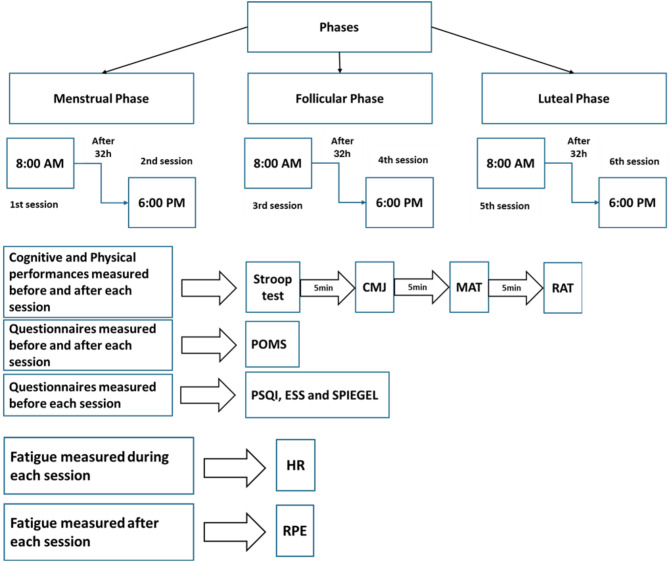
Methods: Thirteen elite female volleyball players were assessed during three different phases of their menstrual cycle (menstrual, follicular, and luteal) and at two different times of day (morning and evening). Physical performance was evaluated using the Modified Agility Test (MAT), Reactive Agility Test (RAT), and Repeated Sprint Ability (RSA) Test. Psychological responses were measured using the Profile of Mood States (POMS), Hooper's Questionnaire, Pittsburgh Sleep Quality Index, Epworth Sleepiness Scale, Vis-Morgen Questionnaire, and Spiegel Questionnaire.
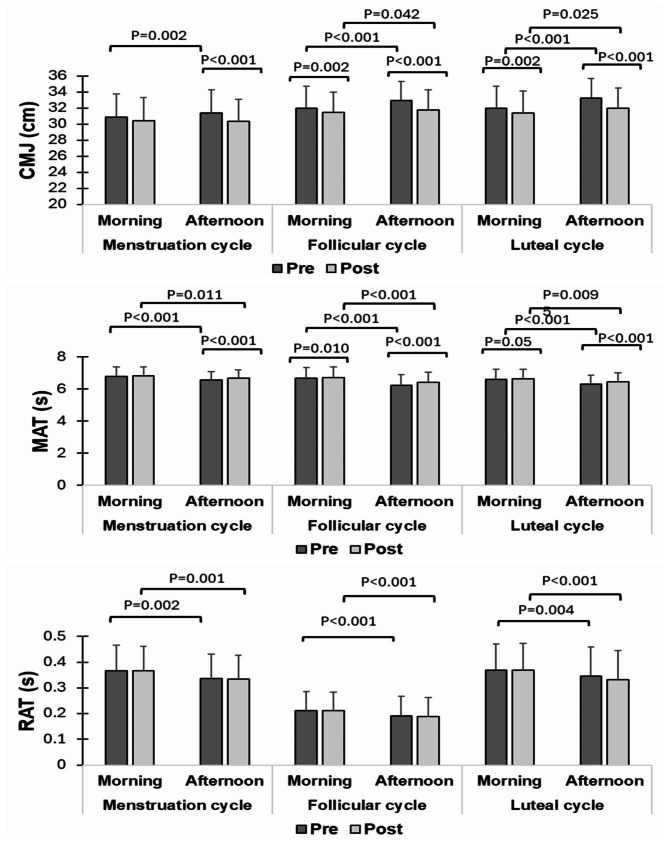
Results: Significant effects of menstrual cycle, time of day, and competition on physical performance, cognitive function, mood, and sleep parameters were found. Physical performance, including the Countermovement Jump (CMJ), the Modified Agility T-test (MAT) and the Reactive Agility test (RAT), was higher in the afternoon than in the morning across all menstrual phases (CMJ: p < 0.001, η² = 0.836; MAT: p < 0.001, η² = 0.777; RAT: p < 0.001, η² = 0.859). After the competition, performance decreased significantly, especially in the follicular and luteal phases. As measured by the Stroop test, cognitive function showed significant diurnal effects (p < 0.001, η² = 0.910), with pre-competition performance being better in the afternoon. Mood disturbances (POMS) increased after the competition, especially in the morning and during the luteal phase (p < 0.001, η² = 0.961). Sleep parameters were significantly influenced by time and menstrual cycle, with higher fatigue (Hooper score: p < 0.001, η² = 0.754) and poorer sleep quality (PSQI: p < 0.001, η² = 0.627) in the morning, especially after the competition.
Conclusion: Our results suggest that aligning high-intensity training and competitions with afternoon circadian peaks may enhance physical and cognitive performance in elite female athletes. Recovery strategies and workload adjustments should account for menstrual phases, particularly reducing morning demands during the luteal phase to mitigate fatigue and mood disruptions. Integrating circadian timing with menstrual cycle monitoring offers a practical, evidence-based approach to optimize athlete readiness and resilience.
期刊介绍:
BMC Sports Science, Medicine and Rehabilitation is an open access, peer reviewed journal that considers articles on all aspects of sports medicine and the exercise sciences, including rehabilitation, traumatology, cardiology, physiology, and nutrition.



 京公网安备 11010802042870号
京ICP备2023020795号-1
京公网安备 11010802042870号
京ICP备2023020795号-1

 分享
分享
 求助内容:
求助内容: 应助结果提醒方式:
 扫码关注我们
