{"title":"Exploited mutualism: the reciprocal effects of plant parasitic nematodes on the mechanisms underpinning plant–mutualist interactions","authors":"Krzysztof Wieczorek, Chris A. Bell","doi":"10.1111/nph.70125","DOIUrl":null,"url":null,"abstract":"<p>We are quickly gaining insights into the mechanisms and functions of plant–mutualist relationships with the common overarching aim of exploiting them to enhance food security and crop resilience. There is a growing mass of research describing various benefits of plant-mutualistic fungi, including increased nutrition, yields, and tolerance to biotic and abiotic factors. The bulk of this research has been focused on arbuscular mycorrhiza; however, there is now an expansion toward other plant mutualistic fungi. Contrary to the established ‘mycorrhizal induced resistance’ principle, increasing evidence shows that certain plant pests and pathogens may, in fact, exploit the benefits that mutualists provide their hosts, resulting in enhanced pathogenicity and reduced mutualist-derived benefits. In this Viewpoint, we propose that studying plant mutualistic fungi under controlled artificial conditions indeed provides in-depth knowledge but may mislead long-term applications as it does not accurately reflect multi-symbiont scenarios that occur <i>in natura</i>. We summarize the reciprocal impacts of plant pests, such as plant parasitic nematodes, on plant–fungal mutualisms and highlight how glasshouse experiments often yield contradictory results. We emphasize the need for collaborative efforts to increase the granularity of experimental systems, better reflecting natural environments to gain holistic insights into mutualist functions before applying them in sustainable crop protection strategies.</p>","PeriodicalId":214,"journal":{"name":"New Phytologist","volume":"246 6","pages":"2435-2439"},"PeriodicalIF":8.1000,"publicationDate":"2025-04-03","publicationTypes":"Journal Article","fieldsOfStudy":null,"isOpenAccess":false,"openAccessPdf":"https://onlinelibrary.wiley.com/doi/epdf/10.1111/nph.70125","citationCount":"0","resultStr":null,"platform":"Semanticscholar","paperid":null,"PeriodicalName":"New Phytologist","FirstCategoryId":"99","ListUrlMain":"https://nph.onlinelibrary.wiley.com/doi/10.1111/nph.70125","RegionNum":1,"RegionCategory":"生物学","ArticlePicture":[],"TitleCN":null,"AbstractTextCN":null,"PMCID":null,"EPubDate":"","PubModel":"","JCR":"Q1","JCRName":"PLANT SCIENCES","Score":null,"Total":0}
引用次数: 0
Abstract
We are quickly gaining insights into the mechanisms and functions of plant–mutualist relationships with the common overarching aim of exploiting them to enhance food security and crop resilience. There is a growing mass of research describing various benefits of plant-mutualistic fungi, including increased nutrition, yields, and tolerance to biotic and abiotic factors. The bulk of this research has been focused on arbuscular mycorrhiza; however, there is now an expansion toward other plant mutualistic fungi. Contrary to the established ‘mycorrhizal induced resistance’ principle, increasing evidence shows that certain plant pests and pathogens may, in fact, exploit the benefits that mutualists provide their hosts, resulting in enhanced pathogenicity and reduced mutualist-derived benefits. In this Viewpoint, we propose that studying plant mutualistic fungi under controlled artificial conditions indeed provides in-depth knowledge but may mislead long-term applications as it does not accurately reflect multi-symbiont scenarios that occur in natura. We summarize the reciprocal impacts of plant pests, such as plant parasitic nematodes, on plant–fungal mutualisms and highlight how glasshouse experiments often yield contradictory results. We emphasize the need for collaborative efforts to increase the granularity of experimental systems, better reflecting natural environments to gain holistic insights into mutualist functions before applying them in sustainable crop protection strategies.
期刊介绍:
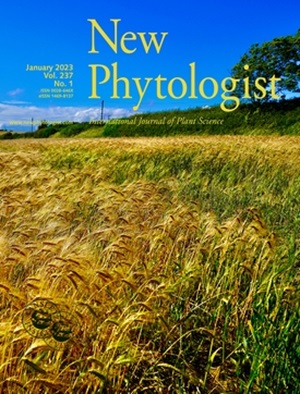
New Phytologist is an international electronic journal published 24 times a year. It is owned by the New Phytologist Foundation, a non-profit-making charitable organization dedicated to promoting plant science. The journal publishes excellent, novel, rigorous, and timely research and scholarship in plant science and its applications. The articles cover topics in five sections: Physiology & Development, Environment, Interaction, Evolution, and Transformative Plant Biotechnology. These sections encompass intracellular processes, global environmental change, and encourage cross-disciplinary approaches. The journal recognizes the use of techniques from molecular and cell biology, functional genomics, modeling, and system-based approaches in plant science. Abstracting and Indexing Information for New Phytologist includes Academic Search, AgBiotech News & Information, Agroforestry Abstracts, Biochemistry & Biophysics Citation Index, Botanical Pesticides, CAB Abstracts®, Environment Index, Global Health, and Plant Breeding Abstracts, and others.




 京公网安备 11010802042870号
京ICP备2023020795号-1
京公网安备 11010802042870号
京ICP备2023020795号-1

 分享
分享
 求助内容:
求助内容: 应助结果提醒方式:
 扫码关注我们
