James E Barrett, Chiara Maria Herzog, Sepideh Aminzadeh-Gohari, Elisa Redl, Isma Ishaq Parveen, Julia Rothärmel, Julia Tevini, Daniela D Weber, Luca Catalano, Victoria E Stefan, Thomas K Felder, Peter Obrist, Twana Alkasalias, Kristina Gemzell-Danielsson, Roland Lang, Barbara Kofler, Martin Widschwendter
{"title":"Epigenetic signatures in surrogate tissues are able to assess cancer risk and indicate the efficacy of preventive measures.","authors":"James E Barrett, Chiara Maria Herzog, Sepideh Aminzadeh-Gohari, Elisa Redl, Isma Ishaq Parveen, Julia Rothärmel, Julia Tevini, Daniela D Weber, Luca Catalano, Victoria E Stefan, Thomas K Felder, Peter Obrist, Twana Alkasalias, Kristina Gemzell-Danielsson, Roland Lang, Barbara Kofler, Martin Widschwendter","doi":"10.1038/s43856-025-00779-w","DOIUrl":null,"url":null,"abstract":"<p><strong>Background: </strong>In order to advance personalized primary cancer prevention, surrogate endpoint biomarkers in distant, easy to access tissues (i.e., field defect indicators) reflecting field cancerization in the organ at risk are essential.</p><p><strong>Methods: </strong>Here we utilized medroxyprogesterone acetate and 7,12-dimethylbenzanthracene to induce mammary gland cancers in mice. We assessed epigenetic signatures reflective of carcinogen exposure, cell-type composition, mitotic age, and methylation at progesterone receptor binding sites in both, the tissue at risk (normal mammary gland; field cancerization) and distant non-at-risk organs (cervix, oviduct, and blood; field defect indicators), in mice that did and did not develop mammary gland cancers.</p><p><strong>Results: </strong>We demonstrate that the anti-progestine mifepristone reduces the cancer risk by more than 50%. Importantly, the reduction in cancer risk is accompanied by a decline in both field cancerization and field defect indicators; specifically, epigenetic signatures in the cervix are predictive of mammary cancer formation but show tissue-specific directionality.</p><p><strong>Conclusions: </strong>These data encourage further exploration of epigenetic biomarkers in certain field defect-indicating tissues with a view to monitor the efficacy of cancer prevention strategies in humans.</p>","PeriodicalId":72646,"journal":{"name":"Communications medicine","volume":"5 1","pages":"97"},"PeriodicalIF":5.4000,"publicationDate":"2025-04-02","publicationTypes":"Journal Article","fieldsOfStudy":null,"isOpenAccess":false,"openAccessPdf":"https://www.ncbi.nlm.nih.gov/pmc/articles/PMC11965489/pdf/","citationCount":"0","resultStr":null,"platform":"Semanticscholar","paperid":null,"PeriodicalName":"Communications medicine","FirstCategoryId":"1085","ListUrlMain":"https://doi.org/10.1038/s43856-025-00779-w","RegionNum":0,"RegionCategory":null,"ArticlePicture":[],"TitleCN":null,"AbstractTextCN":null,"PMCID":null,"EPubDate":"","PubModel":"","JCR":"Q1","JCRName":"MEDICINE, RESEARCH & EXPERIMENTAL","Score":null,"Total":0}
引用次数: 0
Abstract
Background: In order to advance personalized primary cancer prevention, surrogate endpoint biomarkers in distant, easy to access tissues (i.e., field defect indicators) reflecting field cancerization in the organ at risk are essential.
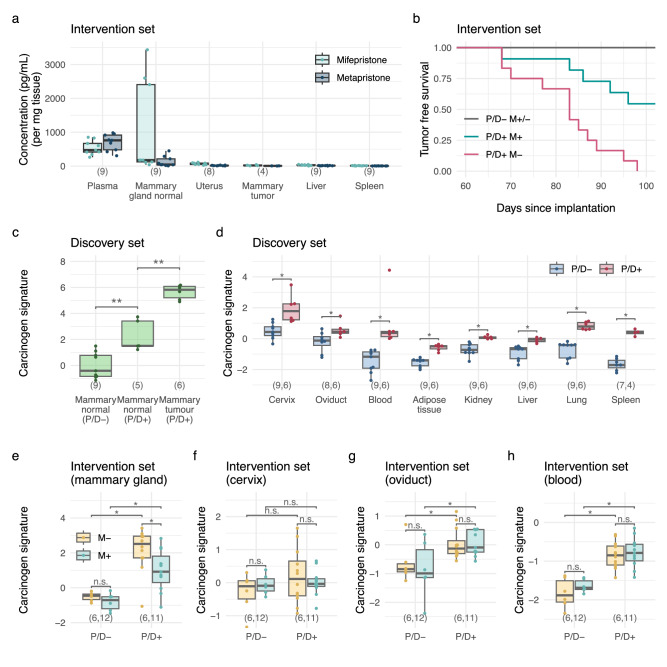
Methods: Here we utilized medroxyprogesterone acetate and 7,12-dimethylbenzanthracene to induce mammary gland cancers in mice. We assessed epigenetic signatures reflective of carcinogen exposure, cell-type composition, mitotic age, and methylation at progesterone receptor binding sites in both, the tissue at risk (normal mammary gland; field cancerization) and distant non-at-risk organs (cervix, oviduct, and blood; field defect indicators), in mice that did and did not develop mammary gland cancers.
Results: We demonstrate that the anti-progestine mifepristone reduces the cancer risk by more than 50%. Importantly, the reduction in cancer risk is accompanied by a decline in both field cancerization and field defect indicators; specifically, epigenetic signatures in the cervix are predictive of mammary cancer formation but show tissue-specific directionality.
Conclusions: These data encourage further exploration of epigenetic biomarkers in certain field defect-indicating tissues with a view to monitor the efficacy of cancer prevention strategies in humans.





 京公网安备 11010802042870号
京ICP备2023020795号-1
京公网安备 11010802042870号
京ICP备2023020795号-1

 分享
分享

 求助内容:
求助内容: 应助结果提醒方式:
 扫码关注我们
