Emma J. Barton, Cornelia Klein, Christopher M. Taylor, John Marsham, Douglas J. Parker, Ben Maybee, Zhe Feng, L. Ruby Leung
{"title":"Soil moisture gradients strengthen mesoscale convective systems by increasing wind shear","authors":"Emma J. Barton, Cornelia Klein, Christopher M. Taylor, John Marsham, Douglas J. Parker, Ben Maybee, Zhe Feng, L. Ruby Leung","doi":"10.1038/s41561-025-01666-8","DOIUrl":null,"url":null,"abstract":"Mesoscale convective systems are a class of storm linked to extensive flooding and other destructive hazards in many regions globally. In West Africa, soil moisture impacts provide a valuable source of predictability for mature storm hazards, but little is known about mature storm sensitivity to soil moisture in other climatic regions. Here we use a storm track dataset, satellite observations and reanalysis fields to investigate the response of mature storms to soil moisture in seven global storm hotspots—West Africa, India, South America, South Africa, Australia and the United States Great Plains. We demonstrate that mesoscale soil moisture gradients (~500 km) can enhance storms by driving increased vertical wind shear conditions, a crucial ingredient for storm organization, through the strengthening of atmospheric temperature gradients. This is evidenced by a 10–30% increase in precipitation feature size and rainfall for the largest storms on days with favourable soil moisture gradients compared with unfavourable gradients. Global simulations confirm that soil moisture gradients influence wind shear. The results demonstrate the importance of soil moisture feedbacks for accurate forecasting of mesoscale convective systems and future projections of extreme events under climate change. Large-scale soil moisture gradients can lead to increases in vertical wind shear that promote the growth of mesoscale convective systems and enhance rainfall, according to an analysis of global hotspots of these extreme storm systems.","PeriodicalId":19053,"journal":{"name":"Nature Geoscience","volume":"18 4","pages":"330-336"},"PeriodicalIF":16.1000,"publicationDate":"2025-04-04","publicationTypes":"Journal Article","fieldsOfStudy":null,"isOpenAccess":false,"openAccessPdf":"https://www.nature.comhttps://www.nature.com/articles/s41561-025-01666-8.pdf","citationCount":"0","resultStr":null,"platform":"Semanticscholar","paperid":null,"PeriodicalName":"Nature Geoscience","FirstCategoryId":"89","ListUrlMain":"https://www.nature.com/articles/s41561-025-01666-8","RegionNum":1,"RegionCategory":"地球科学","ArticlePicture":[],"TitleCN":null,"AbstractTextCN":null,"PMCID":null,"EPubDate":"","PubModel":"","JCR":"Q1","JCRName":"GEOSCIENCES, MULTIDISCIPLINARY","Score":null,"Total":0}
引用次数: 0
Abstract
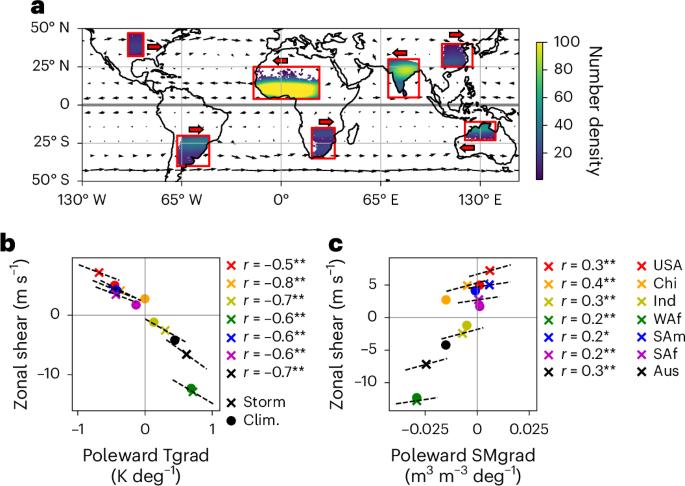
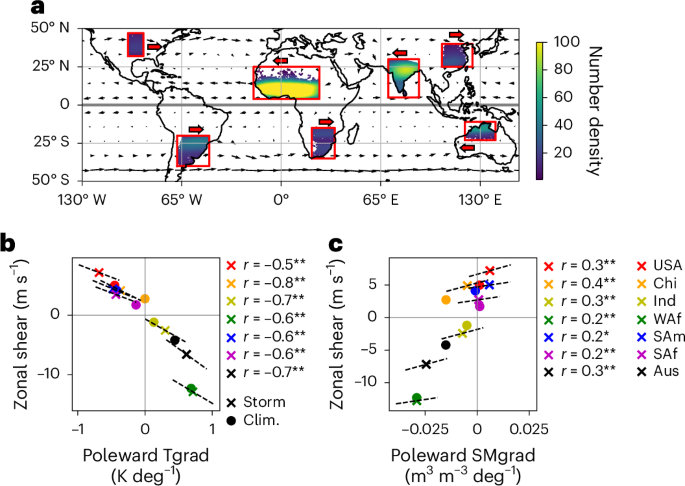
Mesoscale convective systems are a class of storm linked to extensive flooding and other destructive hazards in many regions globally. In West Africa, soil moisture impacts provide a valuable source of predictability for mature storm hazards, but little is known about mature storm sensitivity to soil moisture in other climatic regions. Here we use a storm track dataset, satellite observations and reanalysis fields to investigate the response of mature storms to soil moisture in seven global storm hotspots—West Africa, India, South America, South Africa, Australia and the United States Great Plains. We demonstrate that mesoscale soil moisture gradients (~500 km) can enhance storms by driving increased vertical wind shear conditions, a crucial ingredient for storm organization, through the strengthening of atmospheric temperature gradients. This is evidenced by a 10–30% increase in precipitation feature size and rainfall for the largest storms on days with favourable soil moisture gradients compared with unfavourable gradients. Global simulations confirm that soil moisture gradients influence wind shear. The results demonstrate the importance of soil moisture feedbacks for accurate forecasting of mesoscale convective systems and future projections of extreme events under climate change. Large-scale soil moisture gradients can lead to increases in vertical wind shear that promote the growth of mesoscale convective systems and enhance rainfall, according to an analysis of global hotspots of these extreme storm systems.
期刊介绍:
Nature Geoscience is a monthly interdisciplinary journal that gathers top-tier research spanning Earth Sciences and related fields.
The journal covers all geoscience disciplines, including fieldwork, modeling, and theoretical studies.
Topics include atmospheric science, biogeochemistry, climate science, geobiology, geochemistry, geoinformatics, remote sensing, geology, geomagnetism, paleomagnetism, geomorphology, geophysics, glaciology, hydrology, limnology, mineralogy, oceanography, paleontology, paleoclimatology, paleoceanography, petrology, planetary science, seismology, space physics, tectonics, and volcanology.
Nature Geoscience upholds its commitment to publishing significant, high-quality Earth Sciences research through fair, rapid, and rigorous peer review, overseen by a team of full-time professional editors.



 京公网安备 11010802042870号
京ICP备2023020795号-1
京公网安备 11010802042870号
京ICP备2023020795号-1

 分享
分享
 求助内容:
求助内容: 应助结果提醒方式:
 扫码关注我们
