Joshua Feis, Sebastian Weidemann, Tom Sheppard, Hannah M. Price, Alexander Szameit
{"title":"Space-time-topological events in photonic quantum walks","authors":"Joshua Feis, Sebastian Weidemann, Tom Sheppard, Hannah M. Price, Alexander Szameit","doi":"10.1038/s41566-025-01653-w","DOIUrl":null,"url":null,"abstract":"Time is, figuratively and literally, becoming the new dimension for crystalline matter. In a key recent advance, temporal and spatiotemporal crystals that exhibit periodicity in time and space-time, respectively, were reported, with unique properties such as spectra containing gaps not only in energy but also in momentum. Conversely, the field of topological physics, which has led to celebrated discoveries such as topological insulators featuring protected conducting surface states with immunity to backscattering, has so far been based on the notion of energy gaps and spatial boundaries only. Fundamentally rethinking the role of time, which in contrast to space exhibits a unique unidirectionality called the ‘arrow of time’, thus promises a new dimension for topological physics, setting paradigms of time and space-time topology based on the topological properties of momentum and energy–momentum gaps. Indeed, previous work has shown simulations of states which arise through the topology of momentum gaps and localize at temporal interfaces. Here we enter this new dimension of time and space-time topology. First, using discrete-time quantum walks on synthetic photonic lattices in coupled optical fibre loops, we observe such time topological states. We find a time-topological invariant and establish its relation to the observed time topological states. Transcending the separate concepts of space and time topology, we then propose and implement a system with an energy–momentum gap and introduce the concept of space-time topology, leading to topological states that are localized in both space and time, thus forming space-time topological events. We demonstrate that these are associated with unique effects such as causality-suppressed coupling or the limited collapse of space-time localization. Our study provides a model of time and space-time topology, highlighting an interplay of momentum and energy gap topology with applicability beyond photonics. In the field of topological physics, we anticipate a new role of causality and non-Hermiticity inspired by time and space-time topology. These concepts further invite exploration of connections to other fields where the arrow of time plays an important role. Moreover, our results enable the topological shaping of waves in space and time, with applications in spatiotemporal wave control for imaging or communication and topological lasers, for example. Combining space topology and time topology, topological states that are localized simultaneously in space and time are theoretically and experimentally demonstrated, potentially enabling the space-time topological shaping of light waves with applications in spatiotemporal wave control for imaging, communications and topological lasers.","PeriodicalId":18926,"journal":{"name":"Nature Photonics","volume":"19 5","pages":"518-525"},"PeriodicalIF":32.9000,"publicationDate":"2025-04-04","publicationTypes":"Journal Article","fieldsOfStudy":null,"isOpenAccess":false,"openAccessPdf":"https://www.nature.comhttps://www.nature.com/articles/s41566-025-01653-w.pdf","citationCount":"0","resultStr":null,"platform":"Semanticscholar","paperid":null,"PeriodicalName":"Nature Photonics","FirstCategoryId":"101","ListUrlMain":"https://www.nature.com/articles/s41566-025-01653-w","RegionNum":1,"RegionCategory":"物理与天体物理","ArticlePicture":[],"TitleCN":null,"AbstractTextCN":null,"PMCID":null,"EPubDate":"","PubModel":"","JCR":"Q1","JCRName":"OPTICS","Score":null,"Total":0}
引用次数: 0
Abstract
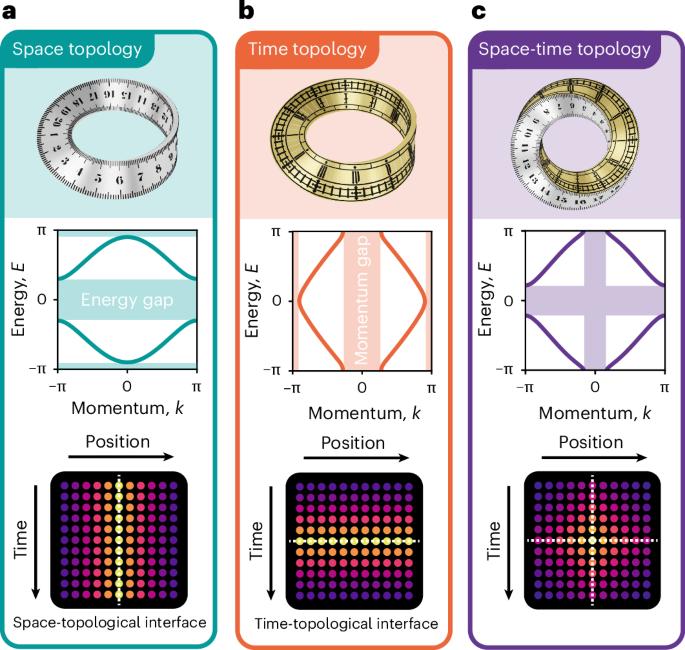
Time is, figuratively and literally, becoming the new dimension for crystalline matter. In a key recent advance, temporal and spatiotemporal crystals that exhibit periodicity in time and space-time, respectively, were reported, with unique properties such as spectra containing gaps not only in energy but also in momentum. Conversely, the field of topological physics, which has led to celebrated discoveries such as topological insulators featuring protected conducting surface states with immunity to backscattering, has so far been based on the notion of energy gaps and spatial boundaries only. Fundamentally rethinking the role of time, which in contrast to space exhibits a unique unidirectionality called the ‘arrow of time’, thus promises a new dimension for topological physics, setting paradigms of time and space-time topology based on the topological properties of momentum and energy–momentum gaps. Indeed, previous work has shown simulations of states which arise through the topology of momentum gaps and localize at temporal interfaces. Here we enter this new dimension of time and space-time topology. First, using discrete-time quantum walks on synthetic photonic lattices in coupled optical fibre loops, we observe such time topological states. We find a time-topological invariant and establish its relation to the observed time topological states. Transcending the separate concepts of space and time topology, we then propose and implement a system with an energy–momentum gap and introduce the concept of space-time topology, leading to topological states that are localized in both space and time, thus forming space-time topological events. We demonstrate that these are associated with unique effects such as causality-suppressed coupling or the limited collapse of space-time localization. Our study provides a model of time and space-time topology, highlighting an interplay of momentum and energy gap topology with applicability beyond photonics. In the field of topological physics, we anticipate a new role of causality and non-Hermiticity inspired by time and space-time topology. These concepts further invite exploration of connections to other fields where the arrow of time plays an important role. Moreover, our results enable the topological shaping of waves in space and time, with applications in spatiotemporal wave control for imaging or communication and topological lasers, for example. Combining space topology and time topology, topological states that are localized simultaneously in space and time are theoretically and experimentally demonstrated, potentially enabling the space-time topological shaping of light waves with applications in spatiotemporal wave control for imaging, communications and topological lasers.
期刊介绍:
Nature Photonics is a monthly journal dedicated to the scientific study and application of light, known as Photonics. It publishes top-quality, peer-reviewed research across all areas of light generation, manipulation, and detection.
The journal encompasses research into the fundamental properties of light and its interactions with matter, as well as the latest developments in optoelectronic devices and emerging photonics applications. Topics covered include lasers, LEDs, imaging, detectors, optoelectronic devices, quantum optics, biophotonics, optical data storage, spectroscopy, fiber optics, solar energy, displays, terahertz technology, nonlinear optics, plasmonics, nanophotonics, and X-rays.
In addition to research papers and review articles summarizing scientific findings in optoelectronics, Nature Photonics also features News and Views pieces and research highlights. It uniquely includes articles on the business aspects of the industry, such as technology commercialization and market analysis, offering a comprehensive perspective on the field.




 京公网安备 11010802042870号
京ICP备2023020795号-1
京公网安备 11010802042870号
京ICP备2023020795号-1

 分享
分享
 求助内容:
求助内容: 应助结果提醒方式:
 扫码关注我们
