{"title":"Thermoelectric and Optical Properties of HfSi2N4 and HfGe2N4: A First-Principles Investigation","authors":"Chayan Das, Abhishek, Dibyajyoti Saikia, Appala Naidu Gandi, Satyajit Sahu","doi":"10.1002/adts.202500223","DOIUrl":null,"url":null,"abstract":"<p>This study explores the thermoelectric and optoelectronic properties of HfSi₂N₄ and HfGe₂N₄ monolayers (ML) through first-principles calculations. Both materials exhibit excellent structural stability, as confirmed by phonon dispersion and ab initio molecular dynamics simulations. HfSi₂N₄ demonstrates superior power factors and higher thermal conductivity, while HfGe₂N₄ achieves a remarkable thermoelectric figure of merit (<span></span><math>\n <semantics>\n <mrow>\n <mi>Z</mi>\n <mi>T</mi>\n </mrow>\n <annotation>$ZT$</annotation>\n </semantics></math>) of 0.92 at 900 K under p-type doping, surpassing many 2D materials. The inclusion of spin-orbit coupling further enhances the thermoelectric performance, especially for HfGe₂N₄. The electronic properties reveal indirect bandgaps of 2.89 eV for HfSi₂N₄ and 2.75 eV for HfGe₂N₄, with strong optical absorption peaks in the visible range, making them suitable for optoelectronic applications. The materials exhibit high carrier mobility, with HfSi₂N₄ reaching 582 cm<sup>2</sup>V⁻¹s⁻¹ and HfGe₂N₄ achieving an impressive 1870 cm<sup>2</sup>V⁻¹s⁻¹ for holes. Thermal conductivity analysis reveals that HfGe₂N₄ has significantly lower values than HfSi₂N₄, favoring thermoelectric efficiency. The synergy of high Seebeck coefficients (<i>S</i>), tunable thermal conductivity, and optical properties makes these monolayers promising candidates for advanced thermoelectric devices and visible-light optoelectronics. This study provides a comprehensive comparison, offering valuable insights into their applicability in next-generation energy conversion and optoelectronic technologies.</p>","PeriodicalId":7219,"journal":{"name":"Advanced Theory and Simulations","volume":"8 8","pages":""},"PeriodicalIF":2.9000,"publicationDate":"2025-04-03","publicationTypes":"Journal Article","fieldsOfStudy":null,"isOpenAccess":false,"openAccessPdf":"","citationCount":"0","resultStr":null,"platform":"Semanticscholar","paperid":null,"PeriodicalName":"Advanced Theory and Simulations","FirstCategoryId":"5","ListUrlMain":"https://advanced.onlinelibrary.wiley.com/doi/10.1002/adts.202500223","RegionNum":4,"RegionCategory":"工程技术","ArticlePicture":[],"TitleCN":null,"AbstractTextCN":null,"PMCID":null,"EPubDate":"","PubModel":"","JCR":"Q1","JCRName":"MULTIDISCIPLINARY SCIENCES","Score":null,"Total":0}
引用次数: 0
Abstract
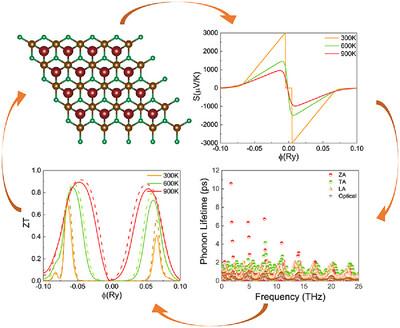
This study explores the thermoelectric and optoelectronic properties of HfSi₂N₄ and HfGe₂N₄ monolayers (ML) through first-principles calculations. Both materials exhibit excellent structural stability, as confirmed by phonon dispersion and ab initio molecular dynamics simulations. HfSi₂N₄ demonstrates superior power factors and higher thermal conductivity, while HfGe₂N₄ achieves a remarkable thermoelectric figure of merit () of 0.92 at 900 K under p-type doping, surpassing many 2D materials. The inclusion of spin-orbit coupling further enhances the thermoelectric performance, especially for HfGe₂N₄. The electronic properties reveal indirect bandgaps of 2.89 eV for HfSi₂N₄ and 2.75 eV for HfGe₂N₄, with strong optical absorption peaks in the visible range, making them suitable for optoelectronic applications. The materials exhibit high carrier mobility, with HfSi₂N₄ reaching 582 cm2V⁻¹s⁻¹ and HfGe₂N₄ achieving an impressive 1870 cm2V⁻¹s⁻¹ for holes. Thermal conductivity analysis reveals that HfGe₂N₄ has significantly lower values than HfSi₂N₄, favoring thermoelectric efficiency. The synergy of high Seebeck coefficients (S), tunable thermal conductivity, and optical properties makes these monolayers promising candidates for advanced thermoelectric devices and visible-light optoelectronics. This study provides a comprehensive comparison, offering valuable insights into their applicability in next-generation energy conversion and optoelectronic technologies.
期刊介绍:
Advanced Theory and Simulations is an interdisciplinary, international, English-language journal that publishes high-quality scientific results focusing on the development and application of theoretical methods, modeling and simulation approaches in all natural science and medicine areas, including:
materials, chemistry, condensed matter physics
engineering, energy
life science, biology, medicine
atmospheric/environmental science, climate science
planetary science, astronomy, cosmology
method development, numerical methods, statistics





 京公网安备 11010802042870号
京ICP备2023020795号-1
京公网安备 11010802042870号
京ICP备2023020795号-1

 分享
分享
 求助内容:
求助内容: 应助结果提醒方式:
 扫码关注我们
