{"title":"Target-responsive DNAzyme hydrogel reinforced by click reaction for surface enhanced Raman scattering detection of okadaic acid","authors":"Ming Wang, Lizhen Zhao, Yuling Hu, Gongke Li","doi":"10.1016/j.snb.2025.137756","DOIUrl":null,"url":null,"abstract":"<div><div>Shellfish toxins are common marine toxins that have attracted worldwide attention due to their serious threats to food safety and human health. In this work, DNA hydrogel based on rolling circle amplification (RCA) and click reaction was developed for surface enhanced Raman scattering (SERS) detection of okadaic acid (OA) combined with target-responsive DNAzyme signal amplification. The RCA strands containing azido-dCTP were combined with cross-linked strands with ethynyl groups via click reaction to form a DNA hydrogel framework. The click reaction strengthened the DNA hydrogel network, making it more rigid and easier to manipulate during the detection process. The aptamer and DNAzyme were introduced into the DNA hydrogel as functionalized DNA components. Upon the specific recognition of OA by the aptamer, the DNAzyme released via the displacement reaction would continuously cleave the enzyme cutting site within the substrate strand to liberate the SERS signal tag. The functionalized DNA hydrogel concurrently achieved the functions of target recognition, signal conversion and signal amplification. Under optimal conditions, this strategy could detect OA with limits of detection as low as 0.2 nmol/L within 30 min. The SERS signal intensity showed good linear relationship with OA concentration in the range of 1.0–300.0 nmol/L. The practical application was validated for detecting trace amounts of OA in aquatic product samples. The stable DNA hydrogel combined with target-responsive DNAzyme signal amplification offers a universal strategy for rapid detection of trace toxins in complex matrixes.</div></div>","PeriodicalId":425,"journal":{"name":"Sensors and Actuators B: Chemical","volume":"437 ","pages":"Article 137756"},"PeriodicalIF":3.7000,"publicationDate":"2025-04-03","publicationTypes":"Journal Article","fieldsOfStudy":null,"isOpenAccess":false,"openAccessPdf":"","citationCount":"0","resultStr":null,"platform":"Semanticscholar","paperid":null,"PeriodicalName":"Sensors and Actuators B: Chemical","FirstCategoryId":"92","ListUrlMain":"https://www.sciencedirect.com/science/article/pii/S0925400525005313","RegionNum":1,"RegionCategory":"化学","ArticlePicture":[],"TitleCN":null,"AbstractTextCN":null,"PMCID":null,"EPubDate":"","PubModel":"","JCR":"Q1","JCRName":"CHEMISTRY, ANALYTICAL","Score":null,"Total":0}
引用次数: 0
Abstract
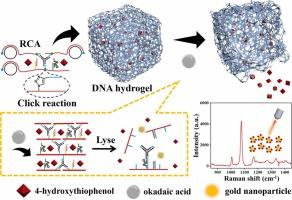
Shellfish toxins are common marine toxins that have attracted worldwide attention due to their serious threats to food safety and human health. In this work, DNA hydrogel based on rolling circle amplification (RCA) and click reaction was developed for surface enhanced Raman scattering (SERS) detection of okadaic acid (OA) combined with target-responsive DNAzyme signal amplification. The RCA strands containing azido-dCTP were combined with cross-linked strands with ethynyl groups via click reaction to form a DNA hydrogel framework. The click reaction strengthened the DNA hydrogel network, making it more rigid and easier to manipulate during the detection process. The aptamer and DNAzyme were introduced into the DNA hydrogel as functionalized DNA components. Upon the specific recognition of OA by the aptamer, the DNAzyme released via the displacement reaction would continuously cleave the enzyme cutting site within the substrate strand to liberate the SERS signal tag. The functionalized DNA hydrogel concurrently achieved the functions of target recognition, signal conversion and signal amplification. Under optimal conditions, this strategy could detect OA with limits of detection as low as 0.2 nmol/L within 30 min. The SERS signal intensity showed good linear relationship with OA concentration in the range of 1.0–300.0 nmol/L. The practical application was validated for detecting trace amounts of OA in aquatic product samples. The stable DNA hydrogel combined with target-responsive DNAzyme signal amplification offers a universal strategy for rapid detection of trace toxins in complex matrixes.
期刊介绍:
Sensors & Actuators, B: Chemical is an international journal focused on the research and development of chemical transducers. It covers chemical sensors and biosensors, chemical actuators, and analytical microsystems. The journal is interdisciplinary, aiming to publish original works showcasing substantial advancements beyond the current state of the art in these fields, with practical applicability to solving meaningful analytical problems. Review articles are accepted by invitation from an Editor of the journal.



 京公网安备 11010802042870号
京ICP备2023020795号-1
京公网安备 11010802042870号
京ICP备2023020795号-1

 分享
分享
 求助内容:
求助内容: 应助结果提醒方式:
 扫码关注我们
