Patritsia M. Stathatou, Ievgenii Petrunia, Torsten Barenthin, George Gotsis, Paul Jeffrey, Christopher Fee, Scott Bergeron, Marios Tsezos, Michael Triantafyllou, Neil Gershenfeld
{"title":"Marine Scrubbers vs Low-Sulfur Fuels: A Comprehensive Well-To-Wake Life Cycle Assessment Supported by Measurements Aboard an Ocean-Going Vessel","authors":"Patritsia M. Stathatou, Ievgenii Petrunia, Torsten Barenthin, George Gotsis, Paul Jeffrey, Christopher Fee, Scott Bergeron, Marios Tsezos, Michael Triantafyllou, Neil Gershenfeld","doi":"10.1021/acs.est.4c10006","DOIUrl":null,"url":null,"abstract":"Maritime transport significantly contributes to global emissions, prompting the International Maritime Organization to implement stricter regulations to reduce pollution. Since 2020, fuel sulfur (S) content limits have been reduced, requiring either the use of low-S fuels or the installation of marine scrubbers to continue using heavy fuel oil (HFO). While scrubbers are a widely adopted solution for reducing S emissions, their benefits are controversial and uncertainty remains regarding scrubber environmental impacts and their appropriate evaluation. Here, we systematically assess the environmental impacts of scrubbers operating on HFO to those of low-S fuels across various categories, through a measurement-informed Well-to-Wake (WtW) life cycle assessment (LCA). Gaseous and particulate matter (PM) emissions data were collected while a bulk carrier vessel was burning 3% S HFO, 0.1% S marine gas oil (MGO), and 0.5% S very low-S fuel oil (VLSFO) under similar engine operating modes during an actual ocean voyage. Seawater and washwater samples were also analyzed, alongside fuel, cylinder oil, and lubricant samples. The results suggest that, in various instances the use of HFO with a scrubber can be considered equivalent to MGO use while outperforming VLSFO use from a WtW perspective, for large, ocean-going bulk carrier vessels in open seas. These findings indicate that end-of-pipe solutions may not always be inferior to start-of-pipe alternatives, underscoring the need for comprehensive LCA studies to properly assess emission abatement technologies.","PeriodicalId":36,"journal":{"name":"环境科学与技术","volume":"23 1","pages":""},"PeriodicalIF":11.3000,"publicationDate":"2025-04-04","publicationTypes":"Journal Article","fieldsOfStudy":null,"isOpenAccess":false,"openAccessPdf":"","citationCount":"0","resultStr":null,"platform":"Semanticscholar","paperid":null,"PeriodicalName":"环境科学与技术","FirstCategoryId":"1","ListUrlMain":"https://doi.org/10.1021/acs.est.4c10006","RegionNum":1,"RegionCategory":"环境科学与生态学","ArticlePicture":[],"TitleCN":null,"AbstractTextCN":null,"PMCID":null,"EPubDate":"","PubModel":"","JCR":"Q1","JCRName":"ENGINEERING, ENVIRONMENTAL","Score":null,"Total":0}
引用次数: 0
Abstract
Maritime transport significantly contributes to global emissions, prompting the International Maritime Organization to implement stricter regulations to reduce pollution. Since 2020, fuel sulfur (S) content limits have been reduced, requiring either the use of low-S fuels or the installation of marine scrubbers to continue using heavy fuel oil (HFO). While scrubbers are a widely adopted solution for reducing S emissions, their benefits are controversial and uncertainty remains regarding scrubber environmental impacts and their appropriate evaluation. Here, we systematically assess the environmental impacts of scrubbers operating on HFO to those of low-S fuels across various categories, through a measurement-informed Well-to-Wake (WtW) life cycle assessment (LCA). Gaseous and particulate matter (PM) emissions data were collected while a bulk carrier vessel was burning 3% S HFO, 0.1% S marine gas oil (MGO), and 0.5% S very low-S fuel oil (VLSFO) under similar engine operating modes during an actual ocean voyage. Seawater and washwater samples were also analyzed, alongside fuel, cylinder oil, and lubricant samples. The results suggest that, in various instances the use of HFO with a scrubber can be considered equivalent to MGO use while outperforming VLSFO use from a WtW perspective, for large, ocean-going bulk carrier vessels in open seas. These findings indicate that end-of-pipe solutions may not always be inferior to start-of-pipe alternatives, underscoring the need for comprehensive LCA studies to properly assess emission abatement technologies.
期刊介绍:
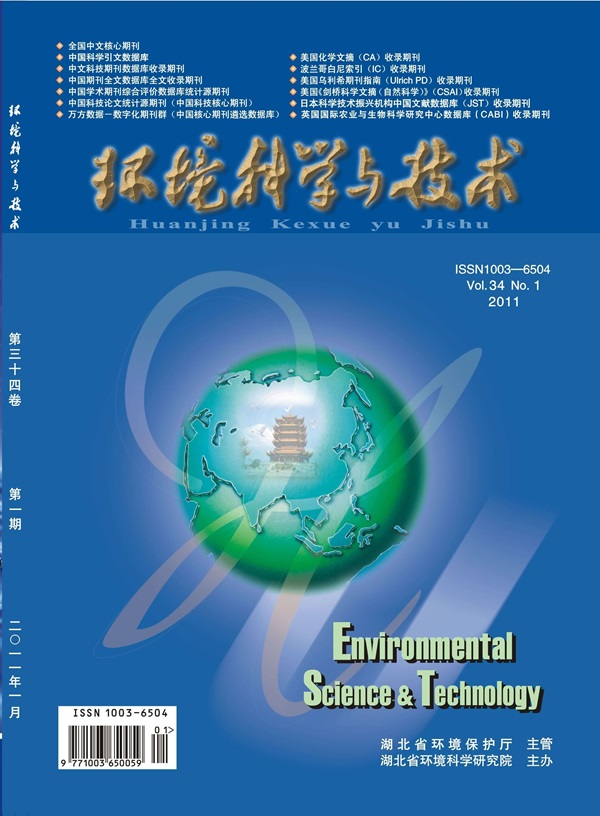
Environmental Science & Technology (ES&T) is a co-sponsored academic and technical magazine by the Hubei Provincial Environmental Protection Bureau and the Hubei Provincial Academy of Environmental Sciences.
Environmental Science & Technology (ES&T) holds the status of Chinese core journals, scientific papers source journals of China, Chinese Science Citation Database source journals, and Chinese Academic Journal Comprehensive Evaluation Database source journals. This publication focuses on the academic field of environmental protection, featuring articles related to environmental protection and technical advancements.




 京公网安备 11010802042870号
京ICP备2023020795号-1
京公网安备 11010802042870号
京ICP备2023020795号-1

 分享
分享
 求助内容:
求助内容: 应助结果提醒方式:
 扫码关注我们
