{"title":"Sulfidated zero-valent iron bimetals for passive remediation of chlorinated vapors in the subsurface","authors":"Clarissa Settimi, Daniela Zingaretti, Iason Verginelli, Renato Baciocchi","doi":"10.1016/j.envpol.2025.126202","DOIUrl":null,"url":null,"abstract":"<div><div>This study explores a novel application of sulfidated zero-valent iron (S-ZVI) bimetals for the treatment of chlorinated solvents in the vapor phase. The potential of these reactive materials was investigated through batch, column, and modeling tests. The materials were produced by disc milling of ZVI, sulfur (S), copper (Cu), and nickel (Ni) with molar ratios of 0.05 and 0.2. The reactivity of the materials was assessed through vapor degradation batch tests conducted under partially saturated conditions using trichloroethylene (TCE) as a model compound. Sulfidated materials with a 0.05 S/ZVI molar ratio were the most reactive, achieving up to 99 % degradation of TCE vapors within 18 h and first-order degradation constants of 5–5.7 d<sup>−1</sup>. Compared to the non-sulfidated materials, sulfidated ones remained reactive even after aging by exposure to air for 30 days. In all tests, C<sub>3</sub>-C<sub>6</sub> hydrocarbons were detected as main byproducts, indicating β-elimination as the dominant TCE degradation pathway, with minor dichloroethylene and vinyl chloride amounts from the hydrogenolysis pathway. To evaluate the use of sulfidated bimetals as Horizontal Permeable Reactive Barriers (HPRBs) for treating chlorinated vapors in the subsurface, TCE diffusion column tests were performed using a 5 cm thick reactive layer of S-ZVI-Ni. These tests demonstrated up to 70 % degradation over 25 days. By integrating the column test results into an analytical model, it was estimated that an 18 cm HPRB could ensure up to 99 % degradation of TCE vapors. These findings highlight the potential of S-ZVI bimetals as an effective passive mitigation system for reducing chlorinated solvent vapor emissions from the subsurface.</div></div>","PeriodicalId":311,"journal":{"name":"Environmental Pollution","volume":"374 ","pages":"Article 126202"},"PeriodicalIF":7.3000,"publicationDate":"2025-06-01","publicationTypes":"Journal Article","fieldsOfStudy":null,"isOpenAccess":false,"openAccessPdf":"","citationCount":"0","resultStr":null,"platform":"Semanticscholar","paperid":null,"PeriodicalName":"Environmental Pollution","FirstCategoryId":"93","ListUrlMain":"https://www.sciencedirect.com/science/article/pii/S0269749125005755","RegionNum":2,"RegionCategory":"环境科学与生态学","ArticlePicture":[],"TitleCN":null,"AbstractTextCN":null,"PMCID":null,"EPubDate":"2025/4/3 0:00:00","PubModel":"Epub","JCR":"Q1","JCRName":"ENVIRONMENTAL SCIENCES","Score":null,"Total":0}
引用次数: 0
Abstract
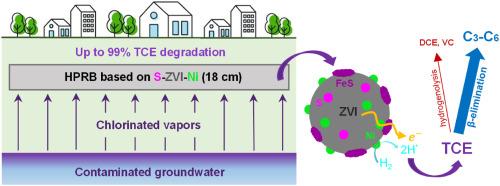
This study explores a novel application of sulfidated zero-valent iron (S-ZVI) bimetals for the treatment of chlorinated solvents in the vapor phase. The potential of these reactive materials was investigated through batch, column, and modeling tests. The materials were produced by disc milling of ZVI, sulfur (S), copper (Cu), and nickel (Ni) with molar ratios of 0.05 and 0.2. The reactivity of the materials was assessed through vapor degradation batch tests conducted under partially saturated conditions using trichloroethylene (TCE) as a model compound. Sulfidated materials with a 0.05 S/ZVI molar ratio were the most reactive, achieving up to 99 % degradation of TCE vapors within 18 h and first-order degradation constants of 5–5.7 d−1. Compared to the non-sulfidated materials, sulfidated ones remained reactive even after aging by exposure to air for 30 days. In all tests, C3-C6 hydrocarbons were detected as main byproducts, indicating β-elimination as the dominant TCE degradation pathway, with minor dichloroethylene and vinyl chloride amounts from the hydrogenolysis pathway. To evaluate the use of sulfidated bimetals as Horizontal Permeable Reactive Barriers (HPRBs) for treating chlorinated vapors in the subsurface, TCE diffusion column tests were performed using a 5 cm thick reactive layer of S-ZVI-Ni. These tests demonstrated up to 70 % degradation over 25 days. By integrating the column test results into an analytical model, it was estimated that an 18 cm HPRB could ensure up to 99 % degradation of TCE vapors. These findings highlight the potential of S-ZVI bimetals as an effective passive mitigation system for reducing chlorinated solvent vapor emissions from the subsurface.
本研究探索了硫化零价铁(S-ZVI)双金属在气相氯化溶剂处理中的新应用。通过批、柱和模型试验研究了这些反应材料的潜力。以ZVI、硫(S)、铜(Cu)和镍(Ni)为原料,摩尔比分别为0.05和0.2,采用圆盘铣削法制备材料。通过在部分饱和条件下以三氯乙烯(TCE)为模型化合物进行的蒸汽降解批次试验,评估了材料的反应性。摩尔比为0.05 S/ZVI的硫化材料反应最活跃,在18小时内对TCE蒸汽的降解率达到99%,一级降解常数为5-5.7 d-1。与未硫化材料相比,硫化材料在空气中暴露30天后仍保持活性。在所有测试中,检测到的主要副产物是C3-C6烃,表明β-消除是主要的TCE降解途径,少量的二氯乙烯和氯乙烯来自氢解途径。为了评估硫化双金属作为水平渗透反应屏障(HPRBs)处理地下氯化蒸汽的作用,使用5厘米厚的S-ZVI-Ni反应层进行了TCE扩散柱试验。这些测试表明,在25天内,降解率高达70%。通过将柱测试结果整合到分析模型中,估计18 cm HPRB可以确保高达99%的TCE蒸汽降解。这些发现突出了S-ZVI双金属作为一种有效的被动减缓系统的潜力,可以减少地下氯化溶剂蒸汽的排放。
期刊介绍:
Environmental Pollution is an international peer-reviewed journal that publishes high-quality research papers and review articles covering all aspects of environmental pollution and its impacts on ecosystems and human health.
Subject areas include, but are not limited to:
• Sources and occurrences of pollutants that are clearly defined and measured in environmental compartments, food and food-related items, and human bodies;
• Interlinks between contaminant exposure and biological, ecological, and human health effects, including those of climate change;
• Contaminants of emerging concerns (including but not limited to antibiotic resistant microorganisms or genes, microplastics/nanoplastics, electronic wastes, light, and noise) and/or their biological, ecological, or human health effects;
• Laboratory and field studies on the remediation/mitigation of environmental pollution via new techniques and with clear links to biological, ecological, or human health effects;
• Modeling of pollution processes, patterns, or trends that is of clear environmental and/or human health interest;
• New techniques that measure and examine environmental occurrences, transport, behavior, and effects of pollutants within the environment or the laboratory, provided that they can be clearly used to address problems within regional or global environmental compartments.





 京公网安备 11010802042870号
京ICP备2023020795号-1
京公网安备 11010802042870号
京ICP备2023020795号-1

 分享
分享
 求助内容:
求助内容: 应助结果提醒方式:
 扫码关注我们
