Hui Guo, Xihong He, Xiaoyu Liu, Wenfeng Li, Huidong Xie, Zuobin Tang, Liuhui Zhao, Hu Liu
{"title":"Stabilizing Ag/CuO Core/Shell Nanotriangles for Selective Hydrogenation Reaction","authors":"Hui Guo, Xihong He, Xiaoyu Liu, Wenfeng Li, Huidong Xie, Zuobin Tang, Liuhui Zhao, Hu Liu","doi":"10.1021/acs.iecr.4c04258","DOIUrl":null,"url":null,"abstract":"Designing high-performance catalysts for selective hydrogenation of nitrostyrolene compounds is challenging. Herein, we present an innovative approach to the creation of reusable CuO-based non-noble metal nanomaterials, which serve as highly efficient catalysts. We describe the use of Ag nanotriangles as a support to <i>in situ</i> grow CuO to form a unique core/shell structure, creating Ag/CuO core/shell nanotriangles catalysts. The well-defined catalyst exhibits excellent activity and selectivity toward the hydrogenation of 4-nitrostyrene to 4-aminostyrene under ambient temperature and atmospheric pressure conditions. The conversion rate and selectivity reach 99%, respectively, with a turnover frequency of 957 h<sup>–1</sup>. After five cycles of experiments, we found that the selectivity did not significantly decrease, indicating the good stability of the catalysts. <i>In situ</i> Fourier transform infrared spectroscopy confirms the preferential adsorption of Ag/CuO core/shell nanotriangles catalysts for -NO<sub>2</sub>. As there are certain oxygen vacancies on the surface of copper oxide, it has a strong adsorption capacity for the nitro group in <i>p</i>-nitrostyrene molecules. This brings the nitro group closer to the active center of the catalyst, thereby facilitating the hydrogenation reaction to occur preferentially on the nitro group. The strategy opens a new approach for designing effective catalysts to meet the requirements and applications for selective hydrogenation reaction.","PeriodicalId":39,"journal":{"name":"Industrial & Engineering Chemistry Research","volume":"34 1","pages":""},"PeriodicalIF":3.9000,"publicationDate":"2025-04-04","publicationTypes":"Journal Article","fieldsOfStudy":null,"isOpenAccess":false,"openAccessPdf":"","citationCount":"0","resultStr":null,"platform":"Semanticscholar","paperid":null,"PeriodicalName":"Industrial & Engineering Chemistry Research","FirstCategoryId":"5","ListUrlMain":"https://doi.org/10.1021/acs.iecr.4c04258","RegionNum":3,"RegionCategory":"工程技术","ArticlePicture":[],"TitleCN":null,"AbstractTextCN":null,"PMCID":null,"EPubDate":"","PubModel":"","JCR":"Q2","JCRName":"ENGINEERING, CHEMICAL","Score":null,"Total":0}
引用次数: 0
Abstract
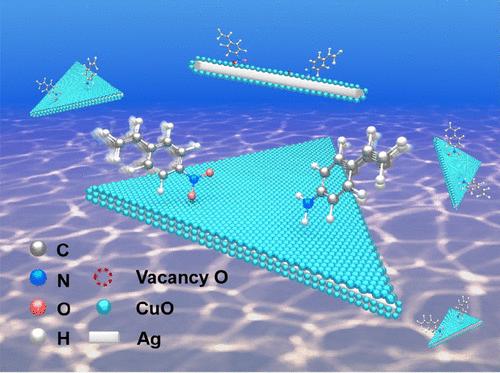
Designing high-performance catalysts for selective hydrogenation of nitrostyrolene compounds is challenging. Herein, we present an innovative approach to the creation of reusable CuO-based non-noble metal nanomaterials, which serve as highly efficient catalysts. We describe the use of Ag nanotriangles as a support to in situ grow CuO to form a unique core/shell structure, creating Ag/CuO core/shell nanotriangles catalysts. The well-defined catalyst exhibits excellent activity and selectivity toward the hydrogenation of 4-nitrostyrene to 4-aminostyrene under ambient temperature and atmospheric pressure conditions. The conversion rate and selectivity reach 99%, respectively, with a turnover frequency of 957 h–1. After five cycles of experiments, we found that the selectivity did not significantly decrease, indicating the good stability of the catalysts. In situ Fourier transform infrared spectroscopy confirms the preferential adsorption of Ag/CuO core/shell nanotriangles catalysts for -NO2. As there are certain oxygen vacancies on the surface of copper oxide, it has a strong adsorption capacity for the nitro group in p-nitrostyrene molecules. This brings the nitro group closer to the active center of the catalyst, thereby facilitating the hydrogenation reaction to occur preferentially on the nitro group. The strategy opens a new approach for designing effective catalysts to meet the requirements and applications for selective hydrogenation reaction.
期刊介绍:
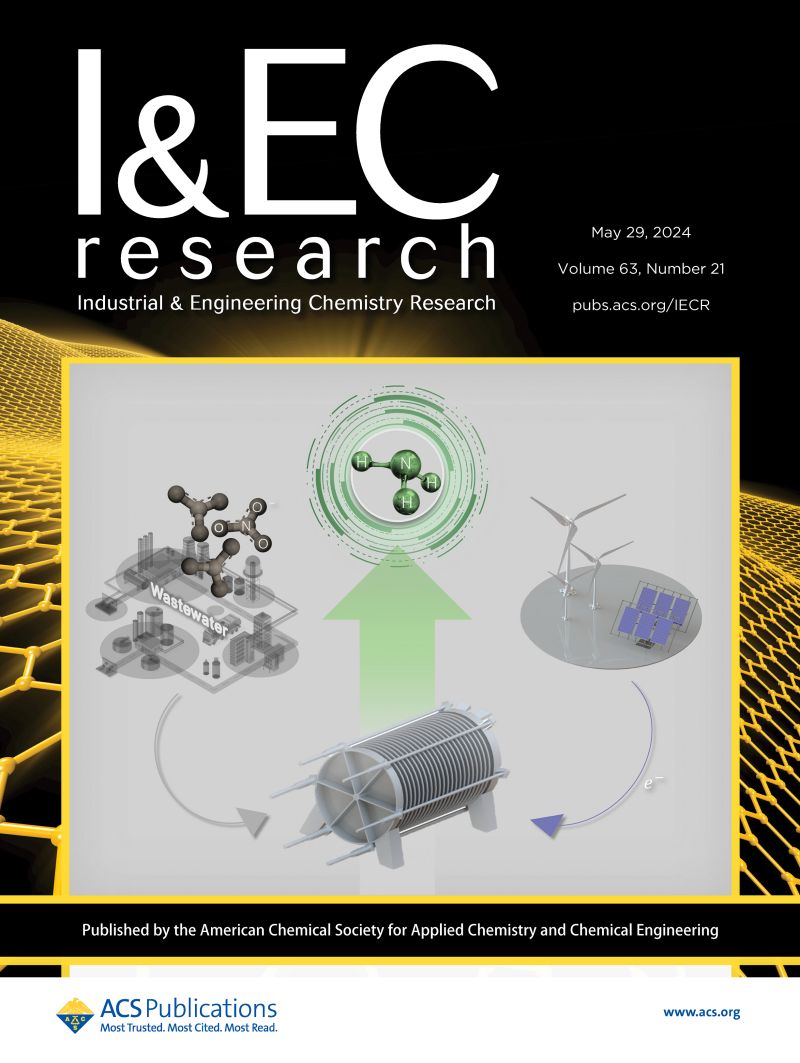
ndustrial & Engineering Chemistry, with variations in title and format, has been published since 1909 by the American Chemical Society. Industrial & Engineering Chemistry Research is a weekly publication that reports industrial and academic research in the broad fields of applied chemistry and chemical engineering with special focus on fundamentals, processes, and products.



 京公网安备 11010802042870号
京ICP备2023020795号-1
京公网安备 11010802042870号
京ICP备2023020795号-1

 分享
分享
 求助内容:
求助内容: 应助结果提醒方式:
 扫码关注我们
