Insights into the pressure-engineered structure–property relationship of organic–inorganic hybrid perovskites through high-throughput first-principles calculations†
{"title":"Insights into the pressure-engineered structure–property relationship of organic–inorganic hybrid perovskites through high-throughput first-principles calculations†","authors":"Ling-Jun He, Huan-Huan Yang and Wen-Yong Lai","doi":"10.1039/D5DT00365B","DOIUrl":null,"url":null,"abstract":"<p >Development of novel organic–inorganic hybrid perovskite materials with long-term stability and excellent optoelectronic properties is the current focus of the optoelectronic field. High pressure, as a special thermodynamic parameter, offers a promising avenue for discovering and designing materials with optimized performance. However, data-driven investigations on pressure-engineered structure–property relationships remain scarce, leading to an insufficient understanding of the physical rules by which pressure regulation influences the microstructure and electronic properties of materials. In this study, we conducted high-throughput first-principles calculations to construct a database of hundreds of cubic ABX<small><sub>3</sub></small> candidates and evaluate their property evolutions under pressures ranging from 0 to 10 GPa. Through systematic assessments of the crystallographic stabilities, thermodynamic stabilities, and electronic properties, we obtained the following findings: the B-site metal predominantly determined the crystal structure stability; the X-site halogen governed the thermodynamic stability; and the ionic radius of the A-site organic cation played a pivotal role in modulating the electronic properties. Based on extensive theoretical calculations, this study confirmed the influence of the “single-component” effect, further enriching the existing knowledge that the synergistic changes in bond length or bond angle between the B-site and X-site under pressure are the main factors affecting the material properties. The insights derived from the current analysis provide a valuable foundation for the rational design of optimized OIHP materials under pressure.</p>","PeriodicalId":71,"journal":{"name":"Dalton Transactions","volume":" 19","pages":" 7726-7733"},"PeriodicalIF":3.3000,"publicationDate":"2025-04-03","publicationTypes":"Journal Article","fieldsOfStudy":null,"isOpenAccess":false,"openAccessPdf":"","citationCount":"0","resultStr":null,"platform":"Semanticscholar","paperid":null,"PeriodicalName":"Dalton Transactions","FirstCategoryId":"92","ListUrlMain":"https://pubs.rsc.org/en/content/articlelanding/2025/dt/d5dt00365b","RegionNum":3,"RegionCategory":"化学","ArticlePicture":[],"TitleCN":null,"AbstractTextCN":null,"PMCID":null,"EPubDate":"","PubModel":"","JCR":"Q2","JCRName":"CHEMISTRY, INORGANIC & NUCLEAR","Score":null,"Total":0}
引用次数: 0
Abstract
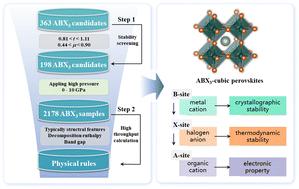
Development of novel organic–inorganic hybrid perovskite materials with long-term stability and excellent optoelectronic properties is the current focus of the optoelectronic field. High pressure, as a special thermodynamic parameter, offers a promising avenue for discovering and designing materials with optimized performance. However, data-driven investigations on pressure-engineered structure–property relationships remain scarce, leading to an insufficient understanding of the physical rules by which pressure regulation influences the microstructure and electronic properties of materials. In this study, we conducted high-throughput first-principles calculations to construct a database of hundreds of cubic ABX3 candidates and evaluate their property evolutions under pressures ranging from 0 to 10 GPa. Through systematic assessments of the crystallographic stabilities, thermodynamic stabilities, and electronic properties, we obtained the following findings: the B-site metal predominantly determined the crystal structure stability; the X-site halogen governed the thermodynamic stability; and the ionic radius of the A-site organic cation played a pivotal role in modulating the electronic properties. Based on extensive theoretical calculations, this study confirmed the influence of the “single-component” effect, further enriching the existing knowledge that the synergistic changes in bond length or bond angle between the B-site and X-site under pressure are the main factors affecting the material properties. The insights derived from the current analysis provide a valuable foundation for the rational design of optimized OIHP materials under pressure.
期刊介绍:
Dalton Transactions is a journal for all areas of inorganic chemistry, which encompasses the organometallic, bioinorganic and materials chemistry of the elements, with applications including synthesis, catalysis, energy conversion/storage, electrical devices and medicine. Dalton Transactions welcomes high-quality, original submissions in all of these areas and more, where the advancement of knowledge in inorganic chemistry is significant.




 京公网安备 11010802042870号
京ICP备2023020795号-1
京公网安备 11010802042870号
京ICP备2023020795号-1

 分享
分享
 求助内容:
求助内容: 应助结果提醒方式:
 扫码关注我们
