{"title":"Efficient Fabrication of Hollow Microspheres by Photopolymerization and Their Application in Thermal Insulation Coatings","authors":"Chijie Guo, Kaiyun Wu, Yu Chen, Kean Chen, Ren Liu, Jing Luo","doi":"10.1021/acs.iecr.4c03957","DOIUrl":null,"url":null,"abstract":"In this paper, a novel and efficient method combining photopolymerization and phase separation in emulsions has been developed for the fabrication of polymer hollow microspheres (PHMS). In this strategy, an emulsion with the oil phase containing UV-curable materials, a photoinitiator, core material (cyclohexane), and solvent was first prepared. During evaporation of solvent, UV-curable materials became phase separated with the core and migrated to the oil–water surface. By subsequent UV irradiation, UV-curable materials underwent cross-linking and converted to a polymer shell, which encapsulated cyclohexane in the core. The ultimate removal of cyclohexane led to the successful fabrication of PHMS. By adjustment of the proportion of cyclohexane and UV-curable materials, a series of PHMS with various core–shell ratios were obtained. The as-prepared PHMS showed good dispersibility in a UV-curable resin system, and the introduction of PHMS endowed the coating with outstanding thermal insulation performance and light reflection. The influence of the core–shell ratio and concentration of PHMS on the coating performance was systematically investigated. At optimum conditions, the thermal conductivity of the PHMS coating was as low as 0.051 W/m·K, and the light reflectance was as high as 62%, which were better than the pure resin coating as well as commercial hollow glass microsphere coating. In addition, in the actual thermal insulation test, the air temperature difference between the hot and cold ends of the PHMS coating reached 22 °C, almost twice that of the pure resin coating.","PeriodicalId":39,"journal":{"name":"Industrial & Engineering Chemistry Research","volume":"83 1","pages":""},"PeriodicalIF":3.9000,"publicationDate":"2025-04-04","publicationTypes":"Journal Article","fieldsOfStudy":null,"isOpenAccess":false,"openAccessPdf":"","citationCount":"0","resultStr":null,"platform":"Semanticscholar","paperid":null,"PeriodicalName":"Industrial & Engineering Chemistry Research","FirstCategoryId":"5","ListUrlMain":"https://doi.org/10.1021/acs.iecr.4c03957","RegionNum":3,"RegionCategory":"工程技术","ArticlePicture":[],"TitleCN":null,"AbstractTextCN":null,"PMCID":null,"EPubDate":"","PubModel":"","JCR":"Q2","JCRName":"ENGINEERING, CHEMICAL","Score":null,"Total":0}
引用次数: 0
Abstract
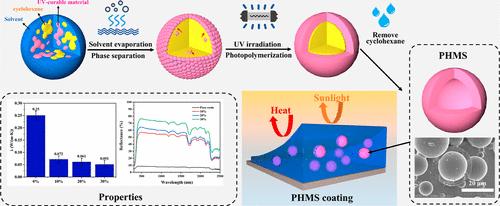
In this paper, a novel and efficient method combining photopolymerization and phase separation in emulsions has been developed for the fabrication of polymer hollow microspheres (PHMS). In this strategy, an emulsion with the oil phase containing UV-curable materials, a photoinitiator, core material (cyclohexane), and solvent was first prepared. During evaporation of solvent, UV-curable materials became phase separated with the core and migrated to the oil–water surface. By subsequent UV irradiation, UV-curable materials underwent cross-linking and converted to a polymer shell, which encapsulated cyclohexane in the core. The ultimate removal of cyclohexane led to the successful fabrication of PHMS. By adjustment of the proportion of cyclohexane and UV-curable materials, a series of PHMS with various core–shell ratios were obtained. The as-prepared PHMS showed good dispersibility in a UV-curable resin system, and the introduction of PHMS endowed the coating with outstanding thermal insulation performance and light reflection. The influence of the core–shell ratio and concentration of PHMS on the coating performance was systematically investigated. At optimum conditions, the thermal conductivity of the PHMS coating was as low as 0.051 W/m·K, and the light reflectance was as high as 62%, which were better than the pure resin coating as well as commercial hollow glass microsphere coating. In addition, in the actual thermal insulation test, the air temperature difference between the hot and cold ends of the PHMS coating reached 22 °C, almost twice that of the pure resin coating.
期刊介绍:
ndustrial & Engineering Chemistry, with variations in title and format, has been published since 1909 by the American Chemical Society. Industrial & Engineering Chemistry Research is a weekly publication that reports industrial and academic research in the broad fields of applied chemistry and chemical engineering with special focus on fundamentals, processes, and products.



 京公网安备 11010802042870号
京ICP备2023020795号-1
京公网安备 11010802042870号
京ICP备2023020795号-1

 分享
分享
 求助内容:
求助内容: 应助结果提醒方式:
 扫码关注我们
