Hyolim Jung, Hae Lin Yang, Gi-Beom Park, Ji-Min Kim and Jin-Seong Park
{"title":"Graphitization of tincone via molecular layer deposition: investigating sulfur's role and structural impacts†","authors":"Hyolim Jung, Hae Lin Yang, Gi-Beom Park, Ji-Min Kim and Jin-Seong Park","doi":"10.1039/D5DT00529A","DOIUrl":null,"url":null,"abstract":"<p >This study investigated the synthesis of sp<small><sup>2</sup></small> carbons using molecular layer deposition (MLD) with tincone, which utilized tetrakis(dimethylamido)tin (TDMASn) as the metal precursor and 4-mercaptophenol (4MP) as the organic linker. Tincone films were deposited at 100 °C without impurities and then subjected to vacuum post-annealing in a tube furnace to induce graphitization. Compositional and structural analyses revealed significant changes as the annealing temperature increased, including the breakdown of the bonds between Sn, O, S, and C. This process led to the reduction of Sn, O, and S and the formation of sp<small><sup>2</sup></small> carbons. At 400 °C, the film thickness was reduced by 57.5%, and the refractive index increased from 1.8 to 1.97, as confirmed by the emergence of G-band and 2D-band peaks in the Raman spectra. X-ray photoelectron spectroscopy analysis indicated that the residual Sn content decreased to 0.75% at 600 °C. Interestingly, at temperatures above 400 °C, unique behavior was observed: increased C–S bonding disrupted the graphite structure due to the thiol (–SH) groups in 4MP. This disruption led to a reduction in C–C bonding and a decrease in the G-band peak in the Raman spectra. This study provides the first detailed investigation of the role of S in the graphitization of tincone, highlighting its impact on sp<small><sup>2</sup></small> carbon formation and emphasizing the importance of the careful selection of precursors and linkers in MLD processes.</p>","PeriodicalId":71,"journal":{"name":"Dalton Transactions","volume":" 17","pages":" 7095-7104"},"PeriodicalIF":3.3000,"publicationDate":"2025-04-03","publicationTypes":"Journal Article","fieldsOfStudy":null,"isOpenAccess":false,"openAccessPdf":"https://pubs.rsc.org/en/content/articlepdf/2025/dt/d5dt00529a?page=search","citationCount":"0","resultStr":null,"platform":"Semanticscholar","paperid":null,"PeriodicalName":"Dalton Transactions","FirstCategoryId":"92","ListUrlMain":"https://pubs.rsc.org/en/content/articlelanding/2025/dt/d5dt00529a","RegionNum":3,"RegionCategory":"化学","ArticlePicture":[],"TitleCN":null,"AbstractTextCN":null,"PMCID":null,"EPubDate":"","PubModel":"","JCR":"Q2","JCRName":"CHEMISTRY, INORGANIC & NUCLEAR","Score":null,"Total":0}
引用次数: 0
Abstract
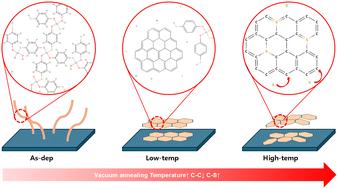
This study investigated the synthesis of sp2 carbons using molecular layer deposition (MLD) with tincone, which utilized tetrakis(dimethylamido)tin (TDMASn) as the metal precursor and 4-mercaptophenol (4MP) as the organic linker. Tincone films were deposited at 100 °C without impurities and then subjected to vacuum post-annealing in a tube furnace to induce graphitization. Compositional and structural analyses revealed significant changes as the annealing temperature increased, including the breakdown of the bonds between Sn, O, S, and C. This process led to the reduction of Sn, O, and S and the formation of sp2 carbons. At 400 °C, the film thickness was reduced by 57.5%, and the refractive index increased from 1.8 to 1.97, as confirmed by the emergence of G-band and 2D-band peaks in the Raman spectra. X-ray photoelectron spectroscopy analysis indicated that the residual Sn content decreased to 0.75% at 600 °C. Interestingly, at temperatures above 400 °C, unique behavior was observed: increased C–S bonding disrupted the graphite structure due to the thiol (–SH) groups in 4MP. This disruption led to a reduction in C–C bonding and a decrease in the G-band peak in the Raman spectra. This study provides the first detailed investigation of the role of S in the graphitization of tincone, highlighting its impact on sp2 carbon formation and emphasizing the importance of the careful selection of precursors and linkers in MLD processes.
期刊介绍:
Dalton Transactions is a journal for all areas of inorganic chemistry, which encompasses the organometallic, bioinorganic and materials chemistry of the elements, with applications including synthesis, catalysis, energy conversion/storage, electrical devices and medicine. Dalton Transactions welcomes high-quality, original submissions in all of these areas and more, where the advancement of knowledge in inorganic chemistry is significant.



 京公网安备 11010802042870号
京ICP备2023020795号-1
京公网安备 11010802042870号
京ICP备2023020795号-1

 分享
分享
 求助内容:
求助内容: 应助结果提醒方式:
 扫码关注我们
