Establishing ion transport channels in plastic crystal electrolytes via multifunctional cross-linked polymer matrices for stable and safe lithium metal batteries
Jingze Chen , Anjun Hu , Kai Chen , Yuanjun Xia , Wang Xu , Kun Li , Borui Yang , Ting Li , Ruizhe Xu , Zhen Wang , Baihai Li , Fei Li , Jianping Long
{"title":"Establishing ion transport channels in plastic crystal electrolytes via multifunctional cross-linked polymer matrices for stable and safe lithium metal batteries","authors":"Jingze Chen , Anjun Hu , Kai Chen , Yuanjun Xia , Wang Xu , Kun Li , Borui Yang , Ting Li , Ruizhe Xu , Zhen Wang , Baihai Li , Fei Li , Jianping Long","doi":"10.1016/j.nanoen.2025.110959","DOIUrl":null,"url":null,"abstract":"<div><div>Despite the excellent ionic conductivity and thermal stability of succinonitrile (SN)-based plastic crystalline electrolytes (SPCEs), their reduction stability is suboptimal, causing undesirable interfacial side reactions. Incorporating a polymer matrix addresses these issues but limits polymer chain mobility, thereby reducing the actual ionic conductivity below expectations. To overcome these challenges, we propose a multifunctional in situ crosslinked polymer matrix (polymeric tris(2-acryloyloxyethyl) isocyanurate, PIATE) to modulating ion transport properties of SPCE. This modification enhances mutual solubility, suppresses SN crystallization, and establishes a rapid ion transport pathway (polymer···[SN···Li<sup>+</sup>]), significantly boosting ionic conductivity. PIATE-modified SPCE also features finely tuned energy levels and concentrated coordination structures, broadening the electrochemical window and forming stable Li<sub>3</sub>N-rich solid electrolyte interphases. Moreover, the isocyanuric acid groups in PIATE release non-flammable gases like nitrogen and water vapor upon thermal decomposition, enhancing fire safety. Consequently, the modified SPCE exhibits improved room temperature ionic conductivity (1.6 mS cm<sup>−1</sup>), high lithium-ion transference number (0.72), and extended electrochemical window (5.2 V). Electrochemical tests show enhanced stability in Li symmetric, Li||LiFePO<sub>4</sub>, and Li||LiCoO<sub>2</sub> cells (up to 4.6 V). The high thermal stability and safety have been further demonstrated in the Li||NCM811 pouch cells, highlighting its potential for practical applications in lithium metal batteries.</div></div>","PeriodicalId":394,"journal":{"name":"Nano Energy","volume":"139 ","pages":"Article 110959"},"PeriodicalIF":17.1000,"publicationDate":"2025-04-04","publicationTypes":"Journal Article","fieldsOfStudy":null,"isOpenAccess":false,"openAccessPdf":"","citationCount":"0","resultStr":null,"platform":"Semanticscholar","paperid":null,"PeriodicalName":"Nano Energy","FirstCategoryId":"88","ListUrlMain":"https://www.sciencedirect.com/science/article/pii/S2211285525003180","RegionNum":1,"RegionCategory":"材料科学","ArticlePicture":[],"TitleCN":null,"AbstractTextCN":null,"PMCID":null,"EPubDate":"","PubModel":"","JCR":"Q1","JCRName":"CHEMISTRY, PHYSICAL","Score":null,"Total":0}
引用次数: 0
Abstract
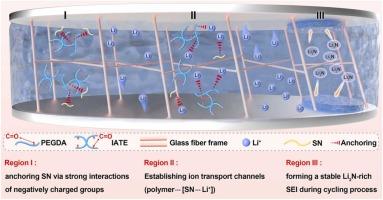
Despite the excellent ionic conductivity and thermal stability of succinonitrile (SN)-based plastic crystalline electrolytes (SPCEs), their reduction stability is suboptimal, causing undesirable interfacial side reactions. Incorporating a polymer matrix addresses these issues but limits polymer chain mobility, thereby reducing the actual ionic conductivity below expectations. To overcome these challenges, we propose a multifunctional in situ crosslinked polymer matrix (polymeric tris(2-acryloyloxyethyl) isocyanurate, PIATE) to modulating ion transport properties of SPCE. This modification enhances mutual solubility, suppresses SN crystallization, and establishes a rapid ion transport pathway (polymer···[SN···Li+]), significantly boosting ionic conductivity. PIATE-modified SPCE also features finely tuned energy levels and concentrated coordination structures, broadening the electrochemical window and forming stable Li3N-rich solid electrolyte interphases. Moreover, the isocyanuric acid groups in PIATE release non-flammable gases like nitrogen and water vapor upon thermal decomposition, enhancing fire safety. Consequently, the modified SPCE exhibits improved room temperature ionic conductivity (1.6 mS cm−1), high lithium-ion transference number (0.72), and extended electrochemical window (5.2 V). Electrochemical tests show enhanced stability in Li symmetric, Li||LiFePO4, and Li||LiCoO2 cells (up to 4.6 V). The high thermal stability and safety have been further demonstrated in the Li||NCM811 pouch cells, highlighting its potential for practical applications in lithium metal batteries.
期刊介绍:
Nano Energy is a multidisciplinary, rapid-publication forum of original peer-reviewed contributions on the science and engineering of nanomaterials and nanodevices used in all forms of energy harvesting, conversion, storage, utilization and policy. Through its mixture of articles, reviews, communications, research news, and information on key developments, Nano Energy provides a comprehensive coverage of this exciting and dynamic field which joins nanoscience and nanotechnology with energy science. The journal is relevant to all those who are interested in nanomaterials solutions to the energy problem.
Nano Energy publishes original experimental and theoretical research on all aspects of energy-related research which utilizes nanomaterials and nanotechnology. Manuscripts of four types are considered: review articles which inform readers of the latest research and advances in energy science; rapid communications which feature exciting research breakthroughs in the field; full-length articles which report comprehensive research developments; and news and opinions which comment on topical issues or express views on the developments in related fields.



 京公网安备 11010802042870号
京ICP备2023020795号-1
京公网安备 11010802042870号
京ICP备2023020795号-1

 分享
分享
 求助内容:
求助内容: 应助结果提醒方式:
 扫码关注我们
