Shunlong Ju , Xiaoyue Zhang , Chaoqun Li , Yingxue Li , Panyu Gao , Sihan Yin , Tengfei Zhang , Guanglin Xia , Baozhong Liu , Xuebin Yu
{"title":"Dendrite-free aluminum metal anode enabled by work function engineering","authors":"Shunlong Ju , Xiaoyue Zhang , Chaoqun Li , Yingxue Li , Panyu Gao , Sihan Yin , Tengfei Zhang , Guanglin Xia , Baozhong Liu , Xuebin Yu","doi":"10.1016/j.ensm.2025.104232","DOIUrl":null,"url":null,"abstract":"<div><div>The uncontrolled deposition behavior, sluggish reaction kinetics and inefficient utilization of Al derived from unstable anode/electrolyte interface have severely impeded the development of aluminum-ion batteries. Here, we discuss the impact of interfacial electron/ion transfer on the electrochemical performance, and as an illustration, propose the construction of Cu@MXene as anodic current collector through work function engineering to simultaneously achieve homogeneous deposition morphology and rapid plating/stripping rate. The difference in work function between Cu nanoparticles and Ti<sub>3</sub>C<sub>2</sub> MXene facilitates charge redistribution in the anode/electrolyte interface and enhances the electron availability, optimizing the interfacial electron/ion transfer behavior. This, in turn, endows Cu@MXene with elevated catalytic efficiency for desolvation reactions and robust reduction ability for the Al plating process. As a result, Cu@MXene enables a high coulombic efficiency of 99.87 % even at a high current density of 10 mA cm<sup>−2</sup>, and sustains reversible Al plating/stripping cycles for over 3200 h at a typical current density of 1 mA cm<sup>−2</sup>. Notably, by coupling graphite cathode and Cu@MXene-Al anode under a limited N/P ratio of 2.2, the full cell exhibits durable lifetime for 2000 cycles with an impressive energy density of 119.6 Wh kg<sup>−1</sup> (based on the total mass of cathode and anode). This work highlights a fundamental understanding of interfacial interactions in the Al deposition process and offer sustainability motivations in designing highly reversible anodes for high-energy-density aluminum-ion batteries.</div></div>","PeriodicalId":306,"journal":{"name":"Energy Storage Materials","volume":"77 ","pages":"Article 104232"},"PeriodicalIF":19.3000,"publicationDate":"2025-04-01","publicationTypes":"Journal Article","fieldsOfStudy":null,"isOpenAccess":false,"openAccessPdf":"","citationCount":"0","resultStr":null,"platform":"Semanticscholar","paperid":null,"PeriodicalName":"Energy Storage Materials","FirstCategoryId":"88","ListUrlMain":"https://www.sciencedirect.com/science/article/pii/S2405829725002326","RegionNum":1,"RegionCategory":"材料科学","ArticlePicture":[],"TitleCN":null,"AbstractTextCN":null,"PMCID":null,"EPubDate":"2025/4/3 0:00:00","PubModel":"Epub","JCR":"Q1","JCRName":"CHEMISTRY, PHYSICAL","Score":null,"Total":0}
引用次数: 0
Abstract
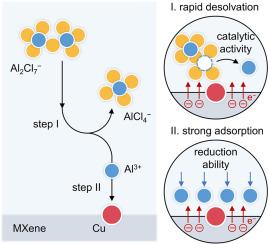
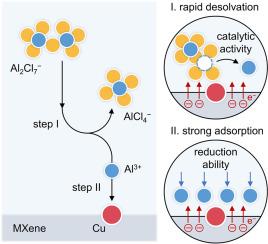
The uncontrolled deposition behavior, sluggish reaction kinetics and inefficient utilization of Al derived from unstable anode/electrolyte interface have severely impeded the development of aluminum-ion batteries. Here, we discuss the impact of interfacial electron/ion transfer on the electrochemical performance, and as an illustration, propose the construction of Cu@MXene as anodic current collector through work function engineering to simultaneously achieve homogeneous deposition morphology and rapid plating/stripping rate. The difference in work function between Cu nanoparticles and Ti3C2 MXene facilitates charge redistribution in the anode/electrolyte interface and enhances the electron availability, optimizing the interfacial electron/ion transfer behavior. This, in turn, endows Cu@MXene with elevated catalytic efficiency for desolvation reactions and robust reduction ability for the Al plating process. As a result, Cu@MXene enables a high coulombic efficiency of 99.87 % even at a high current density of 10 mA cm−2, and sustains reversible Al plating/stripping cycles for over 3200 h at a typical current density of 1 mA cm−2. Notably, by coupling graphite cathode and Cu@MXene-Al anode under a limited N/P ratio of 2.2, the full cell exhibits durable lifetime for 2000 cycles with an impressive energy density of 119.6 Wh kg−1 (based on the total mass of cathode and anode). This work highlights a fundamental understanding of interfacial interactions in the Al deposition process and offer sustainability motivations in designing highly reversible anodes for high-energy-density aluminum-ion batteries.
由于阳极/电解质界面不稳定,铝的沉积行为失控,反应动力学迟缓,利用率低下,严重阻碍了铝离子电池的发展。本文讨论了界面电子/离子转移对电化学性能的影响,并提出通过功函数工程构建Cu@MXene作为阳极集流器,同时实现均匀的沉积形貌和快速的镀/剥离速度。Cu纳米粒子与Ti3C2 MXene的功函数差异促进了电荷在阳极/电解质界面的重新分配,提高了电子的可用性,优化了界面电子/离子转移行为。这反过来又使Cu@MXene具有更高的脱溶反应催化效率和镀铝工艺的强大还原能力。因此,Cu@MXene即使在10 mA cm−2的高电流密度下也能实现99.87%的高库仑效率,并且在1 mA cm−2的典型电流密度下,也能维持3200小时以上的可逆镀铝/剥离循环。值得注意的是,通过在有限的N/P比为2.2的情况下将石墨阴极和Cu@MXene-Al阳极耦合,整个电池具有2000次循环的耐用寿命,能量密度为119.6 Wh kg−1(基于阴极和阳极的总质量)。这项工作强调了对Al沉积过程中界面相互作用的基本理解,并为设计高能量密度铝离子电池的高可逆阳极提供了可持续性动机。
期刊介绍:
Energy Storage Materials is a global interdisciplinary journal dedicated to sharing scientific and technological advancements in materials and devices for advanced energy storage and related energy conversion, such as in metal-O2 batteries. The journal features comprehensive research articles, including full papers and short communications, as well as authoritative feature articles and reviews by leading experts in the field.
Energy Storage Materials covers a wide range of topics, including the synthesis, fabrication, structure, properties, performance, and technological applications of energy storage materials. Additionally, the journal explores strategies, policies, and developments in the field of energy storage materials and devices for sustainable energy.
Published papers are selected based on their scientific and technological significance, their ability to provide valuable new knowledge, and their relevance to the international research community.




 京公网安备 11010802042870号
京ICP备2023020795号-1
京公网安备 11010802042870号
京ICP备2023020795号-1

 分享
分享
 求助内容:
求助内容: 应助结果提醒方式:
 扫码关注我们
