Guangling Zuo , Yuxin Gao , Yujie Zhu , Jia Du , Hongyong Ye
{"title":"Constructing an S-scheme Fe2O3/MnS heterojunction for efficient photocatalytic H2 evolution in visible light","authors":"Guangling Zuo , Yuxin Gao , Yujie Zhu , Jia Du , Hongyong Ye","doi":"10.1016/j.cplett.2025.142064","DOIUrl":null,"url":null,"abstract":"<div><div>A series of S-scheme Fe<sub>2</sub>O<sub>3</sub>/MnS heterojunction composites have been successfully fabricated through the hydrothermal method by loading Fe<sub>2</sub>O<sub>3</sub> onto the surface of MnS. The XRD demonstrates that the crystalline structure of MnS remains unaltered after loading with Fe<sub>2</sub>O<sub>3</sub>. SEM and TEM tests revealed that Fe<sub>2</sub>O<sub>3</sub> is uniformly loaded on the MnS surface and tightly bound to it, forming a high-quality S-scheme heterojunction. Moreover, XPS analysis and work function theory data imply that an internal electric field (IEF) is generated at the interface between Fe<sub>2</sub>O<sub>3</sub> and MnS. Moreover, the IEF not only effectively boosts the separation and transfer of carriers but also greatly preserves the powerful reducing property of MnS conduction band electrons and the strong oxidation property of Fe<sub>2</sub>O<sub>3</sub> valence band holes. The outcomes of hydrogen production by water splitting tests show that the Fe<sub>2</sub>O<sub>3</sub>/MnS composite has better hydrogen production performance than pure MnS and Fe<sub>2</sub>O<sub>3</sub>. When the loading amount of Fe<sub>2</sub>O<sub>3</sub> reaches 6 wt%, the photolytic hydrogen production rate of the Fe<sub>2</sub>O<sub>3</sub>/MnS attains its optimal level, approximately 1075 μmol·g<sup>−1</sup>·h<sup>−1</sup>, which is approximately 4.7 times that of MnS and 3.2 times that of Fe<sub>2</sub>O<sub>3</sub>, respectively. After four cycles, the hydrogen production capacity of Fe<sub>2</sub>O<sub>3</sub>/MnS do not show a significant decrease, indicating the favorable reusability of the Fe<sub>2</sub>O<sub>3</sub>/MnS composite catalyst.</div></div>","PeriodicalId":273,"journal":{"name":"Chemical Physics Letters","volume":"869 ","pages":"Article 142064"},"PeriodicalIF":3.1000,"publicationDate":"2025-06-16","publicationTypes":"Journal Article","fieldsOfStudy":null,"isOpenAccess":false,"openAccessPdf":"","citationCount":"0","resultStr":null,"platform":"Semanticscholar","paperid":null,"PeriodicalName":"Chemical Physics Letters","FirstCategoryId":"92","ListUrlMain":"https://www.sciencedirect.com/science/article/pii/S0009261425002040","RegionNum":3,"RegionCategory":"化学","ArticlePicture":[],"TitleCN":null,"AbstractTextCN":null,"PMCID":null,"EPubDate":"2025/3/28 0:00:00","PubModel":"Epub","JCR":"Q3","JCRName":"CHEMISTRY, PHYSICAL","Score":null,"Total":0}
引用次数: 0
Abstract
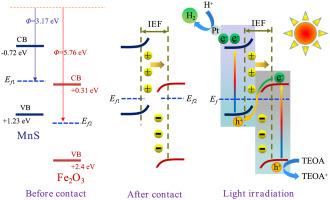
A series of S-scheme Fe2O3/MnS heterojunction composites have been successfully fabricated through the hydrothermal method by loading Fe2O3 onto the surface of MnS. The XRD demonstrates that the crystalline structure of MnS remains unaltered after loading with Fe2O3. SEM and TEM tests revealed that Fe2O3 is uniformly loaded on the MnS surface and tightly bound to it, forming a high-quality S-scheme heterojunction. Moreover, XPS analysis and work function theory data imply that an internal electric field (IEF) is generated at the interface between Fe2O3 and MnS. Moreover, the IEF not only effectively boosts the separation and transfer of carriers but also greatly preserves the powerful reducing property of MnS conduction band electrons and the strong oxidation property of Fe2O3 valence band holes. The outcomes of hydrogen production by water splitting tests show that the Fe2O3/MnS composite has better hydrogen production performance than pure MnS and Fe2O3. When the loading amount of Fe2O3 reaches 6 wt%, the photolytic hydrogen production rate of the Fe2O3/MnS attains its optimal level, approximately 1075 μmol·g−1·h−1, which is approximately 4.7 times that of MnS and 3.2 times that of Fe2O3, respectively. After four cycles, the hydrogen production capacity of Fe2O3/MnS do not show a significant decrease, indicating the favorable reusability of the Fe2O3/MnS composite catalyst.
期刊介绍:
Chemical Physics Letters has an open access mirror journal, Chemical Physics Letters: X, sharing the same aims and scope, editorial team, submission system and rigorous peer review.
Chemical Physics Letters publishes brief reports on molecules, interfaces, condensed phases, nanomaterials and nanostructures, polymers, biomolecular systems, and energy conversion and storage.
Criteria for publication are quality, urgency and impact. Further, experimental results reported in the journal have direct relevance for theory, and theoretical developments or non-routine computations relate directly to experiment. Manuscripts must satisfy these criteria and should not be minor extensions of previous work.



 京公网安备 11010802042870号
京ICP备2023020795号-1
京公网安备 11010802042870号
京ICP备2023020795号-1

 分享
分享
 求助内容:
求助内容: 应助结果提醒方式:
 扫码关注我们
