Qian Li , Pingan Zhang , Tianjie Hong , Feifei Tao
{"title":"Highly-efficient photocatalytic removal of methyl orange on CuO hierarchical hollow microspheres modified by ultrathin and porous g-C3N4 nanosheets","authors":"Qian Li , Pingan Zhang , Tianjie Hong , Feifei Tao","doi":"10.1016/j.jenvman.2025.125233","DOIUrl":null,"url":null,"abstract":"<div><div>Photocatalytic degradation technology is taken as an efficient strategy to alleviate organic dye pollution in wastewater. In order to achieve high catalytic activities, morphology regulation and structure design are crucial for photocatalytic system. In this work, the hierarchical CuO hollow microspheres self-assembled by nanowires (CuO HMS) were successfully synthesized by solvothermal process. Graphitic carbon nitride (g-C<sub>3</sub>N<sub>4</sub>) nanosheets (CNN) with ultrathin and porous feature were anchored on the spherical shell of CuO HMS to manufacture the CuO/g-C<sub>3</sub>N<sub>4</sub> p-n heterojunction via one-step calcination. The unique CuO/g-C<sub>3</sub>N<sub>4</sub> composite possesses the nanowire self-assembled hollow hierarchical microstructures, as well as the self-doped CuO by the C and/or N atoms, which conduces to increasing specific surface area, narrowing band gap, improving visible-light-harvesting capacity, promoting the segregation of photo-induced electron-hole pairs, and accelerating carrier movement. Therefore, CuO/g-C<sub>3</sub>N<sub>4</sub> shows outstanding photocatalytic properties of methyl orange (MO) degradation, compared with CuO HMS and CNN. Especially, the CuO/g-C<sub>3</sub>N<sub>4</sub> composite with 10 wt% CuO HMS (CC-3) achieves almost complete decomposition of MO, and its apparent rate constant (<em>k</em><sub>app</sub>) is superior to that of CuO HMS (19.1 times) and CNN (22.5 times). Compared with the similar materials such as CuO/BiVO<sub>4</sub>, CuO/TiO<sub>2</sub> and CuO/ZnO p-n heterojunctions, the resulting CuO/g-C<sub>3</sub>N<sub>4</sub> composite demonstrates the satisfactory photocatalytic performance. The close cooperation of unique hollow hierarchical morphology, C and/or N self-doping, and p-n heterojunction is proposed to account for the extraordinary photocatalytic MO decomposition. This work proposes a feasible and effective paradigm for the construction of CuO/g-C<sub>3</sub>N<sub>4</sub> composite, which demonstrates excellent photocatalytic performance for pollutant removal in wastewater by establishing hollow structure, non-metallic self-doping and p-n junction.</div></div>","PeriodicalId":356,"journal":{"name":"Journal of Environmental Management","volume":"381 ","pages":"Article 125233"},"PeriodicalIF":9.2000,"publicationDate":"2025-05-01","publicationTypes":"Journal Article","fieldsOfStudy":null,"isOpenAccess":false,"openAccessPdf":"","citationCount":"0","resultStr":null,"platform":"Semanticscholar","paperid":null,"PeriodicalName":"Journal of Environmental Management","FirstCategoryId":"93","ListUrlMain":"https://www.sciencedirect.com/science/article/pii/S0301479725012095","RegionNum":2,"RegionCategory":"环境科学与生态学","ArticlePicture":[],"TitleCN":null,"AbstractTextCN":null,"PMCID":null,"EPubDate":"2025/4/5 0:00:00","PubModel":"Epub","JCR":"Q1","JCRName":"ENVIRONMENTAL SCIENCES","Score":null,"Total":0}
引用次数: 0
Abstract
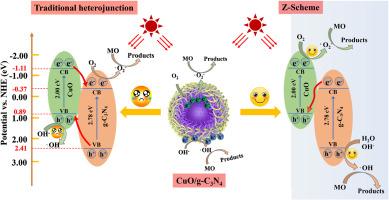
Photocatalytic degradation technology is taken as an efficient strategy to alleviate organic dye pollution in wastewater. In order to achieve high catalytic activities, morphology regulation and structure design are crucial for photocatalytic system. In this work, the hierarchical CuO hollow microspheres self-assembled by nanowires (CuO HMS) were successfully synthesized by solvothermal process. Graphitic carbon nitride (g-C3N4) nanosheets (CNN) with ultrathin and porous feature were anchored on the spherical shell of CuO HMS to manufacture the CuO/g-C3N4 p-n heterojunction via one-step calcination. The unique CuO/g-C3N4 composite possesses the nanowire self-assembled hollow hierarchical microstructures, as well as the self-doped CuO by the C and/or N atoms, which conduces to increasing specific surface area, narrowing band gap, improving visible-light-harvesting capacity, promoting the segregation of photo-induced electron-hole pairs, and accelerating carrier movement. Therefore, CuO/g-C3N4 shows outstanding photocatalytic properties of methyl orange (MO) degradation, compared with CuO HMS and CNN. Especially, the CuO/g-C3N4 composite with 10 wt% CuO HMS (CC-3) achieves almost complete decomposition of MO, and its apparent rate constant (kapp) is superior to that of CuO HMS (19.1 times) and CNN (22.5 times). Compared with the similar materials such as CuO/BiVO4, CuO/TiO2 and CuO/ZnO p-n heterojunctions, the resulting CuO/g-C3N4 composite demonstrates the satisfactory photocatalytic performance. The close cooperation of unique hollow hierarchical morphology, C and/or N self-doping, and p-n heterojunction is proposed to account for the extraordinary photocatalytic MO decomposition. This work proposes a feasible and effective paradigm for the construction of CuO/g-C3N4 composite, which demonstrates excellent photocatalytic performance for pollutant removal in wastewater by establishing hollow structure, non-metallic self-doping and p-n junction.
期刊介绍:
The Journal of Environmental Management is a journal for the publication of peer reviewed, original research for all aspects of management and the managed use of the environment, both natural and man-made.Critical review articles are also welcome; submission of these is strongly encouraged.




 京公网安备 11010802042870号
京ICP备2023020795号-1
京公网安备 11010802042870号
京ICP备2023020795号-1

 分享
分享
 求助内容:
求助内容: 应助结果提醒方式:
 扫码关注我们
