{"title":"A comprehensive review of micro/nano-encapsulated phase change material-based fluids: Modeling, properties, and heat transfer enhancement","authors":"Zoubida Haddad","doi":"10.1016/j.rser.2025.115640","DOIUrl":null,"url":null,"abstract":"<div><div>Micro and Nano-encapsulated Phase Change Materials (M/N-ePCM) based fluids have garnered significant attention due to their dual benefit of high energy storage capacity and thermal performance. These distinctive properties have prompted numerous numerical research studies exploring their potential as an alternative to conventional heat transfer fluids. To accurately predict their behavior, enhance their performance, and optimize their use, this review, unlike previous studies, provides a comprehensive overview of the mathematical models developed to describe the fluid flow and heat transfer characteristics of M/N-ePCM-based fluids, including single-phase and two-phase approaches. It critically evaluates the predictive accuracy of existing theoretical models against experimental data on M/N-ePCM-based fluids and M/N-ePCM-based fluids highlights the latest advancements in convective heat transferM/N-ePCM-based fluids, offering a more integrated and detailed perspective on M/N-ePCM performance. The review highlights several key findings. Firstly, the effectiveness of M/N-ePCMs in thermal applications is strongly dependent on their thermophysical and phase change properties. Identifying the optimal shell-to-core weight ratios is essential for enhancing these properties. Additionally, there are significant discrepancies between experimental and predicted data for the thermophysical and phase change properties of M/N-ePCM-based fluids. Furthermore, a comprehensive understanding of the convective heat transfer behavior of M/N-ePCM-based fluids requires exploring a broader variety of shell and core materials.</div></div>","PeriodicalId":418,"journal":{"name":"Renewable and Sustainable Energy Reviews","volume":"216 ","pages":"Article 115640"},"PeriodicalIF":16.3000,"publicationDate":"2025-04-05","publicationTypes":"Journal Article","fieldsOfStudy":null,"isOpenAccess":false,"openAccessPdf":"","citationCount":"0","resultStr":null,"platform":"Semanticscholar","paperid":null,"PeriodicalName":"Renewable and Sustainable Energy Reviews","FirstCategoryId":"1","ListUrlMain":"https://www.sciencedirect.com/science/article/pii/S1364032125003132","RegionNum":1,"RegionCategory":"工程技术","ArticlePicture":[],"TitleCN":null,"AbstractTextCN":null,"PMCID":null,"EPubDate":"","PubModel":"","JCR":"Q1","JCRName":"ENERGY & FUELS","Score":null,"Total":0}
引用次数: 0
Abstract
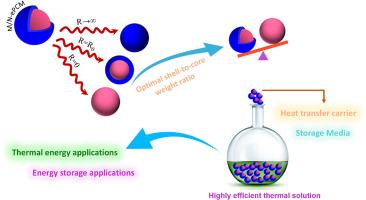
Micro and Nano-encapsulated Phase Change Materials (M/N-ePCM) based fluids have garnered significant attention due to their dual benefit of high energy storage capacity and thermal performance. These distinctive properties have prompted numerous numerical research studies exploring their potential as an alternative to conventional heat transfer fluids. To accurately predict their behavior, enhance their performance, and optimize their use, this review, unlike previous studies, provides a comprehensive overview of the mathematical models developed to describe the fluid flow and heat transfer characteristics of M/N-ePCM-based fluids, including single-phase and two-phase approaches. It critically evaluates the predictive accuracy of existing theoretical models against experimental data on M/N-ePCM-based fluids and M/N-ePCM-based fluids highlights the latest advancements in convective heat transferM/N-ePCM-based fluids, offering a more integrated and detailed perspective on M/N-ePCM performance. The review highlights several key findings. Firstly, the effectiveness of M/N-ePCMs in thermal applications is strongly dependent on their thermophysical and phase change properties. Identifying the optimal shell-to-core weight ratios is essential for enhancing these properties. Additionally, there are significant discrepancies between experimental and predicted data for the thermophysical and phase change properties of M/N-ePCM-based fluids. Furthermore, a comprehensive understanding of the convective heat transfer behavior of M/N-ePCM-based fluids requires exploring a broader variety of shell and core materials.
微纳米封装相变材料(M/N-ePCM)基流体因其具有高储能能力和热性能的双重优势而备受关注。这些独特的特性促使许多数值研究探索其作为传统传热流体替代品的潜力。为了准确预测其行为、提高其性能并优化其使用,与以往的研究不同,本综述全面概述了用于描述M/ n - epcm流体流动和传热特性的数学模型,包括单相和两相方法。根据M/N-ePCM流体的实验数据,对现有理论模型的预测准确性进行了批判性评估,并突出了M/N-ePCM流体对流换热的最新进展,为M/N-ePCM流体的性能提供了更完整、更详细的视角。该报告强调了几项重要发现。首先,M/N-ePCMs在热应用中的有效性强烈依赖于它们的热物理和相变性质。确定最佳的壳芯重量比对于提高这些性能至关重要。此外,M/ n - epcm基流体的热物理和相变性质的实验数据与预测数据存在显著差异。此外,要全面了解基于M/ n - epcm的流体的对流换热行为,需要探索更广泛的壳和芯材料。
期刊介绍:
The mission of Renewable and Sustainable Energy Reviews is to disseminate the most compelling and pertinent critical insights in renewable and sustainable energy, fostering collaboration among the research community, private sector, and policy and decision makers. The journal aims to exchange challenges, solutions, innovative concepts, and technologies, contributing to sustainable development, the transition to a low-carbon future, and the attainment of emissions targets outlined by the United Nations Framework Convention on Climate Change.
Renewable and Sustainable Energy Reviews publishes a diverse range of content, including review papers, original research, case studies, and analyses of new technologies, all featuring a substantial review component such as critique, comparison, or analysis. Introducing a distinctive paper type, Expert Insights, the journal presents commissioned mini-reviews authored by field leaders, addressing topics of significant interest. Case studies undergo consideration only if they showcase the work's applicability to other regions or contribute valuable insights to the broader field of renewable and sustainable energy. Notably, a bibliographic or literature review lacking critical analysis is deemed unsuitable for publication.



 京公网安备 11010802042870号
京ICP备2023020795号-1
京公网安备 11010802042870号
京ICP备2023020795号-1

 分享
分享
 求助内容:
求助内容: 应助结果提醒方式:
 扫码关注我们
