Zeying Wang , Guo Lin , Tu Hu , Shixing Wang , Shiwei Li , Zhen Zhong , Likang Fu , Hongying Xia , Libo Zhang
{"title":"Optimizing multi-source ultrasound configuration for process intensification: numerical simulation and experimental validation","authors":"Zeying Wang , Guo Lin , Tu Hu , Shixing Wang , Shiwei Li , Zhen Zhong , Likang Fu , Hongying Xia , Libo Zhang","doi":"10.1016/j.cep.2025.110294","DOIUrl":null,"url":null,"abstract":"<div><div>This paper investigates the application of ultrasonic simulation in metallurgy, focusing on the effects of ultrasonic power density, number of transducers, and multi-source array mode on the acoustic field distribution characteristics. The simulation results reveal that as power density increases from 375 W/L to 750 W/L at 28 kHz, the maximum sound pressure rises from 4.13 × 10<sup>6</sup> Pa to 4.37 × 10<sup>6</sup> Pa, and the cavitation volume fraction increases from 19% to 50%. The maximum sound pressure (4.13 × 10<sup>6</sup> Pa) and cavitation volume fraction (49%) of two transducers are higher than three transducers. The isosceles triangle array method exhibits the optimal sound field characteristics, with a maximum sound pressure of 2.87 × 10<sup>6</sup> Pa and a cavitation volume fraction of 52%. The maximum sound pressure of 4.13 × 10<sup>6</sup> Pa is achieved when two transducers are 45 mm from the reaction chamber bottom and the peak offset distance is zero. The simulation results are confirmed by measuring the sound pressure in water using a hydrophone under 140–200 W. This research visualizes the ultrasonic process intensification parameters, addressing the issue of random arrangement of transducer in industrial applications and enhancing work efficiency.</div></div>","PeriodicalId":9929,"journal":{"name":"Chemical Engineering and Processing - Process Intensification","volume":"213 ","pages":"Article 110294"},"PeriodicalIF":3.9000,"publicationDate":"2025-03-29","publicationTypes":"Journal Article","fieldsOfStudy":null,"isOpenAccess":false,"openAccessPdf":"","citationCount":"0","resultStr":null,"platform":"Semanticscholar","paperid":null,"PeriodicalName":"Chemical Engineering and Processing - Process Intensification","FirstCategoryId":"5","ListUrlMain":"https://www.sciencedirect.com/science/article/pii/S0255270125001436","RegionNum":3,"RegionCategory":"工程技术","ArticlePicture":[],"TitleCN":null,"AbstractTextCN":null,"PMCID":null,"EPubDate":"","PubModel":"","JCR":"Q3","JCRName":"ENERGY & FUELS","Score":null,"Total":0}
引用次数: 0
Abstract
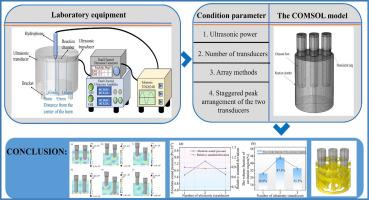
This paper investigates the application of ultrasonic simulation in metallurgy, focusing on the effects of ultrasonic power density, number of transducers, and multi-source array mode on the acoustic field distribution characteristics. The simulation results reveal that as power density increases from 375 W/L to 750 W/L at 28 kHz, the maximum sound pressure rises from 4.13 × 10⁶ Pa to 4.37 × 10⁶ Pa, and the cavitation volume fraction increases from 19% to 50%. The maximum sound pressure (4.13 × 10⁶ Pa) and cavitation volume fraction (49%) of two transducers are higher than three transducers. The isosceles triangle array method exhibits the optimal sound field characteristics, with a maximum sound pressure of 2.87 × 10⁶ Pa and a cavitation volume fraction of 52%. The maximum sound pressure of 4.13 × 10⁶ Pa is achieved when two transducers are 45 mm from the reaction chamber bottom and the peak offset distance is zero. The simulation results are confirmed by measuring the sound pressure in water using a hydrophone under 140–200 W. This research visualizes the ultrasonic process intensification parameters, addressing the issue of random arrangement of transducer in industrial applications and enhancing work efficiency.
期刊介绍:
Chemical Engineering and Processing: Process Intensification is intended for practicing researchers in industry and academia, working in the field of Process Engineering and related to the subject of Process Intensification.Articles published in the Journal demonstrate how novel discoveries, developments and theories in the field of Process Engineering and in particular Process Intensification may be used for analysis and design of innovative equipment and processing methods with substantially improved sustainability, efficiency and environmental performance.



 京公网安备 11010802042870号
京ICP备2023020795号-1
京公网安备 11010802042870号
京ICP备2023020795号-1

 分享
分享
 求助内容:
求助内容: 应助结果提醒方式:
 扫码关注我们
