The surface plasmon resonance aptasensor based on the dual-interface Mott−Schottky heterojunction of Zr-doped MnB4 nanosheets decorated with gold nanoparticles for sensitively detecting nucleolin
Chuanpan Guo , Yihan He , Kaige Chen , Shuai Zhang , Minghua Wang , Linghao He , Zhihong Zhang
{"title":"The surface plasmon resonance aptasensor based on the dual-interface Mott−Schottky heterojunction of Zr-doped MnB4 nanosheets decorated with gold nanoparticles for sensitively detecting nucleolin","authors":"Chuanpan Guo , Yihan He , Kaige Chen , Shuai Zhang , Minghua Wang , Linghao He , Zhihong Zhang","doi":"10.1016/j.snb.2025.137721","DOIUrl":null,"url":null,"abstract":"<div><div>In this work, we have designed and developed a novel surface plasmon resonance (SPR) aptasensor based on the two-dimensional (2D) Zr-doped MnB<sub>4</sub> nanosheets decorated with Au nanoparticles (NPs) (denoted as AuNPs@Zr/MnB<sub>4</sub>) for efficiently detecting nucleolin (NCL).The established AuNPs@Zr/MnB<sub>4</sub> dual-interface Schottky heterojunction benefitted from the modulatory effect of the density state of Mn sites in MnB<sub>4</sub> through Zr doping and the incorporation of Au NPs, endowing it with high optical absorption efficiency, fast charge carrier mobility, and improved work function. Thus, it exhibited enhanced interface electric field energy of the surface plasmon effect, amplifying SPR response. Moreover, the rich Zr sites in AuNPs@Zr/MnB<sub>4</sub> considerably promoted the immobilization of large amounts of AS1411 aptamer strands through the Zr–O–P covalent bond, coordination effect, and van der Waal force, rendering the high detection sensitivity to NCL. The AuNPs@Zr/MnB<sub>4</sub>-based SPR aptasensor demonstrated a wide dynamic range (1.0 ag mL<sup>−1</sup> to 100 ng mL<sup>−1</sup>) and an ultralow detection limit (0.44 ag mL<sup>−1</sup>). This work introduced a new strategy for the construction of SPR aptasensors to enable the sensitive inspection of biomarkers and extended the application of 2D MBene nanomaterials in biosensing and biological diagnosis.</div></div>","PeriodicalId":425,"journal":{"name":"Sensors and Actuators B: Chemical","volume":"437 ","pages":"Article 137721"},"PeriodicalIF":3.7000,"publicationDate":"2025-08-15","publicationTypes":"Journal Article","fieldsOfStudy":null,"isOpenAccess":false,"openAccessPdf":"","citationCount":"0","resultStr":null,"platform":"Semanticscholar","paperid":null,"PeriodicalName":"Sensors and Actuators B: Chemical","FirstCategoryId":"92","ListUrlMain":"https://www.sciencedirect.com/science/article/pii/S0925400525004964","RegionNum":1,"RegionCategory":"化学","ArticlePicture":[],"TitleCN":null,"AbstractTextCN":null,"PMCID":null,"EPubDate":"2025/4/5 0:00:00","PubModel":"Epub","JCR":"Q1","JCRName":"CHEMISTRY, ANALYTICAL","Score":null,"Total":0}
引用次数: 0
Abstract
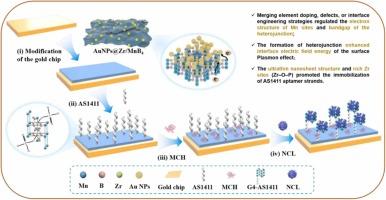
In this work, we have designed and developed a novel surface plasmon resonance (SPR) aptasensor based on the two-dimensional (2D) Zr-doped MnB4 nanosheets decorated with Au nanoparticles (NPs) (denoted as AuNPs@Zr/MnB4) for efficiently detecting nucleolin (NCL).The established AuNPs@Zr/MnB4 dual-interface Schottky heterojunction benefitted from the modulatory effect of the density state of Mn sites in MnB4 through Zr doping and the incorporation of Au NPs, endowing it with high optical absorption efficiency, fast charge carrier mobility, and improved work function. Thus, it exhibited enhanced interface electric field energy of the surface plasmon effect, amplifying SPR response. Moreover, the rich Zr sites in AuNPs@Zr/MnB4 considerably promoted the immobilization of large amounts of AS1411 aptamer strands through the Zr–O–P covalent bond, coordination effect, and van der Waal force, rendering the high detection sensitivity to NCL. The AuNPs@Zr/MnB4-based SPR aptasensor demonstrated a wide dynamic range (1.0 ag mL−1 to 100 ng mL−1) and an ultralow detection limit (0.44 ag mL−1). This work introduced a new strategy for the construction of SPR aptasensors to enable the sensitive inspection of biomarkers and extended the application of 2D MBene nanomaterials in biosensing and biological diagnosis.
在这项工作中,我们设计并开发了一种新型的表面等离子体共振(SPR)适体传感器,该传感器基于二维(2D)掺杂zr的MnB4纳米片,并装饰有Au纳米颗粒(NPs)(表示为AuNPs@Zr/MnB4),用于有效检测核仁蛋白(NCL)。所建立的AuNPs@Zr/MnB4双界面肖特基异质结得益于Zr掺杂和AuNPs掺入对MnB4中Mn位的密度态的调制作用,使其具有较高的光吸收效率、快速的电荷载流子迁移率和改进的功函数。因此,它表现出表面等离子体效应的界面电场能量增强,放大了SPR响应。此外,AuNPs@Zr/MnB4中丰富的Zr位点通过Zr - o - p共价键、配位效应和范德华力显著促进了大量AS1411适体链的固定化,使其对NCL具有较高的检测灵敏度。基于AuNPs@Zr/ mnb4的SPR感应传感器具有宽动态范围(1.0 ag mL−1至100 ng mL−1)和超低检出限(0.44 ag mL−1)。本研究提出了一种构建SPR配体传感器的新策略,以实现对生物标志物的灵敏检测,并扩展了二维MBene纳米材料在生物传感和生物诊断中的应用。
期刊介绍:
Sensors & Actuators, B: Chemical is an international journal focused on the research and development of chemical transducers. It covers chemical sensors and biosensors, chemical actuators, and analytical microsystems. The journal is interdisciplinary, aiming to publish original works showcasing substantial advancements beyond the current state of the art in these fields, with practical applicability to solving meaningful analytical problems. Review articles are accepted by invitation from an Editor of the journal.



 京公网安备 11010802042870号
京ICP备2023020795号-1
京公网安备 11010802042870号
京ICP备2023020795号-1

 分享
分享
 求助内容:
求助内容: 应助结果提醒方式:
 扫码关注我们
