Designed Catalytic Templates for the Universal Synthesis of Metal/Nitrogen-Doped Carbon Nanotubes with Hierarchical Architectures for Enhanced Oxygen Reduction
Hong Huang, Xiaoyuan Sun, Mingming Wang, Jizheng Feng, Xinyi Li, Zhongfeng Wang, Yanjiao Chen, Wenting Lu, Prof. Xiao Zhao
{"title":"Designed Catalytic Templates for the Universal Synthesis of Metal/Nitrogen-Doped Carbon Nanotubes with Hierarchical Architectures for Enhanced Oxygen Reduction","authors":"Hong Huang, Xiaoyuan Sun, Mingming Wang, Jizheng Feng, Xinyi Li, Zhongfeng Wang, Yanjiao Chen, Wenting Lu, Prof. Xiao Zhao","doi":"10.1002/cctc.202402145","DOIUrl":null,"url":null,"abstract":"<p>Hierarchical nitrogen-doped carbon nanotubes (NCNTs) with embedded metal species (M/NCNTs) offer broad applications yet are challenging to synthesize controllably. We report a universal one-step strategy leveraging the designed catalytic templates that catalyze the growth of NCNTs and concurrently direct their assembly into diverse hierarchical architectures. This method applies to various precursors from metal hydroxides to metal-organic frameworks and metal nanoparticles/carbon, yielding M/NCNTs with morphologies from plates to flowers, spheres, and NCNTs-grafted dodecahedrons. The Co/NCNTs with hierarchical architecture exhibits superior oxygen reduction reaction (ORR) performance with a half-wave potential of 0.851 V and high durability (negligible decay after 10,000 cycles) in alkaline relative to commercial Pt/C. Electrochemical impedance spectroscopy analysis implies that the hierarchical architecture reduces the mass transfer resistance. Consequently, this Co/NCNTs enables the zinc-air battery with a peak power density of 234.1 mW cm<sup>−2</sup> and a specific capacity of 798.8 mAh g<sup>−1 </sup><sub>Zn</sub>.</p>","PeriodicalId":141,"journal":{"name":"ChemCatChem","volume":"17 7","pages":""},"PeriodicalIF":3.9000,"publicationDate":"2025-02-12","publicationTypes":"Journal Article","fieldsOfStudy":null,"isOpenAccess":false,"openAccessPdf":"","citationCount":"0","resultStr":null,"platform":"Semanticscholar","paperid":null,"PeriodicalName":"ChemCatChem","FirstCategoryId":"92","ListUrlMain":"https://chemistry-europe.onlinelibrary.wiley.com/doi/10.1002/cctc.202402145","RegionNum":3,"RegionCategory":"化学","ArticlePicture":[],"TitleCN":null,"AbstractTextCN":null,"PMCID":null,"EPubDate":"","PubModel":"","JCR":"Q2","JCRName":"CHEMISTRY, PHYSICAL","Score":null,"Total":0}
引用次数: 0
Abstract
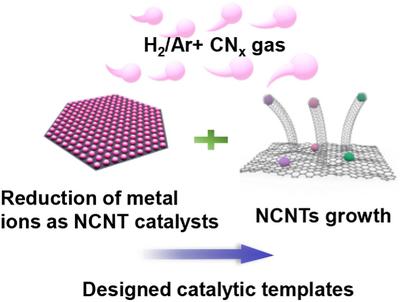
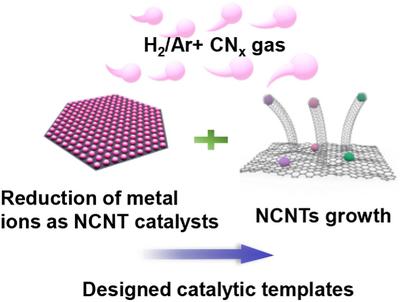
Hierarchical nitrogen-doped carbon nanotubes (NCNTs) with embedded metal species (M/NCNTs) offer broad applications yet are challenging to synthesize controllably. We report a universal one-step strategy leveraging the designed catalytic templates that catalyze the growth of NCNTs and concurrently direct their assembly into diverse hierarchical architectures. This method applies to various precursors from metal hydroxides to metal-organic frameworks and metal nanoparticles/carbon, yielding M/NCNTs with morphologies from plates to flowers, spheres, and NCNTs-grafted dodecahedrons. The Co/NCNTs with hierarchical architecture exhibits superior oxygen reduction reaction (ORR) performance with a half-wave potential of 0.851 V and high durability (negligible decay after 10,000 cycles) in alkaline relative to commercial Pt/C. Electrochemical impedance spectroscopy analysis implies that the hierarchical architecture reduces the mass transfer resistance. Consequently, this Co/NCNTs enables the zinc-air battery with a peak power density of 234.1 mW cm−2 and a specific capacity of 798.8 mAh g−1 Zn.
含嵌入金属的分层氮掺杂碳纳米管(M/NCNTs)具有广泛的应用前景,但其可控合成具有一定的挑战性。我们报告了一种通用的一步策略,利用设计的催化模板来催化NCNTs的生长,同时将其组装成不同的层次结构。该方法适用于从金属氢氧化物到金属有机框架和金属纳米颗粒/碳的各种前体,产生具有从板到花、球体和接枝NCNTs的十二面体等形态的M/NCNTs。与商用Pt/C相比,具有分层结构的Co/NCNTs在碱性环境中表现出优异的氧还原反应(ORR)性能,半波电位为0.851 V,耐久性高(10,000次循环后衰减可忽略不计)。电化学阻抗谱分析表明,分层结构降低了传质阻力。因此,该Co/NCNTs使锌空气电池的峰值功率密度为234.1 mW cm - 2,比容量为798.8 mAh g - 1 Zn。
期刊介绍:
With an impact factor of 4.495 (2018), ChemCatChem is one of the premier journals in the field of catalysis. The journal provides primary research papers and critical secondary information on heterogeneous, homogeneous and bio- and nanocatalysis. The journal is well placed to strengthen cross-communication within between these communities. Its authors and readers come from academia, the chemical industry, and government laboratories across the world. It is published on behalf of Chemistry Europe, an association of 16 European chemical societies, and is supported by the German Catalysis Society.





 京公网安备 11010802042870号
京ICP备2023020795号-1
京公网安备 11010802042870号
京ICP备2023020795号-1

 分享
分享
 求助内容:
求助内容: 应助结果提醒方式:
 扫码关注我们
