{"title":"Supercritical Fluids for Enhanced Chemical Transformation of Postconsumer Plastics: A Review","authors":"Lakshmiprasad Gurrala, Ana Rita C. Morais","doi":"10.1002/cctc.202401725","DOIUrl":null,"url":null,"abstract":"<p>Various chemical transformation approaches are being actively developed to address the environmental accumulation of plastic waste. However, most postconsumer plastics are heterogeneous, exhibit high melt viscosity, and are insoluble in most conventional solvents. Such properties result in transport-limiting chemical transformations, low conversion rates, and low product selectivity. Although supercritical fluids (SCFs) have been a matter of continuing scientific interest in several mass-transfer processes, the use of SCFs as tunable media for the chemical transformation of postconsumer plastics is still in its early stages, but has rapidly advanced in recent years. Therefore, this review reports on the current state-of-art of chemical transformation of plastics using SCFs. It addresses the effects of sub and supercritical CO<sub>2</sub> (scCO<sub>2</sub>) on solvolysis-based technologies. Additionally, it reviews recent advances on the use of supercritical organic solvents (e.g., ethanol, methanol) and supercritical water (SCW) as reaction media for the solvolysis and liquefaction of plastics, respectively, and the latest developments in the simultaneous conversion of CO<sub>2</sub> and waste plastics. Overall, developing technologies that minimize mass transfer limitations during the chemical transformation of plastics is critical to overcoming some of the major bottlenecks hampering product yield and selectively, and ultimately the economic viability of plastics recycling and upcycling.</p>","PeriodicalId":141,"journal":{"name":"ChemCatChem","volume":"17 7","pages":""},"PeriodicalIF":3.9000,"publicationDate":"2025-02-05","publicationTypes":"Journal Article","fieldsOfStudy":null,"isOpenAccess":false,"openAccessPdf":"","citationCount":"0","resultStr":null,"platform":"Semanticscholar","paperid":null,"PeriodicalName":"ChemCatChem","FirstCategoryId":"92","ListUrlMain":"https://chemistry-europe.onlinelibrary.wiley.com/doi/10.1002/cctc.202401725","RegionNum":3,"RegionCategory":"化学","ArticlePicture":[],"TitleCN":null,"AbstractTextCN":null,"PMCID":null,"EPubDate":"","PubModel":"","JCR":"Q2","JCRName":"CHEMISTRY, PHYSICAL","Score":null,"Total":0}
引用次数: 0
Abstract
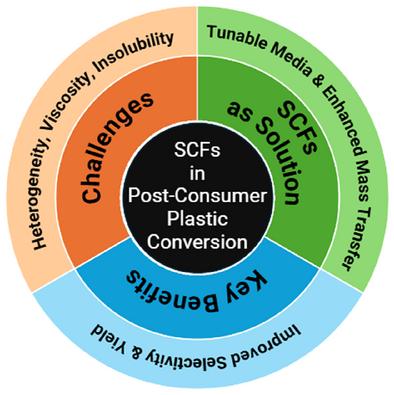
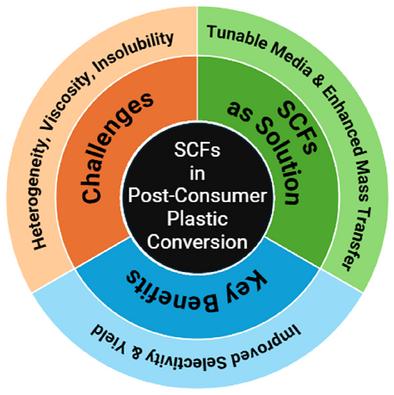
Various chemical transformation approaches are being actively developed to address the environmental accumulation of plastic waste. However, most postconsumer plastics are heterogeneous, exhibit high melt viscosity, and are insoluble in most conventional solvents. Such properties result in transport-limiting chemical transformations, low conversion rates, and low product selectivity. Although supercritical fluids (SCFs) have been a matter of continuing scientific interest in several mass-transfer processes, the use of SCFs as tunable media for the chemical transformation of postconsumer plastics is still in its early stages, but has rapidly advanced in recent years. Therefore, this review reports on the current state-of-art of chemical transformation of plastics using SCFs. It addresses the effects of sub and supercritical CO2 (scCO2) on solvolysis-based technologies. Additionally, it reviews recent advances on the use of supercritical organic solvents (e.g., ethanol, methanol) and supercritical water (SCW) as reaction media for the solvolysis and liquefaction of plastics, respectively, and the latest developments in the simultaneous conversion of CO2 and waste plastics. Overall, developing technologies that minimize mass transfer limitations during the chemical transformation of plastics is critical to overcoming some of the major bottlenecks hampering product yield and selectively, and ultimately the economic viability of plastics recycling and upcycling.
期刊介绍:
With an impact factor of 4.495 (2018), ChemCatChem is one of the premier journals in the field of catalysis. The journal provides primary research papers and critical secondary information on heterogeneous, homogeneous and bio- and nanocatalysis. The journal is well placed to strengthen cross-communication within between these communities. Its authors and readers come from academia, the chemical industry, and government laboratories across the world. It is published on behalf of Chemistry Europe, an association of 16 European chemical societies, and is supported by the German Catalysis Society.





 京公网安备 11010802042870号
京ICP备2023020795号-1
京公网安备 11010802042870号
京ICP备2023020795号-1

 分享
分享
 求助内容:
求助内容: 应助结果提醒方式:
 扫码关注我们
