Dr. Tereza Bílková, Assoc. Prof. Kateřina Pacultová, Bc. Jan Hrbáč, MSc. Dagmar Fridrichová, Dr. Ivana Troppová, Dr. Sylwia Górecka, Dr. Martin Koštejn, Prof. Lucie Obalová
{"title":"Co and Cu-Based Mixed Metal Oxides Foster Reduction of CO and Hydrocarbons Emissions from Small Combustion Devices","authors":"Dr. Tereza Bílková, Assoc. Prof. Kateřina Pacultová, Bc. Jan Hrbáč, MSc. Dagmar Fridrichová, Dr. Ivana Troppová, Dr. Sylwia Górecka, Dr. Martin Koštejn, Prof. Lucie Obalová","doi":"10.1002/cctc.202500092","DOIUrl":null,"url":null,"abstract":"<p>Residential stoves, commonly used for heating, are a significant source of emissions due to the harmful substances produced during biomass combustion, yet they remain largely unregulated. The use of catalytic systems presents a promising approach for mitigating these emissions. This study investigates the potential of Cu–Mg–Mn–Al and Co–Mg–Mn–Al mixed metal oxides, synthesized from hydrotalcite precursors via coprecipitation and calcination, for reducing emissions of CO, C₃H₈, and CH₄. The physicochemical properties of the catalysts were thoroughly characterized using techniques such as AAS, XPS, XRD, H₂-TPR, CO₂-TPD, and NH₃-TPD. Catalytic performance was evaluated over a temperature range of 100–500 °C in both two-component (CO + C₃H₈ or CO + CH₄) and three-component (CO + C₃H₈ + CH₄) gas mixtures with oxygen. Results revealed that Co-based catalysts outperformed Cu-based ones in catalytic activity. However, in the three-component mixture, catalytic activity decreased, likely due to competitive adsorption and interactions with active oxygen species. These preliminary findings underscore the potential of mixed metal oxides for emission control in residential stoves, setting the stage for further optimization and application.</p>","PeriodicalId":141,"journal":{"name":"ChemCatChem","volume":"17 7","pages":""},"PeriodicalIF":3.9000,"publicationDate":"2025-02-05","publicationTypes":"Journal Article","fieldsOfStudy":null,"isOpenAccess":false,"openAccessPdf":"","citationCount":"0","resultStr":null,"platform":"Semanticscholar","paperid":null,"PeriodicalName":"ChemCatChem","FirstCategoryId":"92","ListUrlMain":"https://chemistry-europe.onlinelibrary.wiley.com/doi/10.1002/cctc.202500092","RegionNum":3,"RegionCategory":"化学","ArticlePicture":[],"TitleCN":null,"AbstractTextCN":null,"PMCID":null,"EPubDate":"","PubModel":"","JCR":"Q2","JCRName":"CHEMISTRY, PHYSICAL","Score":null,"Total":0}
引用次数: 0
Abstract
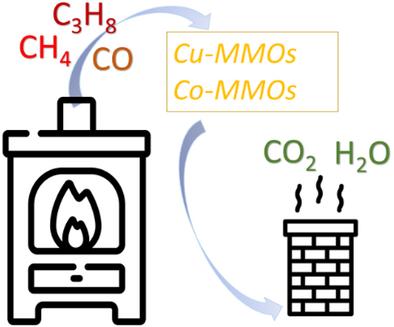
Residential stoves, commonly used for heating, are a significant source of emissions due to the harmful substances produced during biomass combustion, yet they remain largely unregulated. The use of catalytic systems presents a promising approach for mitigating these emissions. This study investigates the potential of Cu–Mg–Mn–Al and Co–Mg–Mn–Al mixed metal oxides, synthesized from hydrotalcite precursors via coprecipitation and calcination, for reducing emissions of CO, C₃H₈, and CH₄. The physicochemical properties of the catalysts were thoroughly characterized using techniques such as AAS, XPS, XRD, H₂-TPR, CO₂-TPD, and NH₃-TPD. Catalytic performance was evaluated over a temperature range of 100–500 °C in both two-component (CO + C₃H₈ or CO + CH₄) and three-component (CO + C₃H₈ + CH₄) gas mixtures with oxygen. Results revealed that Co-based catalysts outperformed Cu-based ones in catalytic activity. However, in the three-component mixture, catalytic activity decreased, likely due to competitive adsorption and interactions with active oxygen species. These preliminary findings underscore the potential of mixed metal oxides for emission control in residential stoves, setting the stage for further optimization and application.
期刊介绍:
With an impact factor of 4.495 (2018), ChemCatChem is one of the premier journals in the field of catalysis. The journal provides primary research papers and critical secondary information on heterogeneous, homogeneous and bio- and nanocatalysis. The journal is well placed to strengthen cross-communication within between these communities. Its authors and readers come from academia, the chemical industry, and government laboratories across the world. It is published on behalf of Chemistry Europe, an association of 16 European chemical societies, and is supported by the German Catalysis Society.






 京公网安备 11010802042870号
京ICP备2023020795号-1
京公网安备 11010802042870号
京ICP备2023020795号-1

 分享
分享
 求助内容:
求助内容: 应助结果提醒方式:
 扫码关注我们
